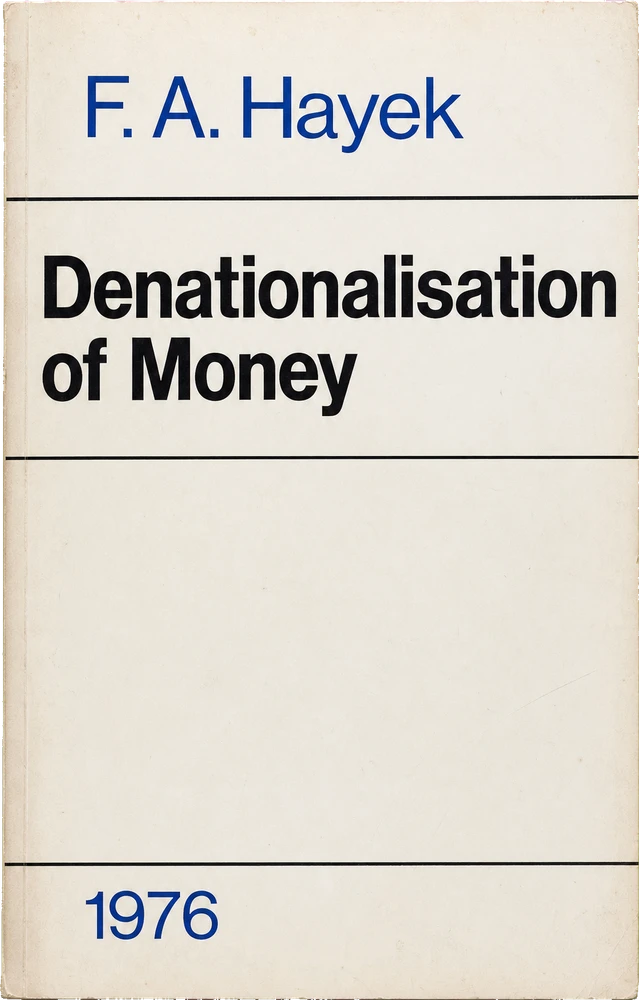
Friedrich August von Hayek · 1976
Denationalisation of Money: An Analysis of the Theory and Practice of Concurrent Currencies
About this work
Denationalisation of Money — Summary
F. A. Hayek’s Denationalisation of Money argues that monetary disorder is not an inherent defect of capitalism but the result of a state monopoly over currency. Beginning with a proposal for Europe—free trade in currencies, abolition of exchange controls, and freedom to contract in any money—Hayek expands the case into a general attack on government’s exclusive power to issue money. Money is treated as an institution whose quality depends on users’ ability to reject bad issuers, not as a natural attribute of sovereignty.
It has the defects of all monopolies: one must use their product even if it is unsatisfactory, and, above all, it prevents the discovery of better methods of satisfying a need for which a monopolist has no incentive.
The historical chapters strip away the aura surrounding coinage, legal tender, and central banking. Hayek accepts that governments once performed a useful certifying role by stamping metallic coins, but he presents seigniorage, debasement, and paper finance as recurrent forms of hidden taxation. Gold’s virtue was not mystical; it mattered because it limited rulers. Legal tender, similarly, is not what makes money money, but a coercive rule requiring acceptance of a designated means of payment.
There certainly can be and has been money, even very satisfactory money, without government doing anything about it, though it has rarely been allowed to exist for long.
A central target is the assumption that every nation must possess its own currency. Hayek regards national money as a legal convention that has encouraged monetary nationalism, exchange controls, and destructive balance-of-payments politics. His treatment of Gresham’s law is especially important: bad money drives out good only where law fixes their exchange relation and compels acceptance. In a regime of fluctuating rates and voluntary contracts, inferior currencies would be discounted or abandoned, while stable ones would attract users.
Gresham’s law will apply only to different kinds of money between which a fixed rate of exchange is enforced by law.
Hayek’s constructive model is the privately issued “ducat,” a bank currency maintained at stable purchasing power against a publicly announced commodity basket. Initial convertibility might help establish confidence, but the deeper discipline would be competitive reputation. Merchants, newspapers, exchange markets, and account holders would monitor issuers; over-issue would show up in depreciation and loss of customers. The issuer’s profit would therefore depend on doing what governments have repeatedly failed to do: preserving the currency’s value.
This proposal also explains Hayek’s distance from both central-bank discretion and simple quantity-rule monetarism. In a world of rival monies and many near-money assets, there is no single measurable money supply that an authority can optimally control. What matters is the public’s demand to hold a particular currency, and that demand can be discovered only through market choice. Banks would expand or contract issue through loans and asset operations only insofar as this helped maintain their promised standard.
No authority can beforehand ascertain, and only the market can discover, the ‘optimal quantity of money’.
Hayek’s theory of inflation emphasizes distorted calculation. Inflation does not merely redistribute income; it falsifies accounting, alters relative prices unevenly, and draws labour and capital into employments sustainable only by further expansion. He therefore rejects “cost-push” explanations as incomplete: higher wages, oil prices, or other costs cannot raise all prices unless monetary policy accommodates them. Stable money is indispensable because economic coordination requires a trustworthy unit of account.
The later argument turns monetary reform into a critique of fiscal politics. Central banks, in Hayek’s view, sustain a system in which commercial banks issue claims redeemable in monopoly base money and then expect rescue in crises. Competitive currencies would reduce this moral hazard, since no issuer could inflate or bail out others without risking its own brand. More broadly, national monetary monopolies enable deficit finance, conceal the cost of public spending, and let governments manipulate prices for political ends.
The book is thus less a detailed blueprint than a constitutional argument for monetary experimentation. Hayek claims that monopoly has prevented the evolution of better money. If users were free to choose among competing issuers, stable currency would become a market service disciplined by reputation, contract, and exit rather than by political promises.
Sections
This work was divided into 26 sections when it entered the library's research corpus—an apparatus for search and citation, not necessarily the author's own table of contents. Each title opens its summary.
1Title page and publication details
2Contents, tables, and charts
3Preface by Arthur Seldon
4Preface to the second extended edition
5Author’s Introduction
6A note to the second edition
7The author
8Introduction to the third edition by Geoffrey E. Wood
9References for the third-edition introduction
10XI. The Possibility of Controlling the Value of a Competitive Currency
11XII. Which Sort of Currency Would the Public Select?
12XIII. Which Value of Money?
13XIV. The Uselessness of the Quantity Theory for Our Purposes
14XV. The Desirable Behaviour of the Supply of Currency
15Free Banking
16No More General Inflation or Deflation? and the End of Monetary Policy
17A Better Discipline Than Fixed Rates of Exchange
18Should There Be Separate Currency Areas?
19The Effects on Government Finance and Expenditure
20Problems of Transition
21Protection Against the State
22The Long-Run Prospects
23Conclusions and the Free Money Movement
24Questions for Discussion
25Appendix: The Destruction of Paper Money, 1950-1975
26Bibliography and Closing Matter
Put a question to this work; the Librarian answers from its 26 sections and cites the passage.
Ask the Librarian