About this work
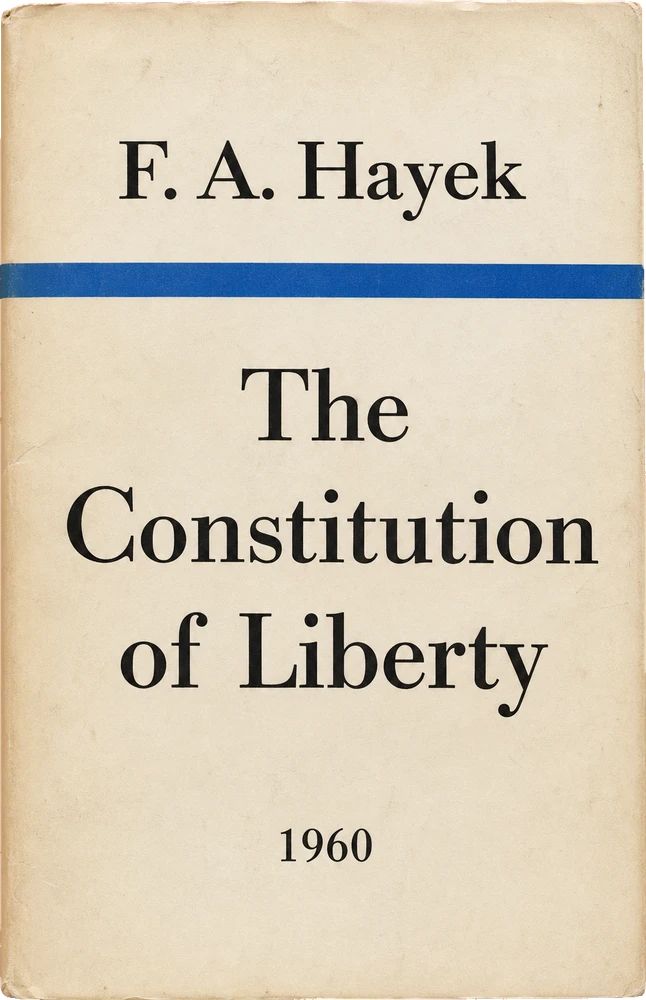
Friedrich A. Hayek, The Constitution of Liberty
Hayek’s book is a systematic defense of liberal civilization: not freedom as political participation, material power, or inner autonomy, but freedom from arbitrary coercion. Its central thesis is announced in the opening definition:
We are concerned in this book with that condition of men in which coercion of some by others is reduced as much as is possible in society.
The argument proceeds from epistemology to constitutional design and then to policy. Hayek’s deepest premise is that no mind or authority can possess the knowledge needed to direct social life. Liberty matters not because every use of it is noble, but because its results cannot be known in advance. A free society is an institutional method for discovering uses of knowledge that no planner can foresee.
Freedom granted only when it is known beforehand that its effects will be beneficial is not freedom.
Part I, “The Value of Freedom,” develops this anti-rationalist liberalism. Progress depends on allowing different persons to try different courses, bear responsibility, imitate success, and learn from failure. Hayek therefore treats inequality, experiment, tradition, and responsibility as connected. Equality before general rules is essential; imposed equality of outcome destroys the very field in which discovery occurs. He does not deny the importance of moral inheritance, but argues that reason works within evolved practices more often than it designs them from nothing. Liberty is thus both individual and civilizational: it protects eccentricity, innovation, and unplanned improvement.
Part II turns this philosophy into constitutional doctrine. The rule of law is Hayek’s institutional answer to coercion. Government may coerce only through known, general, abstract rules, not through discretionary commands aimed at particular persons or ends. Laws should create a predictable framework within which individuals may form their own plans. Democracy is valuable as a peaceful method of changing rulers, but it is not identical with liberty; majorities too must be limited by general rules. The liberal constitution therefore restrains administration, taxation, economic regulation, and emergency powers whenever they become instruments of arbitrary direction rather than general law.
Part III applies these principles to the welfare state. Hayek does not argue that every public service is illegitimate. He allows collective provision where markets cannot easily supply certain goods, and he accepts a safety minimum compatible with general rules. But he sharply distinguishes such measures from redistributive planning, monopoly privileges, price controls, union coercion, progressive taxation used for social engineering, and administrative discretion that makes citizens dependent on official favor. His recurring test is whether policy preserves a general legal order or substitutes purposive command.
His treatment of conservation shows the characteristic move. Hayek rejects sentimental or centrally planned preservation as if resources possessed a single socially correct use. Future provision must be compared with alternative investments, since privately held local knowledge and market prices often register scarcities better than official judgment.
Perhaps the best way of concisely stating the chief point is to say that all resource conservation constitutes investment and should be judged by precisely the same criteria as all other investment.
The book’s relevance lies in this union of political liberty, knowledge theory, and legal form. Hayek’s “constitution” is not merely a written document but a discipline of power: coercion must be minimized, predictable, impersonal, and bound by rules. Against socialism, technocracy, and conservative paternalism alike, he insists that civilization advances through institutions that let people use knowledge no authority can command. Its postscript, “Why I Am Not a Conservative,” clarifies the stance: Hayek defends inherited restraints, but not deference to authority, privilege, or fear of change. Liberalism, for him, is the courageous politics of an open order.
Sections
This work was divided into 135 sections when it entered the library's research corpus—an apparatus for search and citation, not necessarily the author's own table of contents. Each title opens its summary.
1Title Page and Copyright
2Preface
3Table of Contents
4Introduction
5Part I: The Value of Freedom
6Chapter 1: Liberty and Liberties
7Chapter 2: The Creative Powers of a Free Civilization
8Chapter 3: The Common Sense of Progress
9Chapter 4: Freedom, Reason, and Tradition
10Chapter 5: Responsibility and Freedom
11Chapter 6: Equality, Value, and Merit
12Chapter 7: Majority Rule
13Chapter 8: Employment and Independence
14Employee Freedom and the Need for Many Employers
15Employee Standards, Independence, and Remuneration
16Legislation Shaped by the Employed Majority
17Independent Ownership and Competitive Enterprise
18Independent Means, Nonmarket Goods, and Minority Leadership
19The Ethos of Wealth and Intellectual Independence
20Conspicuous Waste, Leisure, and Social Progress
21Part II: Freedom and the Law
22Chapter 9: Coercion and the State
23Chapter 10: Law, Commands, and Order
24Chapter 11: The Origins of the Rule of Law
25Chapter 12: The American Contribution: Constitutionalism
26Chapter 13: Liberalism and Administration: The Rechtsstaat
27Chapter 14: The Safeguards of Individual Liberty
28Chapter 15: Economic Policy and the Rule of Law
29Chapter 16: The Decline of the Law
30Part III: Freedom in the Welfare State—Tocqueville Epigraph
31Chapter 17: Decline of Socialism and the Shift toward Welfare-State Aims
32Chapter 17: Meaning and Dangers of the Welfare State
33Chapter 17: Scope of Policy Discussion, Decentralization, Subsidies, and Monopoly
34Chapter 18: Union Privilege, Coercion, and Wage Effects
35Chapter 18: Economic Harms and Coercive Methods of Unionism
36Chapter 18: Legitimate Functions of Unions and Industrial Democracy
37Labor Unions and Employment: Restoring Equal Law over Union Power
38Labor Unions, Full Employment Policy, and Inflation
39The Choice before Labor Unions: Market Wages or Government Direction
40Labor Unions as a Test of the Rule of Law
41Social Security: Relief, Compulsory Provision, and Liberal Justification
42The Tendencies of Social Insurance toward Monopoly and Redistribution
43Social Security Complexity and the Rise of Institutional Experts
44Growth versus Design in Insurance Institutions
45Expansionism of the Social Security Apparatus
46Old Age Pensions, Inflation, and Generational Conflict
47Health Insurance versus Free State Medicine
48Unemployment Insurance, Wage Rigidity, and Union Policy
49The Crisis of Social Security
50Taxation and Redistribution: The Central Issue of Progressive Taxation
51The Rise of Progressive Taxation and the Utility Argument
52From Moderate Progression to Political Redistribution
53Progressive Taxation and the Myth of Fiscal Necessity
54Progression, Democracy, and Inflationary Bracket Creep
55Proportionality, Equal Pay, Incentives, and Savings
56Appropriate Income, Entrepreneurship, and Capital Formation
57The Moral Issue and a Rule for Limiting Progression
58The Monetary Framework: Money, Credit, and Government Control
59Inflation and the Welfare State
60Inflation, Deflation, Expectations, and Mechanical Rules
61Rules versus Authorities, the Gold Standard, and Commodity Standards
62The Goals of Monetary Policy: Price Stability and Employment
63Inflation as a Threat to Freedom
64Housing and Town Planning: Urban Life, Property, and Neighborhood Effects
65Rent Restriction and Arbitrary Housing Control
66Public Housing and Subsidized Dependence
67The Economics of Slums and Uneconomic Urban Growth
68Town Planning, Property Rights, and the Price Mechanism
69Control of Land Use and the British Town and Country Planning Act
70Building Regulations, Performance Codes, and Local Competition
71Location of Industry and the Limits of Central Planning
72Agriculture, Industrial Progress, and the Shrinking Farm Population
73Price Control, Parity, and Agricultural Surpluses
74Farmers as Wards of Government
75Government, Land Law, and the Dispersion of Agricultural Knowledge
76Underdeveloped Countries, Industrialization, and Agricultural Capital
77Conservation of Natural Resources and Private Property
78Collective and Individual Foresight in Resource Conservation
79Particular Resources and General Progress
80Amenities and the Preservation of Natural Life
81Education and Research: Knowledge, Children, and Minimum Education
82Education and the State
83Educational Pluralism, Psychological Power, and Vouchers
84Public Funding and Selection in Higher Education
85Education, Equality, and Social Justice
86A New Order of Rank?
87The Universities and Research
88Academic Freedom and Tenure
89The Finance of Research
90Freedom at the Boundaries of Knowledge
91Why I Am Not a Conservative: Liberalism, Conservatism, and Direction
92Liberalism and Conservatism as Distinct Directions
93The Conservative Disposition: Change, Authority, Coercion, Democracy, and Economy
94The Weakness of Conservatism: Knowledge, Nationalism, and Imperialism
95Liberal Skepticism, Rationalism, and Religion
96The Name of the Party of Liberty
97A New Appeal to the Old Whigs
98Principles, Practical Possibilities, and the Limits of Conservatism
99Acknowledgments and Notes: Purpose and Debts
100Abbreviations and Introduction Notes
101Notes to Part I and Chapter One: Liberty and Liberties
102Notes to Chapter Two: The Creative Powers of a Free Civilization
103Notes to Chapter Three: The Common Sense of Progress
104Notes to Chapter Four: Freedom, Reason, and Tradition
105Notes to Chapter Five: Responsibility and Freedom
106Notes to Chapter Six: Equality, Value, and Merit
107Notes to Chapter Seven: Majority Rule
108Notes to Chapter Eight: Employment and Independence
109Part II Epigraph Source Note
110Chapter Nine Notes: Coercion and the State
111Chapter Ten Notes: Law, Commands, and Order
112Chapter Eleven Notes: The Origins of the Rule of Law
113Chapter Twelve Notes: The American Contribution: Constitutionalism
114Notes on Bills of Rights, the Ninth Amendment, and Judicial Review
115Notes to Pages 188–93: American Constitutionalism and Judicial Review
116Chapter Thirteen Notes: Liberalism and Administration and the Rechtsstaat
117Chapter Fourteen Notes: The Safeguards of Individual Liberty
118Chapter Fifteen Notes: Economic Policy and the Rule of Law
119Chapter Sixteen Notes: The Decline of the Law Beginning
120Chapter Sixteen Notes (continued): Rule of Law, Administrative Law, and Legal Positivism
121Part III Introductory Note: Tocqueville Epigraph
122Chapter Seventeen Notes: The Decline of Socialism and the Rise of the Welfare State
123Chapter Eighteen Notes: Labor Unions and Employment
124Chapter Nineteen Notes: Social Security
125Notes to Chapter Nineteen: Social Security and the Welfare State (continued)
126Notes to Chapter Twenty: Taxation and Redistribution
127Notes to Chapter Twenty-One: The Monetary Framework
128Notes to Chapter Twenty-Two: Housing and Town Planning
129Notes to Chapter Twenty-Three: Agriculture and Natural Resources
130Notes to Chapter Twenty-Four: Education and Research
131Notes to Postscript: Why I Am Not a Conservative
132End of Notes and Analytical Table of Contents
133Index of Authors Quoted
134Index of Subjects
135Chinese CIP and Publication Data
Put a question to this work; the Librarian answers from its 135 sections and cites the passage.
Ask the Librarian