About this work
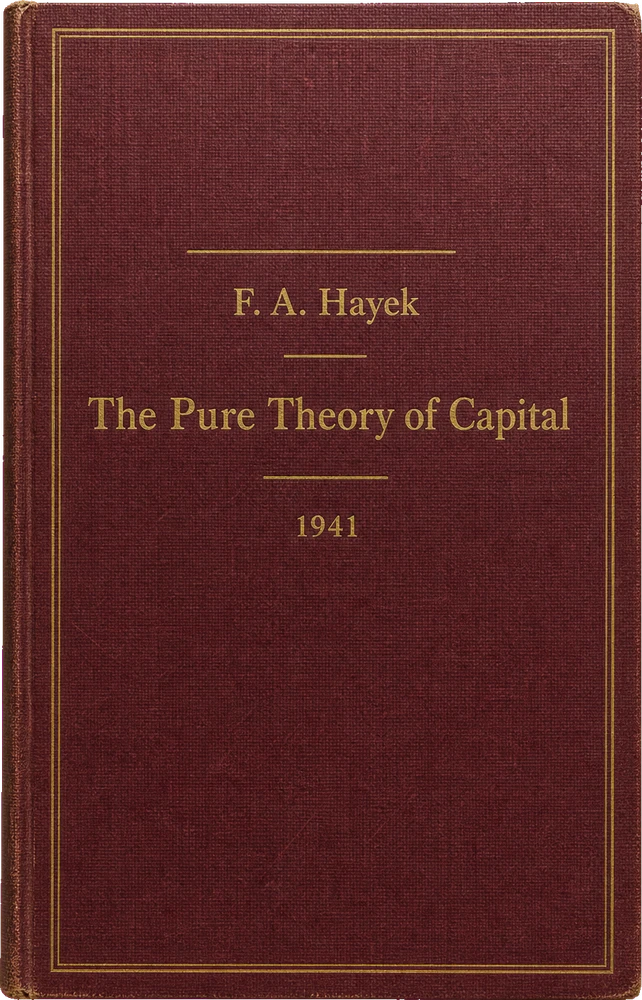
Friedrich A. Hayek, The Pure Theory of Capital — Summary
Hayek’s book reconstructs capital theory by rejecting the treatment of capital as a single measurable fund. Capital is instead a heterogeneous, time-ordered structure of goods, plans, and expected outputs. Its central problem is intertemporal coordination: how present labor and resources are assigned to processes that will yield consumers’ goods only later, and how interest, saving, and relative prices guide that allocation.
The analysis begins from simplified equilibrium conditions in order to show why familiar aggregates—“capital,” “investment,” and “the period of production”—become misleading when separated from the concrete sequence of inputs and outputs. Capital goods matter not simply because they are durable or productive, but because they occupy definite places in production plans. The decisive issue is not the quantity of capital in the abstract, but whether the different stages of production are mutually compatible through time.
Hayek therefore resists inherited classifications, especially the sharp distinction between fixed and circulating capital:
It appears that here as elsewhere any attempt at a sharp division of capital into two groups, although sometimes illustrative, is dangerous and misleading, and has to give place, in more precise analysis, to a treatment which takes account of the essential continuity of the range of periods for which input is invested.
This warning states the book’s method. Capital theory must not begin from visible physical categories but from the temporal function of goods within plans of use, replacement, and output. A machine, inventory, or unfinished product is capital only within a structure of expectations about future services. The relevant analytical object is the changing pattern of investment periods and productive stages, not a rigid taxonomy of things.
Saving, in this framework, does not simply “add” to capital. It changes the relation between present consumption and future-oriented production. If consumers genuinely postpone consumption, resources are released for longer and more roundabout methods. A lower interest rate can then coordinate investment with saving. But if credit expansion lowers interest rates without a corresponding willingness to defer consumption, entrepreneurs are induced to lengthen production in ways the economy cannot complete. Hayek describes the ensuing pressure:
But if they do not and continue to spend on consumption goods as much as before, the amount of capital required for the completion of the process will not be forthcoming; that is, there will arise that "scarcity of capital" discussed in classical theory, which of course means a scarcity of consumers' goods and a rise in their price and in profit margins generally, which will make investment in long processes of this kind unprofitable.
The phrase is important because the shortage is not merely a lack of machines or funds. It often appears as a shortage of consumers’ goods and of resources needed in later stages. Demand for present consumption has not fallen enough to support the new, longer production structure. Prices and profits in late stages rise, costs shift, and investments that seemed profitable under cheap credit prove unsustainable. The book thus supplies the capital-theoretic foundation for Hayek’s business-cycle view: monetary disturbances mislead entrepreneurs by distorting the signals that coordinate production over time.
The structure of the work moves from static clarification to dynamic adjustment. Hayek analyzes capital maintenance, investment, durability, waiting, and the relation between present inputs and future outputs under equilibrium assumptions, then asks how changes in saving, technique, and demand alter the temporal structure of production. His emphasis is not on defending a simple doctrine of “roundaboutness,” but on showing that different production plans must fit together in time if they are to be economically viable.
The final significance of the argument appears in Hayek’s treatment of demand and employment. He accepts that the demand for a particular factor may be derived from demand for a particular product, but denies that this can be generalized into the claim that more consumption demand is automatically more demand for labor as a whole. He revives Mill’s proposition that demand for commodities is not demand for labour, and pushes it to its sharpest form:
We see, therefore, that if we treat the problem in real terms and in its simplest forms, an increase in the demand for consumers’ goods not only does not increase but actually decreases the demand for labour.
The point is not that consumption is irrelevant to employment, but that spending on consumers’ goods may redirect labor and resources toward late stages while weakening investment and shortening the production structure. Conversely, saving may reduce immediate consumption demand while sustaining employment through investment, if the structure adjusts coherently.
The Pure Theory of Capital insists that macroeconomic aggregates conceal problems of composition, timing, and compatibility. Capital is not a lump but an ordered system of commitments extending into the future. Interest and relative prices are coordinating signals for that system. When theory suppresses the heterogeneity of capital, it also suppresses the mechanism by which production is either made sustainable or driven into crisis.
Sections
This work was divided into 40 sections when it entered the library's research corpus—an apparatus for search and citation, not necessarily the author's own table of contents. Each title opens its summary.
1Title and Publication Information
2Preface
3Contents
4Analytical Table of Contents
5Chapter I: The Scope of the Inquiry
6Chapter II: Equilibrium Analysis and the Capital Problem
7Chapter III: The Significance of Analysis in Real Terms
8Chapter IV: The Relation of This Study to the Current Theories of Capital
9Chapter V: The Nature of the Capital Problem
10The Duration of the Process of Production and the Durability of Goods: Some Definitions
11Capital and the Subsistence Fund
12Part II: Investment in a Simple Economy — The Output Function and the Input Function
13Chapter IX: The Continuous Process of Production
14Chapter X: The Position of Durable Goods in the Investment Structure
15Chapter XI: The Productivity of Investment
16Planning for a Constant Output Stream
17Compound Interest and the Instantaneous Rate of Interest
18The Marginal Productivity of Investment and the Rate of Interest
19Input, Output, and the Stock of Capital in Value Terms
20The Marginal Value Product of Investment: The Problem of Attribution (Imputation)
21Chapter XVI: Marginal Value Product of Investment (continued)
22Chapter XVII: Time Preference and Its Effects with Constant Returns on Investment
23Chapter XVIII: Time Preference and Productivity: Their Relative Importance
24Part III: Capitalistic Production in a Competitive Community
25Chapter XIX: The General Conditions of Equilibrium
26Chapter XX: The Accumulation of Capital
27Chapter XXI: The Effect of the Accumulation of Capital on Quantities Produced and Relative Prices
28Chapter XXII: The Adjustment of the Capital Structure to Foreseen Changes
29Chapter XXIII: The Effects of Unforeseen Changes and in Particular of Inventions
30Chapter XXIV: The Mobility of Capital
31Chapter XXV: “Saving”, “Investment”, and the “Consumption of Capital”
32Part IV: The Rate of Interest in a Money Economy; Chapter XXVI: Factors Affecting the Rate of Interest in the Short Run
33Chapter XXVII: Long-Run Forces Affecting the Rate of Interest
34Differences Between Interest Rates: Conclusions and Outlook
35Appendix I: Time Preference and Productivity
36Appendix II: The Conversion of Circulating Capital into Fixed Capital
37Appendix III: Demand for Commodities Is Not Demand for Labour versus Derived Demand
38Bibliography
39Index of Definitions of Some Technical Terms
40Index of Authors Cited
Put a question to this work; the Librarian answers from its 40 sections and cites the passage.
Ask the Librarian