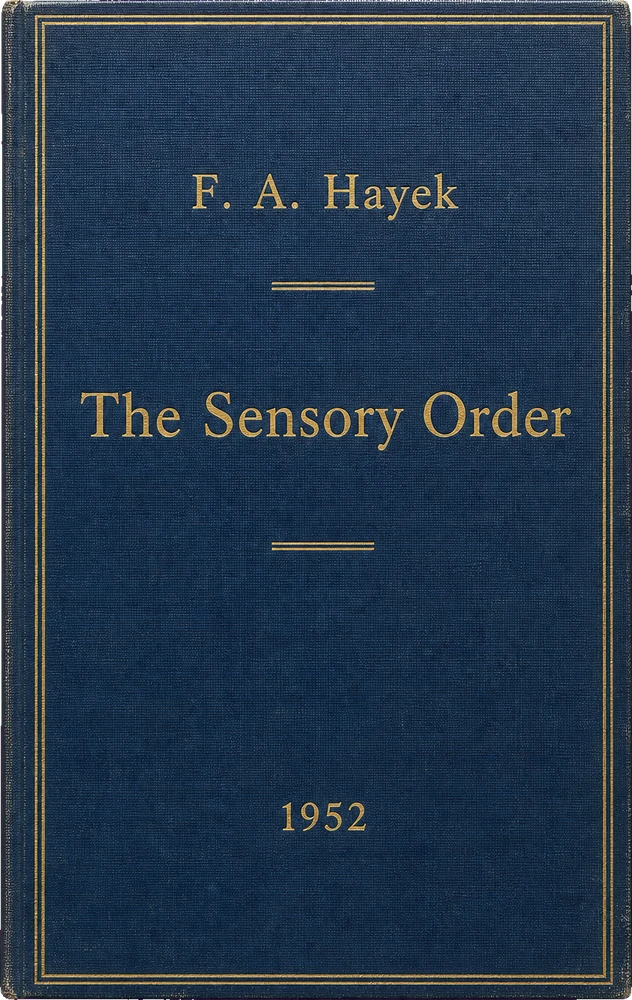
Friedrich August von Hayek · 1952
The Sensory Order: An Inquiry into the Foundations of Theoretical Psychology
About this work
Friedrich A. Hayek, The Sensory Order (1952)
Hayek’s The Sensory Order is a theoretical monograph on psychology and the philosophy of mind, concerned with how the qualitative order of experience can arise within a physical organism. Its starting point is the discrepancy between the order described by the physical sciences and the order in which events appear to consciousness as colors, sounds, pressures, similarities, contrasts, and expectations. Psychology’s problem is not to replace physics, but to explain why a world that can be physically ordered is lived through another, sensory order.
The task of theoretical psychology is the converse one of explaining why these events, which on the basis of their relations to each other can be arranged in a certain (physical) order, manifest a different order in their effect on our senses.
The book’s central thesis is that sensory qualities are not primitive mental atoms or copies of external properties. They are products of classification within the nervous system. A stimulus has the quality it has because of the place its neural impulse occupies in a network of possible relations, dispositions, inhibitions, and responses. Hayek’s decisive move is therefore relational: what a sensation “is” depends on what effects the corresponding impulses can have in varying circumstances.
The order of sensory qualities thus is identical with the totality of the differences of the effects which the different nervous impulses will produce in different circumstances.
From this premise Hayek develops a theory of the mind as an adaptive classificatory apparatus. Perception is not the passive reception of uninterpreted data; it is the outcome of an organized system that groups stimuli according to their functional significance for the organism. This also gives the book its anti-empiricist force. The apparent immediacy of sensation conceals prior ordering. Experience depends on classificatory structures that are already operative before any particular act of sensing, even though those structures themselves have histories in inherited organization and earlier learning.
Sensory experience presupposes, therefore, an order of experienced objects which precedes that experience and which cannot be contradicted by it, though it is itself due to other, earlier experience.
Hayek’s position is naturalistic but not crudely reductionist. He does not claim that psychology can simply be translated into physics. Rather, mental order is a real order instantiated within a physical system, and different sciences legitimately construct different classificatory schemes for different explanatory purposes. The “mental” is not a second substance added to nature, but a pattern of relations within the organism.
This order which we call mind is thus the order prevailing in a particular part of the physical universe—that part of it which is ourselves.
The significance of The Sensory Order lies in its fusion of theoretical psychology, epistemology, and systems thinking. It anticipates later cognitive and connectionist accounts by treating mind as a historically formed network of classifications rather than as a storehouse of sensory atoms. It also illuminates Hayek’s broader intellectual project: the same concern with emergent order, tacit classification, and the limits of explicit reconstruction appears in his social theory and economics. Here, however, the object is the nervous system itself, and the lesson is that perception is already organized before reflective thought begins. The experienced world is neither freely invented nor passively copied; it is ordered through embodied relations formed in the organism’s encounter with its environment.
Sections
This work was divided into 54 sections when it entered the library's research corpus—an apparatus for search and citation, not necessarily the author's own table of contents. Each title opens its summary.
1Front Matter, Title Pages, and Publication Information
2Preface
3Contents
4Introduction by Heinrich Klüver
5Chapter I, Sections 1–3: Mind, the Phenomenal and Physical Orders, and Nervous Impulses
6Chapter I, Section 4: Differences in Quality as Differences in Effects
7Chapter I, Section 5: The Unitary Character of the Sensory Order
8Chapter I, Section 6: The Sensory Order Beyond Conscious Experience
9Chapter I, Section 7: Behaviourism and the Denial of the Problem
10Chapter I, Section 8: Absolute Qualities as a Phantom-Problem and Opening of Chapter II
11Chapter II, Section 1: The Principle of the Explanation
12Chapter II, Section 2: Static and Dynamic Aspects of Sensory Qualities
13Chapter II, Section 3: The Principle of Classification
14Chapter II, Section 4: Multiple Classification
15Chapter II, Section 5: The Central Thesis
16Chapter III, Section 1: An Inventory of the Physiological Data
17Chapter III, Section 2: Simplifying Assumptions for the Principle
18Chapter III, Section 3: Elementary Forms of Classification
19Chapter III, Section 4: Complex Forms of Classification
20Chapter III, Section 5: Classification of Relations Between Classes
21Chapter III, Section 6: Gestalt Phenomena and Abstract Concepts
22Chapter IV, Section 1: Sensation and the Organism
23Chapter IV, Section 2: Evolution and the Hierarchical Order of the Central Nervous System
24From Specific Reflex to Generalized Evaluation
25Proprioception of Low-Level Responses
26Postures, Perception, and Patterns of Motor Response
27Biogenic Needs and Drives
28Emotions and the James-Lange Theory
29Chapter V, Section 1: Pre-Sensory Experience or Linkages
30The Gradual Formation of a Map of Environmental Relations
31The Map and the Model
32Associative Processes and Mechanical or Purpose Behaviour
33The Model-Object Relationship and Transition to Consciousness
34Conscious and Unconscious Mental Processes
35Criteria of Consciousness
36The Common Space-Time Framework
37Attention
38The Functions of Consciousness
39‘Concrete’ and ‘Abstract’
40Conceptual Thought
41Chapter VII: Observed Facts and Older Theories Comprised as Special Cases
42New Experiments Suggested
43Possibilities of Experimental Refutation
44Chapter VIII, Section 1: Pre-Sensory Experience and Pure Empiricism
45Chapter VIII, Section 2: Phenomenalism and the Inconstancy of Sensory Qualities
46Chapter VIII, Section 3: Dualism and Materialism
47Chapter VIII, Section 4: The Nature of Explanation
48Chapter VIII, Section 5: Explanation of the Principle
49Chapter VIII, Section 6: The Limits of Explanation
50Chapter VIII, Section 7: The Division of the Sciences and the Freedom of the Will
51Bibliography
52Bibliographic Note on Later Sensory Learning Work
53Index
54Library Card and Scanned Copy Markings
Put a question to this work; the Librarian answers from its 54 sections and cites the passage.
Ask the Librarian