About this work
Summary of Hayek and Bartley’s The Fatal Conceit
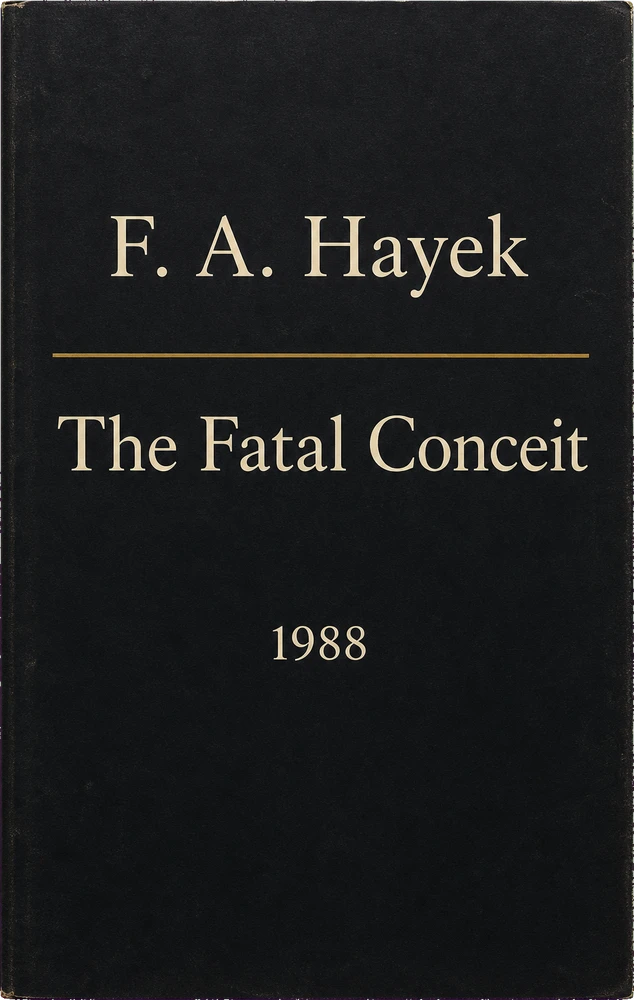
The Fatal Conceit presents Hayek’s late synthesis of his arguments about markets, law, knowledge, and social evolution. Edited by W. W. Bartley III, the book treats socialism less as a technical economic failure than as an epistemological and moral mistake: the belief that reason can consciously reconstruct the extended order of human cooperation. Its paratext frames the work as the culmination of an already canonical career:
The holder of numerous honorary doctorates, and a member of the British Academy, Hayek was awarded the Nobel Memorial Prize in Economics in 1974. He was created Companion of Honour in 1984. He is the author of some fifteen books, …
That framing matters because Hayek is not merely defending particular policies. He is explaining why civilization depends on inherited institutions—property, contract, money, family discipline, honesty, saving, and market exchange—that no single mind designed and no authority fully understands. These rules often restrain immediate impulses, yet they make possible large-scale cooperation among strangers by coordinating dispersed knowledge through practices, prices, and expectations.
A key move is Hayek’s distinction between cultural and biological evolution. He does not claim that markets are simply “natural,” nor that social order is consciously invented. Rather, traditions may be selected and transmitted because they generate consequences no participant foresaw.
Not only is the idea of evolution older in the humanities and social sciences than in the natural sciences, I would even be prepared to argue that Darwin got the basic ideas of evolution from economics.
This distinction lets Hayek reject both instinctivism and constructivist rationalism. The morals of the extended order are not tribal morals: they require impersonal cooperation, abstract rules, and exchange with unknown others rather than solidarity around visible common ends. Yet reason itself is not sovereign over these rules, because it develops within traditions it did not create. The mind cannot step outside the social order and redesign it from first principles when the knowledge sustaining that order is tacit, dispersed, and embedded in practice.
The “fatal conceit” is thus the conceit of deliberate mastery, the demand that social institutions be justified only by purposes explicitly chosen in advance.
- The related idea that it is unreasonable to follow a particular course unless its purpose is fully specified in advance (Einstein, Russell, Keynes).
Hayek’s answer is that many indispensable rules have no single specifiable purpose. Prices condense local knowledge; money extends trust; property creates responsibility; competition discovers information unavailable before the process unfolds. The market is not praised because every outcome is morally pleasing, but because it is a discovery procedure no central planner can replicate.
The book’s structure moves from philosophical diagnosis to social theory and critique. It identifies the errors of socialism and rationalist constructivism, then explains evolved morals, property, exchange, and population growth. Hayek repeatedly contrasts small-group ethics with the abstract rules of the Great Society. Socialism is emotionally powerful because it revives expectations of visible distribution and shared purpose; applied to the extended order, however, those expectations destroy the signals and incentives by which millions coordinate without command.
The work is also a critique of political language. Terms such as “society,” “justice,” and “economy” can make complex outcomes appear to be products of a collective agent, encouraging the suspicion that whatever no one intended must be morally defective. Hayek reverses that intuition: the absence of central intention is what allows civilization to exceed deliberate design. His warning is therefore directed against technocratic overconfidence as much as socialism. He does not reject reason, but denies that reason can abolish the inherited constraints that made it effective. Freedom and tradition are not opposites; liberty depends on evolved rules that channel knowledge no planner can collect.
Sections
This work was divided into 72 sections when it entered the library's research corpus—an apparatus for search and citation, not necessarily the author's own table of contents. Each title opens its summary.
1Cover, Author Biography, and Editor Note
2Plan of The Collected Works
3Title Page, Publication History, Copyright, and Catalogue Data
4Front Matter: Series, ISBN, Supporters, and Contents
5Editorial Foreword
6Title Page and Epigraphs
7Preface
8Was Socialism a Mistake?
9Introduction: Was Socialism a Mistake?
10Chapter One Prelude: Evolutionary Epistemology and Moral Traditions
11Between Instinct and Reason: Biological and Cultural Evolution
12Between Instinct and Reason: Two Moralities in Cooperation and Conflict
13Natural Man Unsuited to the Extended Order
14Mind as a Product of Cultural Evolution
15Cultural Evolution Is Not Darwinian
16The Origins of Liberty, Property and Justice: Epigraphs
17Freedom and the Extended Order
18The Classical Heritage of European Civilisation
19Where There Is No Property There Is No Justice
20The Various Forms and Objects of Property and the Improvement Thereof
21Organisations as Elements of Spontaneous Orders
22The Evolution of the Market: Trade and Civilisation — The Expansion of Order into the Unknown
23The Density of Occupation of the World Made Possible by Trade
24Trade Older than the State
25The Philosopher's Blindness
26The Revolt of Instinct and Reason: The Challenge to Property
27Our Intellectuals and Their Tradition of Reasonable Socialism
28Morals and Reason: Some Examples
29Keynes, Moore, and Chisholm Against Moral Tradition
30The Revolt of Instinct and Reason: Einstein, Born, and Socialist Scientism
31A Litany of Errors
32Positive and Negative Liberty
33'Liberation' and Order
34Chapter Five: Traditional Morals Fail to Meet Rational Requirements
35Justification and Revision of Traditional Morals
36The Limits of Guidance by Factual Knowledge and the Impossibility of Observing Moral Effects
37Unspecified Purposes in the Extended Order
38The Ordering of the Unknown
39How What Cannot Be Known Cannot Be Planned
40The Mysterious World of Trade and Money: Disdain for the Commercial
41Marginal Utility versus Macro-economics
42The Intellectuals' Economic Ignorance
43The Distrust of Money and Finance
44The Condemnation of Profit and the Contempt for Trade
45Seven: Our Poisoned Language — Words as Guides to Action
46Terminological Ambiguity and Distinctions among Systems of Coordination
47Our Animistic Vocabulary and the Confused Concept of Society
48The Weasel Word Social
49Social Justice and Social Rights
50The Extended Order and Population Growth: The Malthusian Scare
51The Regional Character of the Population Problem
52Diversity and Differentiation
53The Centre and the Periphery
54Capitalism Gave Life to the Proletariat
55The Calculus of Costs Is a Calculus of Lives
56Life Has No Purpose But Itself
57Religion and the Guardians of Tradition: Natural Selection from Among the Guardians of Tradition
58Appendices: Appendix A Heading
59Appendix A: 'Natural' versus 'Artificial'
60Appendix B: The Complexity of Problems of Human Interaction
61Appendix C: Time and the Emergence and Replication of Structures
62Appendix D: Alienation, Dropouts, and the Claims of Parasites
63Appendix D (continued): Rights, Duties, and Entitlements
64Play, the School of Rules
65Remarks on the Economics and Anthropology of Population
66Superstition and the Preservation of Tradition
67Editor's Acknowledgements
68Bibliography: Alchian through Thorpe (partial)
69Bibliography Continued: Thorpe to Wynne-Edwards
70Name Index
71Subject Index and Closing Image Placeholder
72Back Cover: Editorial Credit, Description, Endorsements, and Publisher Information
Put a question to this work; the Librarian answers from its 72 sections and cites the passage.
Ask the Librarian