About this work
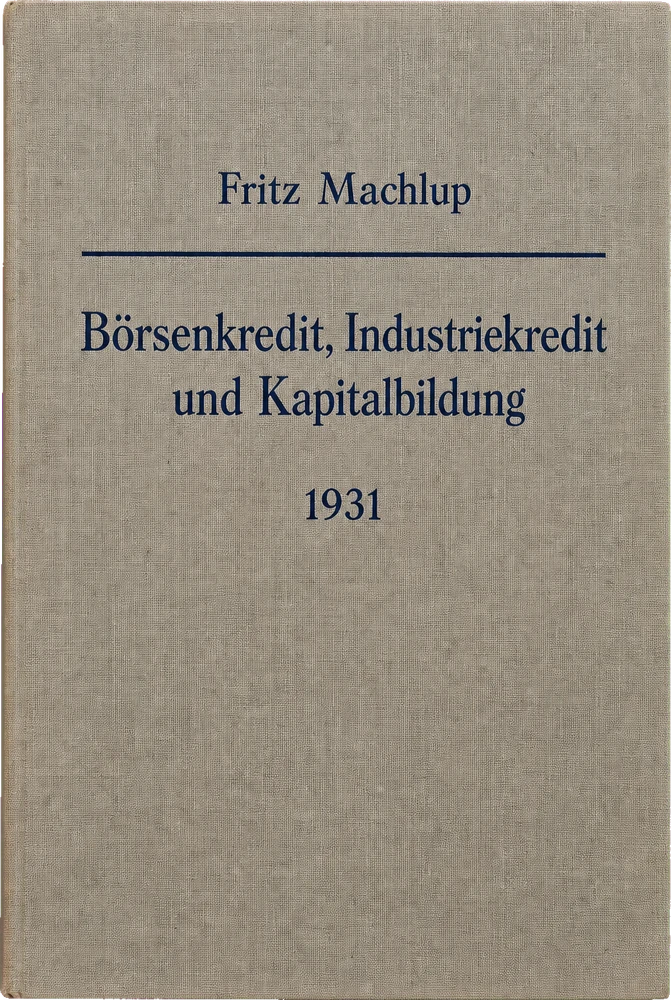
Fritz Machlup, Börsenkredit, Industriekredit und Kapitalbildung (1931)
Machlup’s monograph addresses the interwar charge that stock-exchange credit drains resources from industry, raises the cost of industrial borrowing, and prepares crises. He begins from public criticism of “speculation,” but recasts the issue as an analytical problem: what is actually taken up when securities are bought with credit?
„Nimmt die Börse Kapital in Anspruch?“
English translation: "Does the stock exchange lay claim to capital?"
His answer depends on a strict distinction between Realkapital and Kapitaldisposition. Real capital consists of produced means of production; capital disposition is command over purchasing power available for investment, whether from saving, amortization funds, or bank credit. Securities speculation may alter claims, prices, and purchasing power, but it does not physically immobilize plant, machinery, or materials.
„Realkapital — produzierte Produktionsmittel — also Ziegelsteine, Eisenträger, Maschinen, Drahtstifte, Hebekrane usw. werden von der Effektenspekulation weder absorbiert noch aufgesaugt, noch gebunden.“
English translation: "Real capital—produced means of production—that is, bricks, iron girders, machines, wire nails, cranes, and so on, is neither absorbed nor soaked up nor tied up by securities speculation."
This distinction structures Machlup’s theory of capital formation. Social saving is not mere withholding or hoarding; it becomes capital formation only when saved income is placed at the disposal of production. Hence the purchase of already-issued securities normally changes ownership of claims rather than creating or destroying capital. New issues, by contrast, can transmit saved purchasing power to firms and thus finance productive investment.
„Kapitalbildung ist Sparen und Verwendung der gesparten Einkommensteile in der Produktion.“
English translation: "Capital formation is saving and the employment of the saved portions of income in production."
Machlup therefore rejects the simple thesis that the exchange “binds” capital. Professional exchange transactions, especially with clearing and offsetting, do not require cash in proportion to turnover. He concedes that during a boom there may be a temporary congestion of funds in speculative chains, especially among the public, but this is not a normal absorption of capital by the exchange. It is a symptom of credit inflation: newly created purchasing power may first raise securities prices before flowing into production.
The book then becomes a contribution to monetary-cycle theory. Additional bank credit is capital disposition only at the moment of creation; once spent, it enters the money stream unless it is saved again. Machlup rejects the idea that credit expansion is safe merely because the commodity price level remains stable. By pushing the money rate below the capital-market rate, expansion can lengthen production processes beyond the limits set by voluntary saving. His discussion of Betriebskapital reinforces this point: working capital may look liquid to an individual firm, yet for the economy as a whole it is embodied in an interlocking production structure. Short-term credit can therefore support long-term commitments.
Machlup’s analysis of Kassenüberschußkredit—credit based on temporarily idle cash balances—extends the same argument. Such balances may appear to represent short-term saving, but if their owners have not really released command over real resources, lending them can have inflationary consequences. Seasonal and cyclical movements in money markets thus cannot be understood by looking only at the formal maturity or visible purpose of loans.
For this reason Machlup opposes policies that distinguish harmless “productive” credit from dangerous stock-exchange credit. Once bank credit is expanded, its effects depend on relative prices, interest rates, and the decisions of marginal borrowers, not on the label attached by the bank.
„Form, Weg und sichtbarer Verwendungszweck des Kredits sind für seine Wirkungen nicht relevant.“
English translation: "The form, path, and visible purpose of the use of credit are not relevant to its effects."
The conclusion reverses the usual criticism of the exchange. Machlup does not defend inflationary booms, but he denies that the stock market is the enemy of industry. On the contrary, securities markets help transform temporary savings into long-term industrial finance; a hausse that raises security prices and lowers yields may cheapen industrial capital even while short-term money becomes dearer.
„Der Effektenmarkt ist der Hauptmarkt für den Industriekredit. Die Börsenhausse ist eine Verbilligung des Industriekredits.“
English translation: "The securities market is the principal market for industrial credit. A stock-market boom amounts to a cheapening of industrial credit."
The policy lesson is therefore not to suppress exchange lending while continuing credit expansion elsewhere. A securities boom should be read as a possible sign of monetary overexpansion, but the underlying danger lies in inflationary credit, not in the stock exchange as such.
Sections
This work was divided into 36 sections when it entered the library's research corpus—an apparatus for search and citation, not necessarily the author's own table of contents. Each title opens its summary.
1Front Matter and Publication Information
2Preface
3Table of Contents
4Table of Contents Continued: Chapters 10–12 and Index
5Chapter 1: Competition in the Credit Market
6Chapter 2: Conceptual and Terminological Clarifications
7Chapter 2: Program for the Inquiry
8Chapter 3 Opening: Real Capital and the Securities Exchange
9Securities, Effectification, and Speculation as a Market Reservoir
10New Share Issues, Saving, and Cases of Real Capital Formation
11Existing Securities, Course Gains, Temporary Savings, and Speculative Capital
12Partial Summary of Capital-Disposition Paths Through Speculation
13Completion of the Nine Cases of Speculative Share Purchases
14Chapter IV: Defining the Binding of Capital Disposition and the Time Objection
15Conditions for Temporary Binding of Capital Disposition in Stock Speculation
16Stock Market Losses, Capital Disposition, and International Speculation
17Chapter V: The Alleged Money Demand of the Stock Exchange
18Clearing, Cession Payments, and the Public’s Role in Securities Transactions
19Credit Expansion, Speculative Chains, and Localized Inflation
20Capital Supply and Production Disturbances
21Additional Credit and Attempts to Define Its Permissible Expansion
22Permissible Credit Expansion and the Form of Additional Credit
23Working Capital and Operating Credit
24Money Market and Business-Cycle Movement
25Industrial Investment, Credit Expansion, and Stock-Market Boom
26Stock Exchange, Credit Inflation, and Credit Dearness
27End of Chapter Eleven: Interest-Rate Spreads and Bank Credit Costs
28Chapter Twelve: Purpose and Scope of the Results
29Section 85 Begins: Securities Transfers and Capital Disposition
30Concluding theses on stock exchange credit, industrial credit, and capital formation
31Practical implications of anti-inflationary credit theory
32Central bank policy, stock-exchange credit, and the discount rate
33Name index
34Austrian Institute for Business Cycle Research: governance and organization
35Monthly reports of the Austrian Institute for Business Cycle Research
36Publication series: Contributions to Business Cycle Research
Put a question to this work; the Librarian answers from its 36 sections and cites the passage.
Ask the Librarian