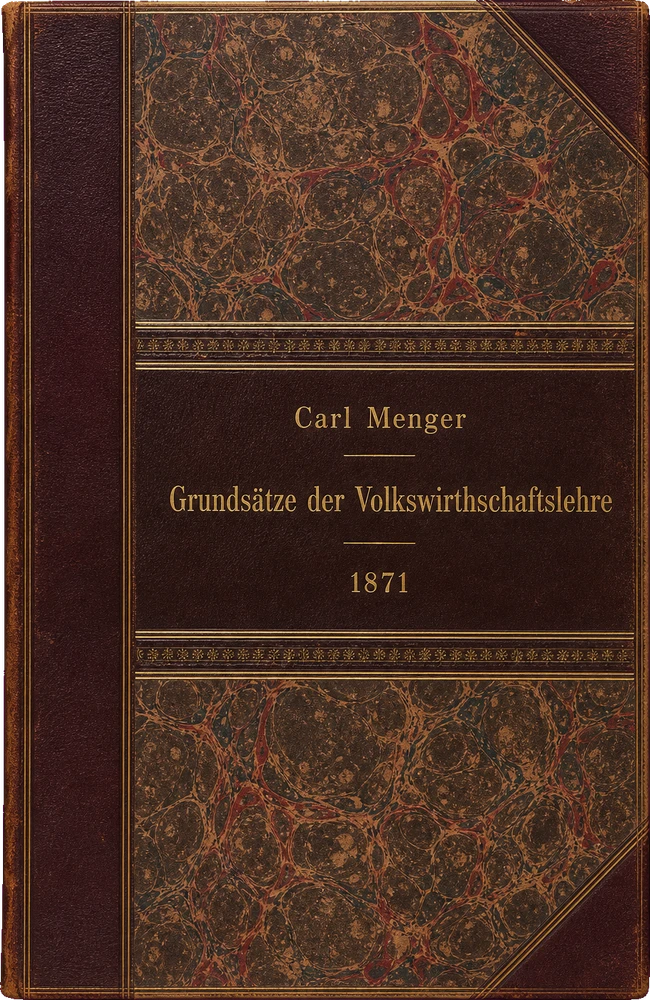
Carl Menger · 1871
Grundsätze der Volkswirthschaftslehre. Erster, allgemeiner Theil
About this work
Carl Menger, Grundsätze der Volkswirthschaftslehre — Summary
Carl Menger’s Grundsätze der Volkswirthschaftslehre (1871) is the “first, general part” of a projected reconstruction of economics. Rather than beginning with classes, nations, or labor quantities, Menger begins with the causal relation between human wants and the means capable of satisfying them. A thing becomes a good only when it is causally connected to a want, when that connection is known, and when command over it is possible. His famous distinction between lower-order and higher-order goods then lets him explain production without making cost an independent source of value: tools, raw materials, land uses, and labor services matter economically because they help bring about future satisfactions.
Scarcity is the hinge of the system. Goods become economic when available quantities are insufficient for all desired uses; where supply exceeds need, things may remain useful but cease to be objects of economizing. Menger therefore denies that usefulness alone creates value.
Die nicht ökonomischen Güter haben demnach nicht nur, wie dies bisher angenommen wurde, keinen Tauschwerth, sondern überhaupt keinen Werth, und somit auch keinen Gebrauchswerth.
English translation: Non-economic goods therefore have not only, as hitherto assumed, no exchange value, but no value at all, and consequently also no use value.
Value, for Menger, is not an intrinsic property of goods and not labor embodied in them. It is the significance a concrete good has for an economizing person who recognizes that some satisfaction depends on command over it. Its measure is governed by the least important satisfaction that would be lost if one unit of the available stock disappeared. In this way Menger formulates the marginal principle as a causal theory of valuation rather than as a mathematical apparatus.
Der Werth ist demnach nicht nur seinem Wesen, sondern auch seinem Masse nach subjectiver Natur.
English translation: Value is therefore subjective in nature not only in its essence but also in its measure.
This subjective theory also reverses classical cost doctrines. Goods of higher order receive value by imputation from the lower-order goods they help produce; expected product value governs the value of productive means, not the other way around. Menger thus preserves a rigorous account of production while denying that costs can ultimately explain value independently of wants, scarcity, and anticipated satisfactions.
The analysis of exchange follows directly. Exchange does not rest on equality of value, but on inequality of valuations: each party gives up what is less important to him in order to obtain what is more important. Price forms within limits set by the valuations of buyers and sellers. Menger’s distinction between use value and exchange value clarifies that an economizing person compares alternative employments of the same good.
Es ist demnach in allen Fällen, wo ein Gut für dessen Besitzer sowohl Gebrauchswerth, als auch Tauschwerth hat, derjenige der ökonomische, welcher der grössere ist.
English translation: In all cases in which a good has for its possessor both use value and exchange value, the economic value is whichever of the two is the greater.
Menger applies the same causal logic to monopoly and competition. A monopolist’s conduct is not explained by a special moral psychology but by control over a scarce supply and by the attempt to select the quantity that yields the greatest proceeds.
Seine Wirthschaftspolitik geht rücksichtlich der ihm verfügbaren Quantitäten des Monopolgutes auf den möglichst grossen Erlös.
English translation: His economic policy with respect to the quantities of the monopoly good available to him is directed toward the greatest possible yield.
Competition alters this situation by introducing rival sellers and limiting the gains from withholding. Yet competitive price, like monopoly price, remains grounded in subjective valuations and scarcity rather than in objective equivalence.
The final movement of the book treats commodities and money. A commodity is a good held for exchange rather than direct use. Money emerges because some goods are more saleable than others: individuals trying to overcome the limits of barter gradually accept highly marketable goods, not for immediate consumption, but because they can more easily be exchanged again. Money is therefore presented as an unintended social institution arising from individual economizing action, not primarily as a legal creation.
The importance of the Grundsätze lies in the unity of this reconstruction. Menger derives value, production, price, monopoly, competition, commodities, and money from the same foundation: purposeful action under scarcity. Its originality is not only the claim that value is subjective, but the systematic use of that claim to rebuild economic theory around marginal significance and causal-genetic explanation.
Sections
This work was divided into 55 sections when it entered the library's research corpus—an apparatus for search and citation, not necessarily the author's own table of contents. Each title opens its summary.
1Title Page and Dedication
2Preface on Method and the Reform of Economics
3Table of Contents
4Chapter 1, Section 1: On the Nature of Goods
5Goods Quality, Imaginary Goods, and Useful Relations
6The Causal Connection of Goods
7Complementary Goods and the Goods-Quality of Higher-Order Goods
8Dependence of Higher-Order Goods on Lower-Order Goods
9Time, Error, and Uncertainty in Production
10Causes of the Progressive Welfare of Humanity
11Possession of Goods as an Ordered Whole
12Chapter Two Introduction: Economy and Economic Goods
13Human Requirements for First-Order Goods
14Human Requirements for Higher-Order Goods
15Time Limits of Human Requirements
16Available Quantities and Commercial Knowledge of Stocks
17Economic Goods, Economizing, and the Origin of Property
18Non-Economic Goods and Natural Communism under Abundance
19Transitions between Economic and Non-Economic Goods
20Laws Governing the Economic Character of Higher-Order Goods
21Wealth, Economic Goods, and National Wealth
22Nature and Origin of Goods Value
23The Subjective Moment in Measuring Goods Value
24The Objective Moment in Measuring Goods Value
25Concluding Principles of the Measure of Value and the Water-Diamond Comparison
26Influence of Differences in the Quality of Goods on Their Value
27Subjective Character of the Measure of Value, Labor, and Error
28Value of Higher-Order Goods: The Governing Principle
29Productivity of Capital and the Value of Complementary Higher-Order Goods
30Value of Individual Higher-Order Goods within Complementary Production
31Value of Land Use, Capital Use, and Labor Services
32Chapter IV: Foundations of Economic Exchange
33The Limits of Economic Exchange
34Chapter Five Introduction: The Doctrine of Price
35Price Formation in Isolated Exchange
36Monopoly Price Formation: Competition for One Indivisible Monopoly Good
37Monopoly Price Formation: Competition for Quantities of a Monopoly Good
38Monopoly Trade: Quantity Offered, Price Limits, and Distribution Principles
39Effects of Monopolist-Fixed Prices on Sales Quantity and Distribution
40Monopoly Policy: Revenue Maximization, Supply Restriction, and Historical Examples
41Bilateral Competition: The Emergence of Competition from Factual Monopoly
42Quantities and Fixed Prices under Competition in Supply
43Competition Policy: How Supply Competition Alters Quantities, Prices, and Production
44Use Value and Exchange Value: Their Common Basis in Need Satisfaction
45The Relation between Use Value and Exchange Value
46Changes in the Economic Center of Gravity between Use Value and Exchange Value
47The Concept of the Commodity in Popular and Scientific Usage
48The Limits of Commodity Saleability
49Degrees of Commodity Saleability and the Role of Organized Markets
50Circulability of Commodities across Multiple Hands
51Chapter VIII §1: The Nature and Origin of Money
52Chapter VIII §2: Money Specific to Each People and Era
53Chapter VIII §3: Money as Price Measure and Economical Form of Exchange Reserves
54Chapter VIII §4: Coinage
55Name Index
Put a question to this work; the Librarian answers from its 55 sections and cites the passage.
Ask the Librarian