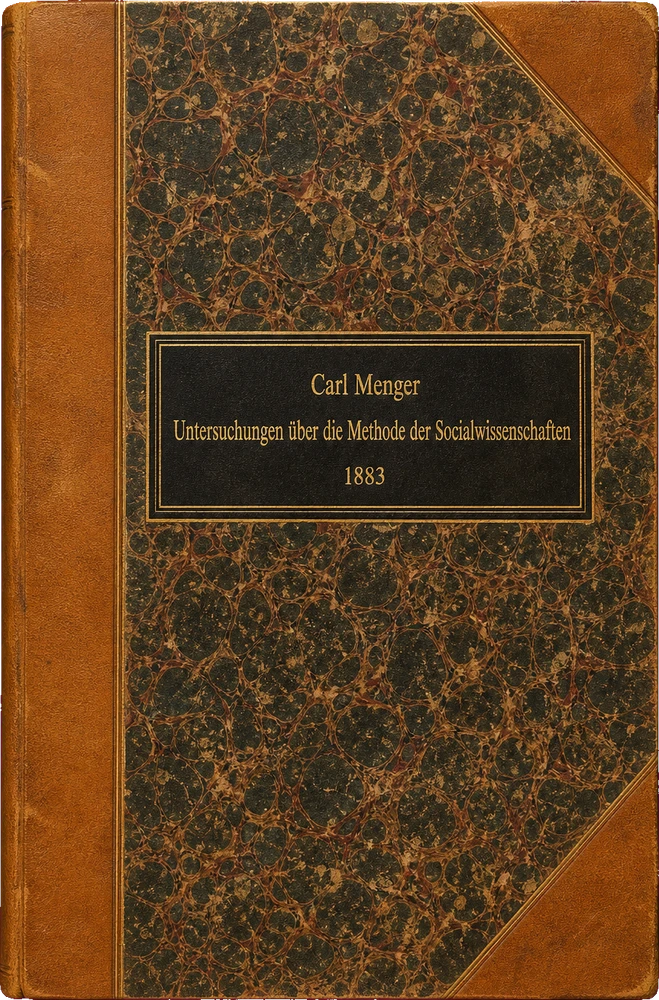
Carl Menger · 1883
Untersuchungen über die Methode der Socialwissenschaften, und der Politischen Oekonomie insbesondere
About this work
Carl Menger, Untersuchungen über die Methode der Socialwissenschaften und der Politischen Oekonomie insbesondere (1883)
Menger’s Untersuchungen is a methodological monograph: its scope is the epistemological status of the social sciences, with political economy as the decisive case. Written at the opening of the Methodenstreit, it argues that economics cannot be reduced either to historical description or to practical statecraft. Its central thesis is that political economy contains distinct scientific tasks: historical-statistical inquiry into individual phenomena, theoretical inquiry into general types and laws, and practical inquiry into maxims for action. Confusing these tasks, Menger contends, has damaged economics by obscuring what kind of knowledge theory can and cannot provide.
Die Methoden der theoretischen Nationalökonomie und der praktischen Wissenschaften von der Volkswirthschaft können nicht die gleichen sein.
English translation: The methods of theoretical political economy and of the practical sciences of the national economy cannot be the same.
This distinction governs the whole work. Theoretical economics seeks general connections among economic phenomena; practical economics asks what ought to be done; historical and statistical studies reconstruct concrete, individual developments. Menger’s polemical target is not history as such, but the claim that historical method can replace theory. He therefore insists that theoretical economics must be defended as an autonomous science.
Die theoretische Nationalökonomie kann nie als eine historische, oder, wie manche wollen, als eine praktische Wissenschaft aufgefasst werden.
English translation: Theoretical political economy can never be conceived as a historical science, or, as some would have it, as a practical science.
A major conceptual move is Menger’s separation of two modes of theoretical research. One is “realistic” or empirical, aiming at regularities as they appear in full complexity; the other is “exact,” isolating elementary forms and necessary relations. The exact method does not deny reality but abstracts in order to identify causal structures. Menger’s point is not that realism is inferior, but that it answers a different question.
Der Realismus in der theoretischen Forschung ist gegenüber der exacten Richtung der letzteren nicht etwas höheres, sondern etwas verschiedenes.
English translation: Realism in theoretical research is, as compared with the exact orientation of the latter, not something higher, but something different.
The work’s structure follows this program. It first classifies the sciences of economy and marks off theory from history and policy. It then develops the “exact” orientation of theoretical inquiry, defending abstraction against the charge that it is empty or “atomistic.” It next addresses social institutions that arise without design—forms such as money, law, and markets—where explanation must show how purposive individual actions can generate unintended social formations. Finally, it turns historically and polemically to the German historical school, tracing how a legitimate historical interest became, in Menger’s view, a methodological dogma.
Wir befinden uns aber hiemit an dem Ausgangspunkte derjenigen Schule deutscher Nationalökonomen, welche gegenwärtig die „historische“ genannt wird.
English translation: But we have herewith arrived at the starting point of that school of German economists which is currently called the "historical."
Menger’s critique of the historical school is sharp because he sees in it a category error: it mistakes the accumulation of historical material for the solution of theoretical problems. Historical research is indispensable for knowing particular economies, but it cannot by itself produce the general propositions by which economic phenomena become intelligible. The book thus defends division of labor within the social sciences rather than a single sovereign method.
Was hier klar gestellt werden soll, sind die der Entwicklung unserer Wissenschaft und insbesondere des theoretischen Theiles derselben verderblich gewordenen methodischen Irrthümer des Begründers der historischen Schule deutscher Volkswirthe.
English translation: What is to be made clear here are the methodological errors of the founder of the historical school of German economists which have proved ruinous to the development of our science and in particular of its theoretical part.
The relevance of the Untersuchungen lies in this defense of causal-theoretical explanation in the social sciences. Menger does not merely oppose “history” with “deduction”; he argues that social inquiry needs different forms of knowledge for different objects. His account of exact theory also prepares his explanation of spontaneous order: social formations may be intelligible neither as natural organisms nor as products of collective design, but as unintended outcomes of individual actions under definite conditions.
The polemical force of the book comes from Menger’s warning that methodological simplification can purchase clarity only by abandoning the problem itself. If economics is treated solely as historical narration or administrative counsel, its theoretical core disappears.
Die Probleme der Wissenschaft können solcherart allerdings ausserordentlich vereinfacht werden — indess nur um den Preis des ganzen Erfolges.
English translation: The problems of science can indeed be extraordinarily simplified in this manner—but only at the price of the entire success.
Menger’s enduring contribution is therefore methodological as much as economic: he gives political economy a place among the theoretical social sciences while preserving the legitimate roles of history and policy. The Untersuchungen is a foundational text for Austrian economics and for later debates over abstraction, causality, individual action, and institution formation in social theory.
Sections
This work was divided into 49 sections when it entered the library's research corpus—an apparatus for search and citation, not necessarily the author's own table of contents. Each title opens its summary.
1Title Page and Publication Information
2Preface: Aims of Methodological Inquiry in Political Economy
3Table of Contents: Structure of Books I and II (Partial)
4Table of Contents: Organic Understanding, Historical Treatment, and Appendices
5Book I, Chapter 1: Research Viewpoints in Economics
6Book I, Chapter 2: Errors from Misunderstanding Theoretical Economics
7Chapter 3: Theoretical Knowledge and the Scientific Character of Political Economy
8Chapter 4: Two Directions of Theoretical Research in Political Economy
9Chapter 5: Exact and Realistic-Empirical Research in the Social Sciences
10Chapter 6: On Treating Economic Phenomena in Relation to Social and State Development
11Chapter 7: The Dogma of Self-Interest in Theoretical Economics
12Chapter 8: The Charge of Atomism in Theoretical Economics
13Book II Introduction: The Historical Standpoint in Political Economy
14Book II, Chapter 1, Section 1: Development of Economic Phenomena
15Book II, Chapter 1, Section 2: Development and Realistic-Empirical Theory
16Book II, Chapter 1, Section 3: Limits of the Historical Method Against Overgeneralization
17Influence of Economic Development on Exact Theoretical Research
18Pseudo-Historical Directions in Theoretical Economics
19Historical Viewpoint in Practical Economic Sciences
20Book Three: The Organic Understanding of Social Phenomena
21Theory of the Analogy between Social Phenomena and Natural Organisms
22Limits of the Analogy between Social Phenomena and Organisms
23Methodological Consequences of the Incomplete Organism Analogy
24Chapter 2, Sections 1–2: Exact Understanding of Organic Social Phenomena and Research Directions
25Section 3: Critique of Earlier Attempts to Explain Organic Social Phenomena
26Section 4: Exact Explanation of Money and Other Spontaneously Originating Institutions
27Concluding Remarks on Organic Social Phenomena and Exact Method
28Fourth Book, Chapter 1: Historical Treatment of Political Economy Was Long Known
29Fourth Book, Chapter 2: German Historical Economists and the Historical School of Law
30Fourth Book, Chapter 3: Origins of the German Historical School of Economists
31Roscher and the Methodological Errors of the Historical School
32Hildebrand on Economic Development Laws
33Knies and the Limits of Historical Political Economy
34Appendix I: On the Nature of the National Economy
35Appendix II: The Concept of Theoretical Political Economy and the Nature of Its Laws
36Appendix III: Practical Economic Sciences, Economic Practice, and Theoretical Economics
37On the Terminology and Classification of the Economic Sciences
38Historical and Theoretical Economic Sciences in Menger’s Classification
39Appendix IV: Practical Economic Sciences and Socialist Economic Systematics
40Appendix V: Exact Laws in Social Phenomena
41Appendix VI: The Determined Starting Point and Goal of Economic Activity
42Appendix VII: Aristotle and the Origin of the State
43Appendix VIII: The Problem and Method of Explaining the Organic Origin of Law
44Appendix VIII: Early Customary Law, Morality, Coercion, and State Formation
45Appendix VIII: Sacred Law, Authority, Jurists, and the Transition to State Law
46Appendix VIII: The Historical School of Law, Customary Wisdom, and Legislative Reform
47Appendix IX: The So-Called Ethical Direction of Political Economy
48Errata
49Name Index
Put a question to this work; the Librarian answers from its 49 sections and cites the passage.
Ask the Librarian