About this work
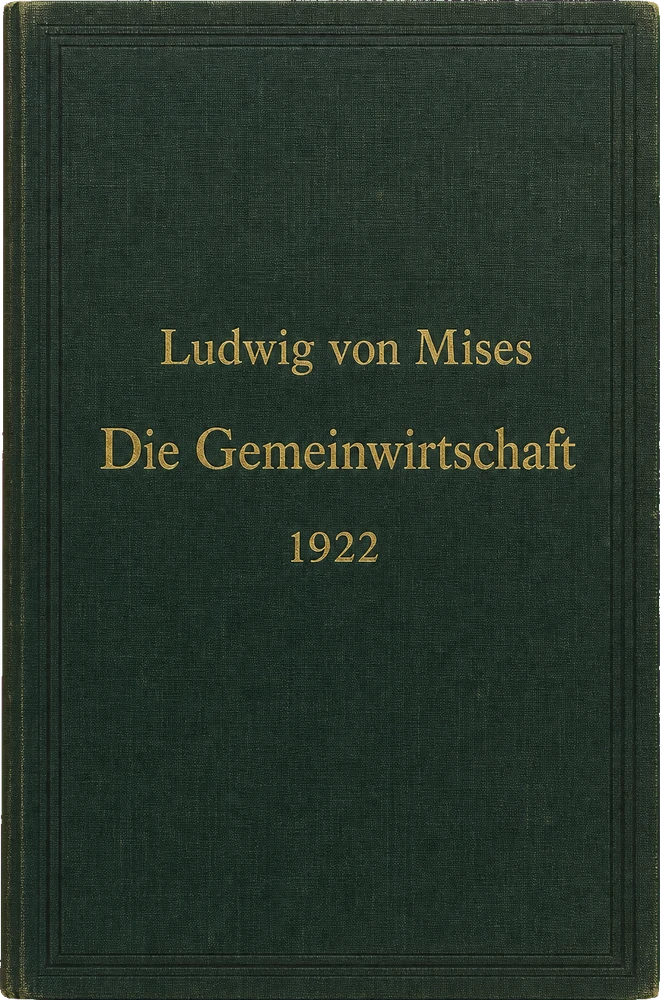
Ludwig von Mises, Die Gemeinwirtschaft (1932)
Mises presents Die Gemeinwirtschaft as a theoretical examination of socialism. Its opening posture is methodological: socialism must be judged not by its moral aspirations or political popularity, but by whether it can sustain rational economic organization.
Mein Buch ist eine wissenschaftliche Untersuchung und keine politische Kampfschrift.
English translation: My book is a scientific investigation and not a political polemic.
The book therefore begins by fixing its object. Socialism, for Mises, is not simply social reform, redistribution, or sympathy for labor. It is the abolition of private ownership in the means of production and their concentration under a collective authority.
Der sozialistische Staat ist Eigentümer aller sachlichen Produktionsmittel und damit der Leiter der gesamten Produktion.
English translation: The socialist state is the owner of all material means of production and thereby the director of the entire production.
From this definition follows the central argument. If capital goods are no longer privately owned and exchanged, there can be no genuine market prices for them. Without such prices, planners lack a common denominator for comparing alternative uses of land, labor, machinery, and materials. Mises does not rest his case on the claim that socialist officials would necessarily be corrupt, ignorant, or malicious. His point is more structural: even capable and sincere administrators would be unable to calculate whether one technically possible plan uses scarce means better than another.
Ohne Wirtschaftsrechnung keine Wirtschaft.
English translation: Without economic calculation, no economy.
“Economic calculation” here means monetary comparison among alternatives: whether steel should become rails or machines, whether a longer production process economizes resources, whether an output justifies the inputs it absorbs. Capitalism supplies these comparisons through money prices formed in exchange under private property. Socialism may still count physical quantities—tons, hours, acres—but such inventories cannot resolve choices among qualitatively different goods and processes. Planning can command and record, but without prices for means of production it cannot know whether it is economizing.
Much of the work develops this thesis against rival forms and defenses of socialism. Mises examines ethical, democratic, evolutionary, and interventionist versions, arguing that they do not overcome the calculation problem. The critique is immanent: granting socialism its aim of organized production for collective ends, he asks what institutional mechanism could select rationally among competing production possibilities once the market in capital goods has disappeared.
His conclusion states the point in compressed form.
Sozialismus ist Aufhebung der Rationalität und der Wirtschaft.
English translation: Socialism is the abolition of rationality and of economy.
This does not mean that socialist ends are unintelligible or that socialists are irrational persons. It means that rational economic action, in a complex division-of-labor society, requires calculable relations among scarce means. The loss of private property in the means of production is therefore also the loss of the price system’s function as a social instrument of comparison.
The lasting significance of Die Gemeinwirtschaft lies in this shift from moral controversy to institutional analysis. Mises makes the socialist calculation problem central to twentieth-century debates over planning, markets, prices, and knowledge. His argument also reaches beyond full socialism: wherever policy suppresses price formation while demanding efficient allocation, he sees the same tension. Command may replace ownership, but it cannot reproduce the calculative role of exchange.
Sections
This work was divided into 73 sections when it entered the library's research corpus—an apparatus for search and citation, not necessarily the author's own table of contents. Each title opens its summary.
1Initial Title Page
2Publisher Advertisement for Surányi-Unger’s Philosophy in Economics
3Main Title Page and Copyright Notice
4Preface to the Second Edition
5Table of Contents
6Introduction §1: The Success of Socialist Ideas
7Introduction §2: Scientific Treatment of Socialism
8Introduction §3: Methods for Studying Socialism
9Property as Sociological Control and the Origins of Legal Property
10The Force Principle, Liberalism, and Imperialism
11Redistribution, Common Ownership, and the Grandeur of the Socialist Idea
12Primitive Communal Property and the Definition of Socialism
13Economic Fundamental Rights and the Socialist Program
14Collectivism, Peace, and Liberal Democracy
15Equality, Social Democracy, and the Dictatorship of the Proletariat
16Communist Utopia, Socialism, Marriage, and the Force Principle in Sexual Relations
17Capitalism, Contract Marriage, Love, and the Women’s Movement
18Free Love, Family Abolition, and Socialist Promiscuity
19Prostitution, Capitalism, and Prejudices about Sexual Morality
20Part II Opening: Economy, Rational Action, and Final Ends
21Rational Action, Scarcity, and Methodological Individualism
22Exchange, Value Judgments, and Money as Calculation Unit
23Limits and Necessity of Monetary Calculation
24Prerequisites of Calculation and the Failure of Natural Calculation in Socialism
25The Socialist Commonwealth and the Impossibility of Rational Planning
26Capitalism as Capital Calculation
27Purely Economic and Extra-Economic Motives
28The Socialist Commonwealth, State, and Socialization of Production
29The Impossibility of Economic Calculation under Socialism
30Economic Calculation as the Fundamental Problem of Socialism
31Capital, Profit, and the Productivity–Profitability Distinction
32Net Yield versus Gross Yield in Socialist and Capitalist Production
33Distribution of Income in the Socialist Commonwealth
34Stationary Socialist Economy and the Disutility of Labor
35Labor Incentives, Enforcement, and Productivity under Socialism
36The Integration of the Individual into the Socialist Labor Community
37The Socialist Commonwealth in Motion
38The Impracticability of Socialism: Calculation and Responsibility
39Socialist Misunderstanding of Entrepreneurship, Speculation, and Bureaucratic Management
40Decentralized Socialist Departments and the Return to Capitalism
41World Socialism and State Socialism
42Migration as a Problem of Socialism
43Foreign Trade Policy of Socialist Commonwealths
44Special Forms of the Socialist Ideal: Definition and Marxist Claims
45State Socialism, Nationalization, and Conservative Etatism
46Military Socialism and Warrior Communism
47Theocratic and Christian Socialism
48Planned Economy, War Socialism, and State Capitalism
49Guild Socialism, Industrial Self-Government, and Syndicalist Drift
50Pseudosocialist Constructs: Solidarism
51Redistribution, Expropriation, and the Limits of Egalitarian Property Reform
52Worker Profit Sharing and Mixed Enterprises
53Syndicalism as Tactic and as Social Ideal
54Failed Compromises Between Private and Common Ownership
55Part III, Section I, Chapter I: Socialist Chiliasm
56Society, Division of Labor, and the Critique of Struggle Theories
57Class Antagonism and Class Struggle
58The Materialist Conception of History
59Capital Concentration and Monopoly: Statement of the Problem
60Concentration of Establishments
61Concentration of Enterprises
62Concentration of Fortunes
63Monopoly and Its Effects
64Socialism as an Ethical Demand: Ethics and Ascetic Life
65Christianity and Socialism
66Ethical Socialism, Neo-Kantianism, and Economic Democracy
67Capitalist Ethics
68Drivers of Destructionism
69The Path of Destructionism and Its Overcoming
70Historical Significance of Modern Socialism
71Appendix: Critique of Socialist Economic Calculation Schemes
72Subject Index
73Gustav Fischer Publisher Catalog
Put a question to this work; the Librarian answers from its 73 sections and cites the passage.
Ask the Librarian