About this work
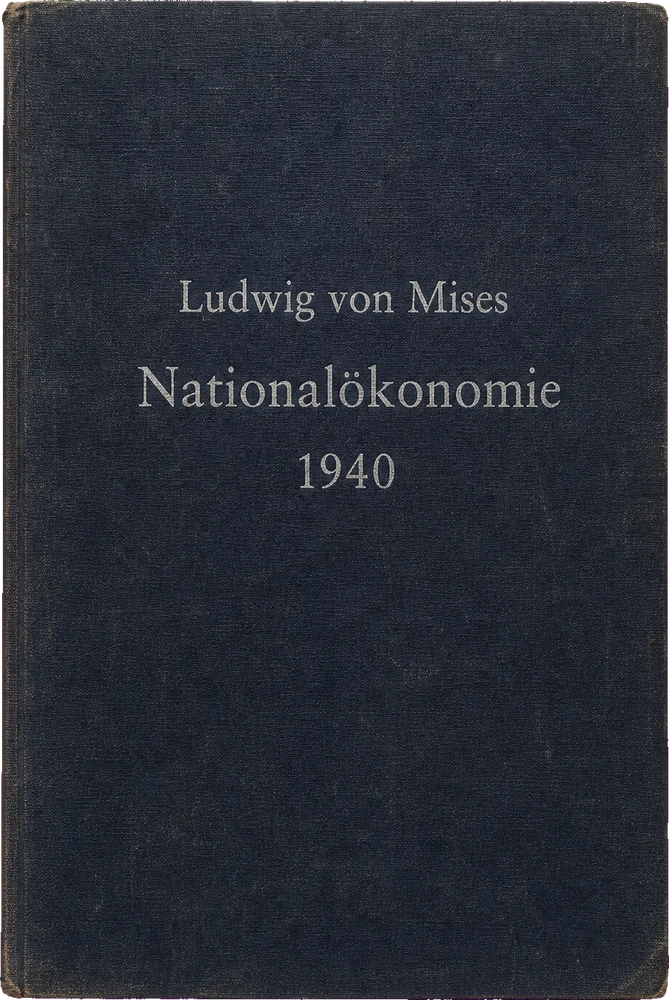
Ludwig von Mises, Nationalökonomie (1940)
Mises’s Nationalökonomie reconstructs economics as a general theory of human action. Against historicism, positivism, and doctrines that make reason class- or nation-bound, it treats economic laws as implications of purposeful choice. Economics does not measure psychic quantities; it analyzes the form of preferring, choosing, and using scarce means for selected ends.
Im Handeln wird nicht gemessen und nicht gewogen, im Handeln wird nicht gleichgehalten, sondern gewählt, d.h. vorgezogen und zurückgestellt.
English translation: In action nothing is measured and nothing is weighed; in action things are not treated as equal, but chosen—that is, preferred and set aside.
This methodological claim grounds Mises’s subjectivism. Value is not an objective property of goods but is imputed by acting persons who rank alternatives. Costs, prices, capital, money, and profit become intelligible only within plans formed under scarcity and uncertainty. Economic science can judge whether means are suitable to ends, but it cannot prescribe ultimate ends themselves. Its discipline is therefore both theoretical and anti-technocratic: it refuses natural-scientific imitation as well as historical relativism.
From action Mises turns to society. Social cooperation is neither an organism above individuals nor a mechanical product of material forces. It emerges because persons grasp the advantages of exchange and the division of labor. Mises thus reverses materialist explanation by giving priority to ideas, expectations, and institutions.
Mithin ist Gesellschaft ein Produkt der Ideologie, und nicht die Ideologie ein Produkt der Gesellschaft.
English translation: Society is therefore a product of ideology, and not ideology a product of society.
The market order is the most developed form of this cooperation. In it, social coordination proceeds through exchange rather than command. Prices are not arbitrary conventions or moral verdicts; they condense the competing valuations of buyers and sellers and transmit information about alternative uses of resources. Entrepreneurs respond to these signals, bear uncertainty, and reallocate capital through profit and loss.
Der Markt lenkt, der Markt bringt in das Getriebe Sinn und Ordnung.
English translation: The market directs; the market brings meaning and order into the machinery.
The sentence expresses not a simple doctrine of automatic harmony but a theory of calculation. Money prices make heterogeneous goods, labor, and capital goods comparable in business accounts. They permit entrepreneurs to estimate whether projects conserve or waste scarce means. Mises therefore rejects the image of a social product first produced and then distributed among classes: wages, rents, interest, and profits arise within one pricing process for complementary factors.
The book’s central institutional thesis is that capitalism is defined by this possibility of monetary calculation. Money is important not merely as a medium of exchange but as the condition of capital accounting across time.
Das charakteristische Merkmal des Kapitalismus ist die Wirtschaftsrechnung.
English translation: The characteristic feature of capitalism is economic calculation.
This is also the basis of Mises’s critique of socialism. A socialist authority may command labor and resources, but without private ownership of the means of production there can be no genuine market for them. Without such markets there are no money prices for capital goods, and without those prices there is no rational comparison among technically possible plans. Planning can inherit or imitate earlier capitalist prices for a while, but it cannot reproduce the process that generates them.
The later sections extend this architecture to time, capital, money, credit, and intervention. Interest is rooted in time preference, not exploitation; capital goods embody past plans and must be maintained through calculation. Credit expansion can falsify interest-rate signals and produce unsustainable investment patterns. Price ceilings, subsidies, debt cancellation, exchange controls, devaluation, and inflation are treated as attempts to override market relations while continuing to depend on the order they deform.
Sie ist ein Hammerschlag, der zertrümmert und nichts kann als zertrümmern.
English translation: It is a hammer-blow that shatters and can do nothing but shatter.
Mises’s critique of interventionism is cumulative: partial controls fail to achieve their stated ends, invite further controls, and push policy either back toward the market or forward toward comprehensive planning. The unity of Nationalökonomie lies in linking epistemology, value theory, exchange, money, capital, socialism, and intervention around one argument: modern civilization depends on the fragile institutional device of market calculation through money prices. When that device is abolished or systematically distorted, production may continue physically, but rational economic orientation is lost.
Sections
This work was divided into 235 sections when it entered the library's research corpus—an apparatus for search and citation, not necessarily the author's own table of contents. Each title opens its summary.
1Front Matter: Dedication, Title Page, and Copyright
2Preface
3Table of Contents
4Introduction: Economics, Praxeology, and the Science of Human Action
5Action and Unconscious Reaction
6Reason in Action, Irrationality, Subjectivism, and Scientific Objectivity
7The Formal and A Priori Character of the Science of Action
8Theory and Experience
9On Causality
10One’s Own and Others’ Action
11On Instinct
12General Conditions of Action
13Starting Point of the Science of Human Action: The Individual
14I and We
15Starting Point of the Science of Human Action: The Single Act
16Influences of Heredity and Environment on Action
17Immutability of the Structure of Action
18The Logical Character of Praxeology
19The Praxeological Problem
20Theory and History: Qualitative and Quantitative Knowledge
21Conceptual Comprehension and Interpretive Understanding
22Praxeological Concept and Humanistic Type
23The Unity of Science
24Praxeological Concept and Reality
25Limits of Praxeological Concept Formation and Opening of Chapter 3
26Ends, Means, Goods, Hedonism, Drives, and Needs
27Preference and the Ranking of Ends and Means
28The Non-Acting Human
29Action as Exchange: Value, Price, Costs, Success, Profit, and Loss
30Time and Action: Temporality, Past, Present, and Future
31Thinking in the Future Perfect and the Economization of Time
32Simultaneity and the Alleged Irrationality of Action
33Action, Quantity, Quality, and Marginal Utility
34The Law of Returns and the Opening Definition of Labor
35Human Labor as a Means: Disutility, Scarcity, and Value
36Indirect and Direct Labor Enjoyment
37The Pioneering Achievement
38Production and the Transition to Acting in Society
39Society as the Union of Human Action
40Critique of Universalist and Collectivist Views of Society
41The Division of Labor
42The Ricardian Law of Association
43Misunderstandings Concerning the Law of Association
44Effects of the Division of Labor
45The Individual in Society
46The Fable of Community
47Society as Exchange Society in the Broadest Sense
48The Fighting and Destruction Instinct
49The Idea in Action: Human Reason
50Worldview and Ideology
51The Marxist Doctrine of Ideologies
52The Racial-Biological Variant of Polylogism
53Idea, Power, Violence, and Rule: Society as Product of Ideology
54Delayed Footnote to the Racial-Biological Section: Ressentiment and Antisemitism
55Idea, Power, Violence, and Rule: Power, Coercion, and Legitimacy
56Traditionalism as Ideology
57The Metaphorical Use of the Term “Rule”
58Praxeological Subjectivism and Pseudohistorical Relativism
59Critique of the Racial-Biological Theory of Society and the State
60Critique of Progress Optimism
61Chapter 3: Exchange in Society
62Chapter 3: Exchange in Society — Internal and Interpersonal Exchange
63Exchange Society and Hegemonic Association
64The Problem of Calculating Action
65Part III: Calculation in Action — Chapter 1: Valuation Without Calculation
66Ranking of Means
67Barter Fiction, Socialism, and the Problem of Economic Calculation
68Economic Calculation and Market Exchange
69Chapter 2: Monetary Calculation—Monetary Entries
70The Scope of Monetary Calculation
71The Changeability of Money Prices
72Stabilization
73Origin of the Stabilization Idea and Coexistence of Several Kinds of Money
74Money Calculation as a Mental Tool of Action and the Opening of Part IV
75Chapter 1: Problem Statement and Method of Catallactics
76Demarcating the Catallactic Problem Field
77The Method of Imaginary Constructions
78The Imaginary Construction of the Pure Market Economy
79Maximization of Profits
80The Imaginary Construction of the Simple Economy
81Simple and Final States of Rest in Market Price Theory
82The Evenly Rotating Economy and the Static Method
83Direct Exchange, Monetary Calculation, and Neutral Money
84Stationary Economy and the Problem of Economic Dynamics
85The Functionally Divided Market Economy
86Entrepreneurial Function in the Stationary Economy
87Steering Action through the Market: The Nature of the Market Economy
88Capital Accounting, Real Capital, Money Capital, and Capitalism
89Entrepreneurs, Consumers, and Entrepreneurial Spending
90Competition
91Entrepreneurial Profit and Loss
92The Market’s Selection Process
93Producers and Consumers
94Advertising
95Entrepreneurs and the National Economy
96Price Formation on the Market
97Valuation, Appraisement, and Market Price Formation
98Prices of Goods of Higher Order and Entrepreneurial Imputation
99A Limit of the Factor-Price Formation Process
100Cost Calculation, Indivisibility, Scale, and Fixed Capital
101Menger-Böhm Approach to Imputation and Mathematical Catallactics
102Monopoly Prices: Competitive Benchmark and Conditions a-f
103Incomplete Monopoly, Duopoly, Oligopoly, and Scarcity
104Monopoly Profit, Monopoly Goods, Cartels, Tariffs, and Overcapacity
105Costs, Ownership, and Entrepreneurial Profit in Monopoly Pricing
106Labor Supply Monopoly and Union Wage Policy
107Mathematical Treatment of the Theory of Monopoly Prices
108Clientele and Goodwill
109Price Formation under Demand Monopoly
110Consumption under the Influence of Monopoly Prices
111Discrimination Prices
112The Interconnection of Prices
113Prices and Income Formation; Opening of the Ordering of Production
114Prices and the Ordering of Production Continued
115Chapter 4: Indirect Exchange
116Exchange Media, Money, and Errors in Monetary Theory
117Cash Balances, Demand for Money, and the Modern Quantity Theory
118Menger’s Origin of Money and the Opening of the Purchasing-Power Problem
119Purchasing Power of Money, Regression, and Uneven Price Effects
120The Hume-Mill Problem and the Driving Force of Money
121Purchasing Power Changes from the Money Side and the Goods Side
122Purchasing Power Changes and Monetary Calculation
123Money in Credit Transactions
124Influence of Expected Purchasing-Power Changes on Purchasing Power
125Specific Money Value and Money Service: Opening Distinctions
126Footnote on Inflation and Deflation Terminology
127Specific Money Value, Credit Money, Token Money, and Cash Balances
128Money Substitutes: Money Certificates and Fiduciary Media
129The Limits of Fiduciary Media Issuance
130Remarks on the Discussion of Free Banking
131The Size of Individual Cash Balances
132The Balance of Payments
133Parities
134Interest Rate Arbitrage and the Discount Policy of Central Banks
135Secondary Media of Exchange
136The Inflationist Interpretation of History
137The Gold Standard
138Chapter 5: Action in the Passage of Time — Different Valuation of Equal Time Periods
139Extending the Period of Provision and the Role of Waiting Time
140Remarks on Böhm-Bawerk’s Doctrine of the Higher Valuation of Present Goods
141Praxeological Proof of the Higher Valuation of Earlier Satisfaction
142Capital Goods and Capital Accounting
143Production Time, Waiting Time, and the Period of Provision
144The Redirectability of Capital Goods
145Capital as the Influence of the Past on Production and Consumption
146Capital Replacement, New Capital Formation, and Capital Consumption
147Money and Capital; Saving and Investing
148The Interest Phenomenon
149Originary Interest
150The Level of Interest
151Originary Interest in a Changing Economy
152Interest Calculation
153Problems of the Theory of Money Interest
154The Risk Component in Gross Interest
155The Price Premium in Gross Interest
156The Loan Market
157Changes in the Money Relation and Originary Interest
158Market Interest under Inflation and Credit Expansion
159Market Interest under Restriction and Deflation
160The Circulation Credit Theory of the Trade Cycle
161The Market Economy in the Business Cycle
162Idle Factors of Production at the Beginning of the Boom
163Critique of Non-Monetary Business Cycle Theories
164Inner Labor and Outer Labor
165Joy and Torment in Work
166Wages as the Price of Labor Services
167Unemployment in an Unhampered Market
168Wage Formation from the Buyer’s Side
169Wage Formation from the Seller’s Side
170Labor Disutility and the Supply of Labor
171The Worker’s Entrepreneurial Risk
172The Labor Market
173The Labor of Animals and Slaves
174Remarks on Rent Theory
175The Indestructibility of Land Powers
176The Abundance of Land
177Land as Location
178Land Prices
179The Myth of the Soil
180The Given and the Datum
181Power as a Datum
182Violence as a Datum
183The Concrete Human Being as a Datum
184Reaction Time: Short-Run and Long-Run Effects
185Private Property Boundaries, External Costs, and External Economies
186Property in Recipes and Methods
187Privileges and Quasi-Privileges
188The Source of Gains on the Market
189Birth Control and Population
190The Harmony of Rightly Understood Interests
191Private Property as a Social Function
192The Conflicts of the Modern World
193Part V Heading: The Trafficless Division-of-Labor Economy
194Origins of the Planned-Economy Idea
195Praxeological Nature of the Socialist Commonwealth
196Attempts to Solve Socialist Economic Calculation
197The Task of Economic Calculation in Socialism
198The Artificial Market
199Mathematical Catallactics and Equilibrium Equations
200Part VI: The Hampered Market Economy—Market and Authority
201A Third Solution
202The Intervention
203Justice as a Standard of Action
204Authority
205Authority and the Choice of Ends
206Tax Policy Interventions: The Neutral Tax
207The Total Tax
208Fiscal and Social-Policy Aims of Taxation
209The Three Varieties of Tax Interventions
210Continuation: Expropriation Options and Their Classification
211Production-Policy Interventions
212Price Policy Interventions I: Power or Economic Law
213Price Policy Interventions II: Market Reaction to Price Controls
214Excursus: Economic Causes of the Decline of Ancient Civilization
215Monetary and Banking Interventions I: Interventionist Monetary Policy
216Monetary and Banking Interventions II: Shifting the Burden of Debts
217Monetary and Banking Interventions III: Devaluation
218Monetary and Banking Interventions IV: Credit Expansion
219Monetary and Banking Interventions V: Foreign Exchange Control and Clearing Agreements
220Confiscation and Redistribution I: Equalizing Justice in Agriculture
221Confiscation and Redistribution II: Confiscation Through Taxation
222Confiscation and Redistribution III: Restricting Non-Labor Income
223Corporative State and Syndicalism I: The New Estate Idea
224Corporative State and Syndicalism II: Political Constitution of the Corporative State
225Corporative State and Syndicalism III: Economic Constitution of Corporatism
226War Economy II: Army War and Total War
227War Economy III: Total Mobilization
228War Economy IV: Wartime Autarky
229War Economy V: The Problem of the Last War
230Conclusion I: Science and Life
231Conclusion II: Science and Politics
232Corporative State and Syndicalism IV: Syndicalism
233The Crisis of Interventionism
234Conclusion III: Science and the Future
235Subject Index
Put a question to this work; the Librarian answers from its 235 sections and cites the passage.
Ask the Librarian