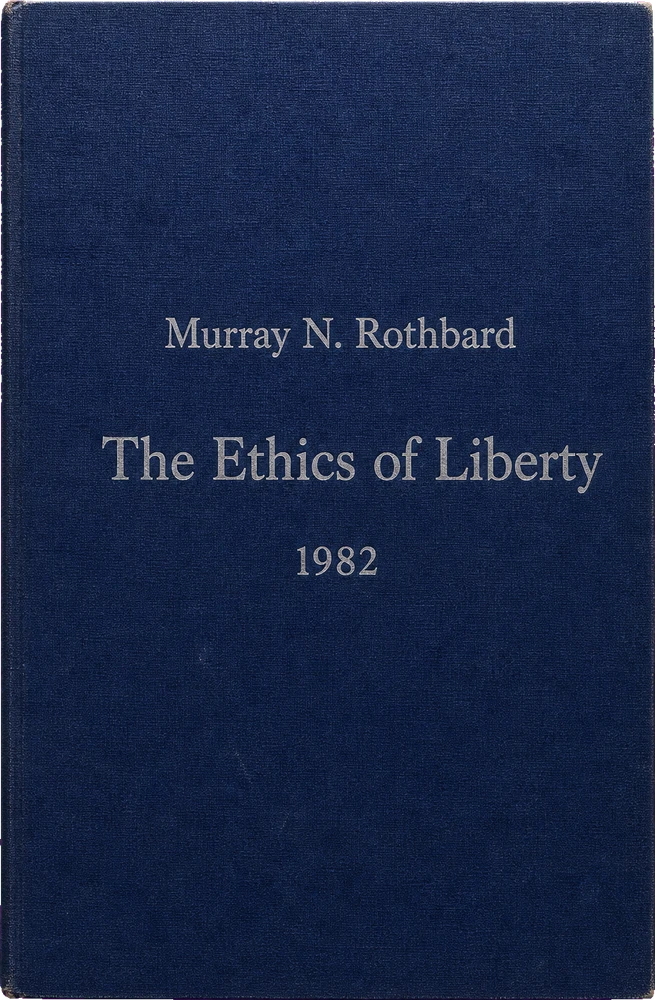
About this work
Murray N. Rothbard, The Ethics of Liberty — Summary
The Ethics of Liberty is a single-author philosophical treatise. Its scope is systematic: Rothbard tries to supply the moral foundation for libertarian political order, moving from natural-law method to self-ownership, property, contract, punishment, taxation, the state, and war. Its central thesis is that liberty is not merely efficient or prudential but ethically required by the nature of human beings as choosing, acting agents.
Rothbard begins by rejecting the idea that political theory can be value-neutral. Any account of law, rights, coercion, or the state already presupposes judgments about what people may do to one another. Hence libertarianism requires an explicit ethics rather than a merely economic defense.
Political judgments are necessarily value judgments, political philosophy is therefore necessarily ethical, and hence a positive ethical system must be set forth to establish the case for individual liberty.
The book’s first major conceptual move is to revive natural law as a rational, critical standard. For Rothbard, natural law is not custom, theology, or conservative respect for existing institutions; it is a standard by which institutions are judged. This is why his natural-law argument is radical rather than traditionalist: it licenses condemnation of any legal or political order that violates human nature and individual rights.
The natural law is, in essence, a profoundly “radical” ethic, for it holds the existing status quo, which might grossly violate natural law, up to the unsparing and unyielding light of reason.
From this premise Rothbard develops his account of rights through self-ownership. Each person has moral jurisdiction over his or her own body, and external property arises when persons mix labor with unowned resources, transforming them into usable goods. Property is therefore not a grant from the state but an extension of human action into the world.
In the free society we have been describing, then, all ownership reduces ultimately back to each man's naturally given ownership over himself, and of the land resources that man transforms and brings into production.
This grounding gives the work its distinctive structure. Rothbard’s libertarianism is not first a theory of limited government but a theory of just ownership and unjust aggression. Law should protect property titles and bodily integrity, not impose virtue, redistribute wealth, or enforce moral duties that have not involved invasion of rights. His discussion of contract illustrates this precision. A contract is enforceable only when it transfers title to alienable property; a mere promise may be morally binding, but it is not automatically a matter for coercive law.
Our contention here is that mere promises are not a transfer of property title; that while it may well be the moral thing to keep one's promises, that it is not and cannot be the function of law (i.e., legal violence) in a libertarian system to enforce morality (in this case the keeping of promises).
The same logic underlies Rothbard’s attack on the state. If private persons may not seize property by force, public officials acquire no special moral privilege by acting under law. Taxation is therefore not treated as a regrettable civic necessity but as institutionalized aggression against rightful owners.
Taxation is theft, purely and simply, even though it is theft on a grand and colossal scale which no acknowledged criminals could hope to match.
The book’s later political implications follow from this anti-statist premise. Rothbard distinguishes legitimate defense from institutionalized war-making and argues that state war necessarily mobilizes coercion, taxation, conscription, and mass violence against innocents. The principle of liberty therefore condemns the normal practices of states even where it may allow private resistance or revolution under specific conditions.
We must therefore conclude that, while some revolutions and some private conflicts may be legitimate, State wars are always to be condemned.
The relevance of The Ethics of Liberty lies in its uncompromising attempt to make libertarianism a complete moral philosophy. Rothbard does not merely argue that markets work better than planning; he argues that ownership, exchange, and nonaggression define justice itself. Its core conceptual moves are the ethical necessity of political philosophy, the rational radicalism of natural law, the reduction of rights to self-ownership and homesteading, the title-transfer theory of contract, and the identification of the state with systematic rights-violation. The result is one of the major texts of modern anarcho-capitalist theory: a work that treats liberty not as one social value among others, but as the political expression of human nature and moral right.
Sections
This work was divided into 41 sections when it entered the library's research corpus—an apparatus for search and citation, not necessarily the author's own table of contents. Each title opens its summary.
1Publication Information, Contents, Dedication, and Natural-Rights Epigraph
2Hoppe's Introduction: Property as the Foundation of Economics and Ethics
3Self-Ownership, Original Appropriation, and the Case Against the State
4Academic Reception, Nozick, Libertarian Activism, and Praxeological Ethics
5Introduction: Rothbard’s Later Work, Cultural Conservatism, and Libertarian Legacy
6Acknowledgments: Intellectual Formation and Support for the Book
7Preface: Why Liberty Requires a Positive Ethical Theory
8Preface: Structure of the Theory of Liberty
9Natural Law and Reason
10Natural Law as Science
11Natural Law versus Positive Law
12Natural Law and Natural Rights
13The Task of Political Philosophy
14A Crusoe Social Philosophy
15Interpersonal Relations: Voluntary Exchange
16Interpersonal Relations: Ownership and Aggression
17Property and Criminality
18The Problem of Land Theft
19Land Monopoly, Past and Present
20Self-Defense
21Punishment and Proportionality
22Punishment and Proportionality: Retribution versus Deterrence and Rehabilitation
23Children and Rights
24Human Rights as Property Rights
25Knowledge, True and False
26Bribery, Payola, and Contractual Responsibility
27The Boycott
28Property Rights and the Title-Transfer Theory of Contracts
29Lifeboat Situations: Absolute Rights and Emergency Necessity
30The Rights of Animals and the Species Basis of Natural Rights
31Part III: The State Versus Liberty — The Nature of the State
32The Inner Contradictions of the State
33The Moral Status of Relations to the State
34On Relations Between States
35Alternative Theories of Liberty: Utilitarian Free-Market Economics
36Isaiah Berlin on Negative Freedom
37F. A. Hayek and the Concept of Coercion
38Editorial Cross-Reference to the Standalone Nozick Critique
39Part V: Toward a Theory of Strategy for Liberty
40Bibliography
41Index of Subjects, Authors, and Works
Put a question to this work; the Librarian answers from its 41 sections and cites the passage.
Ask the Librarian