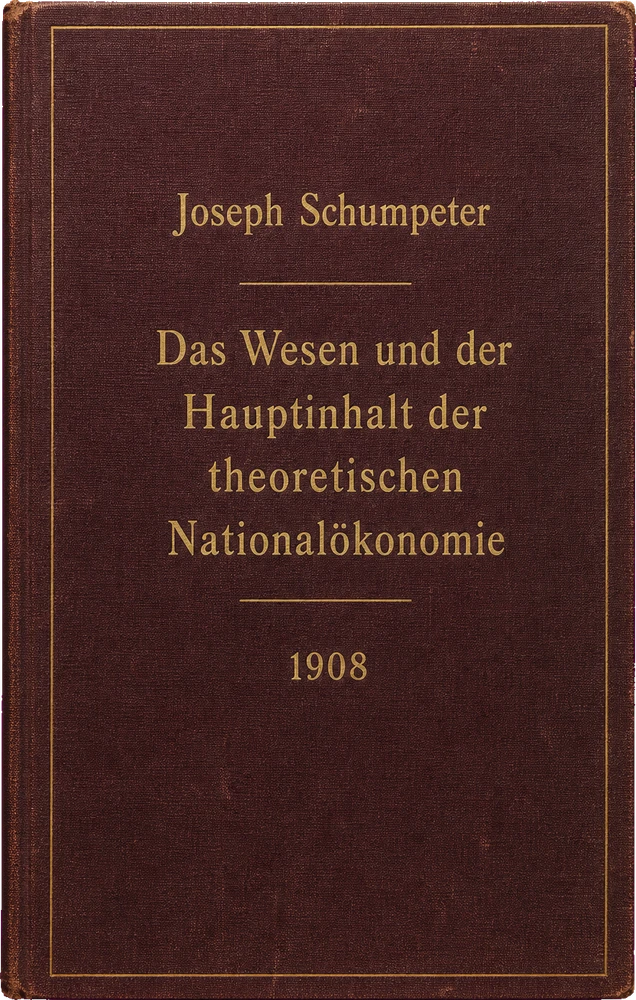
Joseph Alois Schumpeter · 1908
Das Wesen und der Hauptinhalt der theoretischen Nationalökonomie
About this work
Schumpeter’s Das Wesen und der Hauptinhalt der theoretischen Nationalökonomie is a methodological founding text for “pure” economics. Its main thesis is that theoretical economics becomes exact not by resolving philosophical disputes about society, history, or motives, but by isolating a specific object: the relations among economic quantities. Against both older classical systems and the debates of the Methodenstreit, Schumpeter recasts theory as a disciplined analysis of functional dependence. It does not explain economic life in its total social fullness; it constructs an exact domain in which prices, quantities, incomes, and related magnitudes are mutually determined. This “exakte Ökonomie” names both the ambition and the restriction of the work.
“Exact” economics is not a universal social philosophy, nor a political doctrine, nor a psychology of desire. Schumpeter’s key move is subtractive: he removes ethics, policy, metaphysics, and thick accounts of motivation from the core of theory wherever they are not logically required. Economic “laws” are therefore not moral commands or natural necessities, but compressed descriptions of relations among variables. Explanation means showing how one quantity depends on others within a system.
The book’s structure follows from this methodological decision. It first clears the ground: theoretical economics must not be judged by standards appropriate to history or practical policy, because its task is narrower. It then turns to the static system, where the central analytical problem is equilibrium. Schumpeter treats the economy not as a chain of one-way causes but as a network of simultaneous mutual determination. Prices and quantities are intelligible only within a system in which each element presupposes the others. This is the work’s most important formal commitment: causal narration gives way to interdependence.
The static analysis also defines the limits of pure equilibrium theory. In a stationary economy, conduct is routinized, productive combinations are given, and the system reproduces itself without endogenous transformation. Such a model can clarify the logic of valuation, exchange, and allocation, but it cannot explain phenomena that arise only when the system is disturbed from within. Schumpeter’s later theory of development is already foreshadowed here: the exact static apparatus is necessary, but not sufficient.
This becomes clearest in the treatment of interest. Schumpeter rejects attempts to derive interest from ordinary goods loans or from the physical productivity of capital within a static system. Interest is not a timeless reward automatically generated by production. It belongs to a different analytical field: the economy in development, where new combinations require purchasing power before their results exist.
Die Neuschaffung von Kredit ist das Essentielle.
English translation: The creation of new credit is the essential thing.
The sentence is decisive because it shifts the theory of interest from commodity exchange to credit creation. Credit is not merely a veil over “real” transactions; it is the mechanism through which the static circular flow is broken and new enterprise becomes possible. The money and credit market therefore cannot be treated as an accidental appendage to pure theory. It marks the point where static equilibrium gives way to dynamics.
In der Entwicklung und im Kredite also liegt die Quelle des Zinsphänomens, dort ist seine Erklärung zu suchen.
English translation: In development and in credit, then, lies the source of the phenomenon of interest; there its explanation is to be sought.
These passages show Schumpeter’s conceptual architecture in miniature. Static theory explains the mutual adjustment of quantities under given conditions; dynamic theory explains the emergence of new conditions. Interest appears at the boundary between the two. It is not explained by the mere existence of capital goods, but by the financing of development through newly created purchasing power. The source of interest is therefore tied to entrepreneurial transformation, even where the later terminology of innovation is not yet fully developed.
The relevance of the work lies in this double gesture. On one side, Schumpeter gives German-language economics a rigorous account of pure theory close to general equilibrium analysis: economics becomes a science of systems, not of isolated causal anecdotes. On the other side, he refuses to let equilibrium analysis exhaust economic reality. The very precision of statics reveals what it cannot explain—development, credit, and the distinctive phenomena of capitalist change.
Thus the book is neither a mere methodological treatise nor a complete dynamic economics. It is a reconstruction of the foundations of theory and a demarcation of its frontier. Schumpeter’s core conceptual move is to make abstraction productive: by narrowing economics to relations among quantities, he clarifies the exact content of equilibrium; by identifying what equilibrium excludes, he opens the path toward a theory of capitalist development.
Sections
This work was divided into 120 sections when it entered the library's research corpus—an apparatus for search and citation, not necessarily the author's own table of contents. Each title opens its summary.
1Google Books Public Domain Notice and Usage Guidelines
2German Google Books Public Domain Notice and Usage Guidelines
3Scanned Library Provenance and OCR Artifacts Before Title Page
4Title, Publication, Copyright, and Dedication Pages
5Preface: Method, Exact Economics, Statics, Dynamics, and Theoretical Neutrality
6Table of Contents
7Reader’s Note and Opening of Part I: Foundations
8Introduction: Disciplinary Disputes and Method
9Survey of Contemporary Schools in Economics
10Foundational Problems and Methodological Reduction
11Economic Quantities, Interdependence, and Equilibrium
12Critique of Definitions of Economics
13Determinate Systems, Normal Values, and Policy Neutrality
14Explanation as Description and Theory versus History
15Economic Laws, Hypotheses, and Functional Relations
16The Exchange Relation as the Formal Core of Pure Economics
17Chapter IV §1: Exchange Relations and the Limits of Cost and Labor Principles
18Chapter IV §2: The Value Principle Without Psychological Foundations
19Chapter IV §3: The Value Function as a Formal Demand-Price Relation
20Chapter V §1 Duplicate Fragment: Exact Method and Economic Motives
21Chapter V §1: Exact Economics, Motives, Ethics, and Social Philosophy
22Chapter V §2: Egoism, Homo Economicus, and Alternative Scientific Constructions
23Methodological Individualism: Opening, Anti-Atomism, and Political Stakes
24Methodological Individualism as a Method of Pure Theory
25Social Categories, Social Value, and the Utility-Value Distinction
26Chapter VII: The Concept of Value
27Part Two Opening: Static Equilibrium as the Central Problem
28Goods Possession, Environment, Society, and Methodological Bracketing
29Empirical and Exact Equilibrium in Repeated Economic Periods
30Formal Derivation of the Marginal Utility Level
31Interdependence in Isolated and Exchange Economies
32Methodological Summary: Deriving Goods Quantities from Prior Goods Quantities
33Chapter II, §1: Critique of the Usual Starting Point in Economic Theory
34§2: System-Determining Facts and the Exclusion of Hybrid Disciplines
35§3: Capital Concepts, Interest Theory, and J. B. Clark's Capital Fund
36Chapter III: Static Assumptions and the Isolating Method
37Limits of Pure Economics: Data, Capital Formation, and Dynamic Problems
38Statics and Dynamics as Distinct Domains of Economic Theory
39The Boundary of Statics and Dynamics and the Problem of Development
40Preliminary Objections to Price Theory
41Free Competition as a Methodological Assumption
42The Maximum Theorem and Static Equilibrium
43The Imputation Problem: Equilibrium Equations and Costs
44Costs, Supply Curves, Disutility, and Diminishing Returns
45Production as Exchange and the Emergence of Wieser’s Imputation Problem
46Solving the Imputation Problem
47General Price Theory as a System of Equations
48Monopoly Price and the Exact Conditions of Free Competition
49Indirect Exchange and the Opening of Money Theory
50Critique of Existing Money Theory
51Foundations of Money Theory: Exchange Medium, Value Measure, Paper Money, and Quantity Theory
52The Theory of Saving
53Note on the Theory of Capital Formation
54Distribution Theory: General Incomes and Normative Neutrality
55Scope of Static Income Theory and Contemporary Distribution Doctrines
56Formal Equivalence of Static Income Branches
57Wage Theory: Basic Derivation and the Temptation of a General Social Theory
58Wage Theory: Doctrinal Extensions, Entrepreneurial Profit, and Social Critique
59Wage Theory: Verification, Abstraction, and the Limits of Exact Theory
60Wage Theory §2: Verification of Labor Price and the Problem of a Unitary Wage Rate
61Wage Theory §2: Social Class, National Barriers, and Labor Market Segmentation
62Wage Theory §2: Labor Islands, Abstract Utility Machines, and Imperfect Competition
63Wage Theory §3: Reproduction Costs, Subsistence Wages, and the Iron Law
64Wage Theory §3: Standard of Life, Wages from Capital, and the Wage Fund
65Wage Theory §4: The Proper Scope of the Wage Phenomenon
66Ground Rent Theory §1: Land Services and the General Price System
67Ground Rent Theory §2: Land Value, Land Services, and Verification
68Ground Rent Theory §3: Replacing Ricardian Differential Rent with Imputation Theory
69Chapter IV, Section 1: The Problem of Interest as a Third Static Income Branch
70Capital Replacement and the Limits of Static Analysis
71Loan Interest, Industrial Interest, and Misleading Terminology
72Critique of Productivity, Clark, Jevons, and Abstinence Theories of Interest
73Böhm-Bawerk’s Agio Theory and the Need to Move Beyond Statics
74Prolegomena to a Dynamic Theory of Interest: Negative Results and Apparent Capital Income
75Interest Theory II: Productive Loans, Credit Creation, and the Money Market
76Interest Theory III: Development, Credit, and the Transformation of Capital
77Interest Theory IV–V: New Credit, Money Capital, and Relations to Other Theories
78Entrepreneurial Profit §1: Critique of Rent and Ability Theories
79Entrepreneurial Profit §2: Risk, Friction, Development, and Relation to Interest
80Part Four Title Page: The Variation Method
81General Part §1: The Variation Problem and the Scope of Pure Economics
82§2: Definition of the Variation Method and the Need for Quantitative Analysis
83§3: Static Preconditions, Value Functions, and Infinitesimal Variations
84§4: Extending the Method, Long Periods, and the Static-Dynamic Distinction
85§5: Simplifications, Constant Money Value, and Applying Disturbances to the Schema
86Opening of Chapter II: Limits of Theory in Tax Incidence
87A Simple Isolated Tax Case and the Theory of Tax Production
88Elasticity and the Two-Good Tax Model
89Tax Incidence with Independent Goods and Boundary Cases
90Further Simplifications in the Variation Method
91Transition from General Method to Concrete Disturbances
92Value and Limits of Mathematical-Abstractive Economics
93Adjusting Concrete Disturbances to the Variation Schema
94Chapter II Examples: Commodity Taxation and the Two-Good Interdependence Setup
95Tax Incidence as a System of Differential Variations
96Applications and Limits of the Exact Theory of Taxation
97Tariff Theory: Static Analysis, Free Trade, and Protection
98Income Shifts, Transport Costs, Market Practice, and Technical Progress
99Fifth Part: Summary of the Nature and Value of Theoretical Economics
100Introduction: Nature, Value, and Future of Exact Economics
101Pure Static Economics as an Exact but Empirically Conditioned Schema
102Analogies with Mechanics and Biology; Relation to Sociology
103Psychology, Motives, Popular Psychological Explanations, and Ethics
104Ethnology, Primitive Economies, and the Limits of Anthropological Evidence for Static Theory
105Chapter II, Section 1: Framing the Value of Pure Economics
106Exact Sciences, Empty Formalism, and the Intermediate Worth of Economics
107Defending the Cognitive Value of Economic Equilibrium Theory
108Applications, Empirical Breadth, and the Banal Everyday Basis of Static Economics
109Economic Development, the Equilibrium Man, and Verification in Routine Life
110Marginal Utility, Constant Budgets, and the Final Assessment of Theoretical Value
111Chapter II, Section 2: The Limited Practical Use of Pure Economics
112Industrial Policy, World-Market Struggle, and the Narrow Practical Domain of Theory
113Chapter III, Section 1: Restating the Boundaries of Pure Economic Knowledge
114Defects of the Existing Economic Doctrine
115Inherent Defects of the Static Economic System
116Chapter IV §1: General Reform Program for Theoretical Economics
117Chapter IV §2: Specific Reform Desiderata—Social Categories, Effort, Development, and Time
118Chapter V, §1: Development Possibilities of Theoretical Economics
119Chapter V, §2: Dynamic Problems and the Future of Pure Economics
120Library End Matter and Digitization Artifacts
Put a question to this work; the Librarian answers from its 120 sections and cites the passage.
Ask the Librarian