About this work
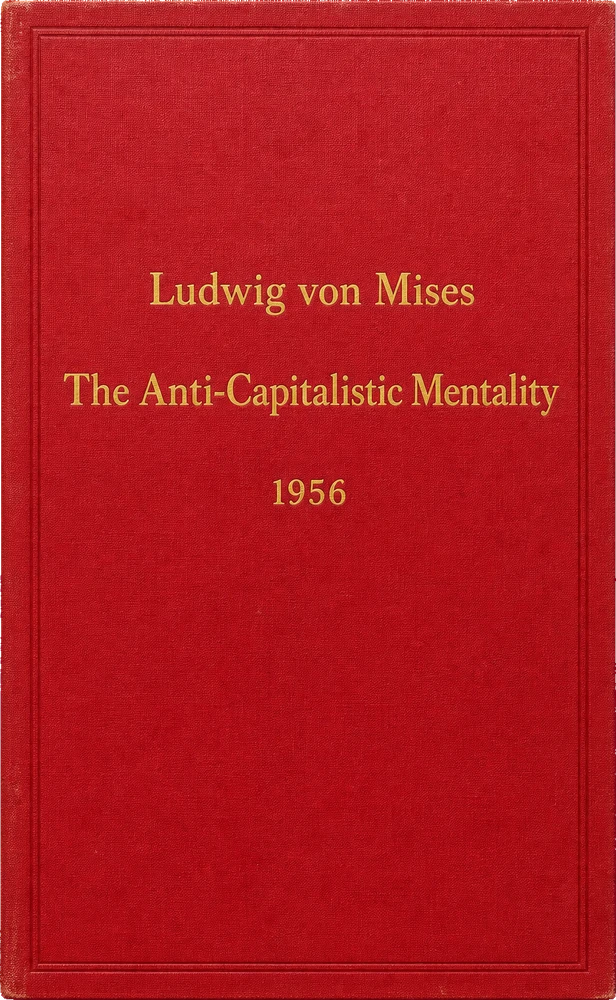
Ludwig von Mises, The Anticapitalistic Mentality
Mises’s essay explains a paradox: capitalism, which he credits with unprecedented mass prosperity, is hated by many of those it benefits. Its thesis is that anticapitalism rests less on economic evidence than on bad theory and wounded ambition. Capitalism is not rule by grandees but mass production under consumer sovereignty: owners keep command of resources only by satisfying buyers.
Big business always serves—directly or indirectly—the masses.
The first chapter contrasts capitalism with status society. In caste orders, failure can be blamed on birth; under equality before the law, failure appears as one’s own. Capitalism opens careers, but it also exposes unequal ability, effort, and judgment. Mises reads the resentment of intellectuals, clerks, rich “cousins,” and entertainers in this light: each is near enough to success to measure himself against its winners, yet tempted to turn disappointment into moral accusation. Anticapitalist doctrine becomes a refuge from the fact that consumers preferred someone else.
Chapter II turns this psychology into an economic argument. The “ordinary man,” Mises says, treats prosperity as an automatic gift of technology or “progress,” not as the result of saving, capital accumulation, entrepreneurship, and private property. Against Marxian and unionist accounts of labor productivity, he insists that rising real wages depend on more capital per worker.
There is but one means available to improve the material conditions of mankind: to accelerate the growth of capital accumulated as against the growth in population.
This is the book’s Austrian core. The market coordinates savers, entrepreneurs, and technologists in the service of consumers; interventionism and socialism threaten the capital base that makes mass consumption possible. Thus the “anticapitalistic front” is sustained by envy, economic ignorance, and the illusion that planning can replace prices without destroying calculation.
The chapters on literature extend the analysis into culture. Capitalism created a mass market for books, newspapers, theatre, and film, freeing authors from courts and patrons; but it could not make the public discerning. The market rewards what enough readers recognize, not necessarily what genius produces. Detective stories, exposés, and “social” novels become, for Mises, cultural forms of resentment when they portray success as hidden criminality and poverty as capitalism’s necessary product.
Literature is not conformism, but dissent.
His cultural argument becomes a political defense of publication rights. A socialist state may subsidize culture, but if it controls presses, paper, jobs, and permissions, it controls dissent. Private property is therefore an institutional condition of expression.
A free press can exist only where there is private control of the means of production.
Chapter IV answers the noneconomic objections. Capitalism does not promise perfect happiness; it lets people remove felt uneasiness. It is not refuted by remaining poverty, because innovations spread from pioneers to the many. Nor is “materialism” persuasive for Mises, who points to modern music, literature, science, and architecture. The charge of injustice receives his sharpest reply: there is no natural fund waiting to be fairly distributed; wealth must be produced and renewed through saving and calculation.
Nature is not bountiful but stingy.
His account of liberty follows. Western civilization, he argues, rests on institutions that restrain arbitrary power, but constitutions protect rather than create the freedom generated by the market. Under capitalism one may choose a vocation, challenge incumbents, seek capital, and appeal to consumers instead of rulers. Socialism, by transferring control of production to the state, destroys economic calculation and practical freedom.
The final chapter addresses the Cold War setting. Mises criticizes “anticommunists” who reject Soviet violence while endorsing planning, welfare statism, or socialism under milder names. Since these all require public control over production, he treats them as variants of the same collectivist error. A merely negative politics cannot defeat communism; it must defend laissez-faire capitalism without embarrassment.
People must fight for something that they want to achieve, not simply reject an evil, however bad it may be.
The work presents an Austrian critique of anticapitalist culture: consumer sovereignty, capital accumulation, and private property are treated as conditions of prosperity and freedom. Mises explains anticapitalism largely through envy, ignorance, status anxiety, and literary hostility to bourgeois life. The struggle over capitalism is, for him, psychological and literary as much as economic: a conflict over status, resentment, and the moral imagination of modern society.
Sections
This work was divided into 26 sections when it entered the library's research corpus—an apparatus for search and citation, not necessarily the author's own table of contents. Each title opens its summary.
1Front Matter and Table of Contents
2Introduction
3Chapter I.1 – The Sovereign Consumer
4Chapter I.2 – The Urge for Economic Betterment
5Chapter I.3 – Status Society and Capitalism
6Chapter I.4 – The Resentment of Frustrated Ambition
7Chapter I.5 – The Resentment of the Intellectuals
8Chapter I.6 – The Anticapitalistic Bias of American Intellectuals
9Chapter I.7 – The Resentment of the White-Collar Workers
10Chapter I.8 – The Resentment of the “Cousins”
11Chapter I.9 – The Communism of Broadway and Hollywood
12Chapter II.1 – Capitalism as It Is and as It Is Seen by the Common Man
13Chapter II.2 – The Anticapitalistic Front
14Chapter III.1 – The Market for Literary Products
15Chapter III.2 – Success on the Book Market
16Chapter III.3 – Remarks about the Detective Stories
17Freedom of the Press
18The Bigotry of the Literati
19The “Social” Novels and Plays
20The Noneconomic Objections to Capitalism: The Argument of Happiness
21Materialism
22Injustice
23The “Bourgeois Prejudice” of Liberty
24Liberty and Western Civilization
25“Anticommunism” versus Capitalism
26Index
Put a question to this work; the Librarian answers from its 26 sections and cites the passage.
Ask the Librarian