About this work
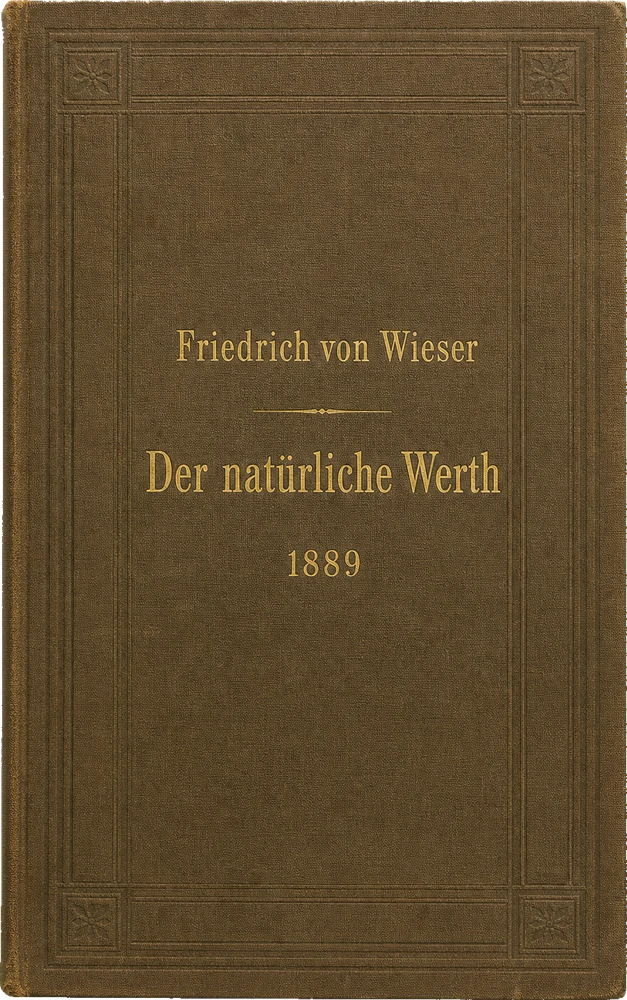
Friedrich von Wieser, Der natürliche Werth (1889)
Wieser’s Der natürliche Werth is a single-author theoretical monograph in political economy. Its scope is systematic: it seeks to reconstruct value theory from the standpoint of utility, scarcity, and rational economic calculation, then to extend that account from consumption goods to production goods, costs, capital, and social valuation. Its central thesis is that “natural value” is not an accidental market price but the value goods would possess insofar as their importance is measured by their contribution to want-satisfaction under economically ordered conditions.
Wieser begins from the idea that value cannot be detached from human purposes. Goods matter because they stand in relation to needs, plans, and future satisfactions; economic theory therefore cannot treat utility as a merely external ornament added after production.
Die Idee des Nutzens kann unmöglich von den Absichten der Wirthschaft und vom Begriffe des Werthes getrennt werden.
English translation: The idea of utility cannot possibly be separated from the aims of economic life and from the concept of value.
This is the conceptual move that places Wieser within the Austrian marginalist tradition: value is not inherent in things as physical objects, nor reducible to labor expended on them, but arises from the dependence of satisfactions upon scarce means. Yet Wieser’s argument is not confined to final consumption. He insists that unfinished, instrumental, or productive objects are also genuine goods, because their value is transmitted from the satisfactions they help to secure.
Der Same, der Baum und der Boden, das Garn, die Kohle und die Maschine sind zwar nicht reife, nicht fertige Güter, sowie die Frucht und das Kleid, aber sie sind ebensowohl Güter.
English translation: The seed, the tree and the soil, the yarn, the coal and the machine, are indeed not ripe, not finished goods, as are the fruit and the garment, but they are just as much goods.
The theory of imputation follows from this. If production goods are goods because they condition future satisfactions, their value must be assigned by tracing their contribution to those satisfactions. Wieser’s “natural value” therefore supplies a rule for economic calculation: it explains how the worth of land, labor, capital goods, raw materials, and intermediate products can be derived from the marginal importance of the final uses they make possible.
A major polemical target is any doctrine that turns one element of production—especially labor—into an independent and exclusive source of value. Wieser treats such simplifications as historically powerful but theoretically misleading. His memorable warning is directed at the degeneration of a large explanatory idea into dogma:
Ein grossartiger Gedanke kann schliesslich zu einem kindischen Irrthum werden.
English translation: A grand idea can in the end turn into a childish error.
The relevance of the work lies here: it offers one of the classic Austrian alternatives to labor-value and cost-of-production theories. Costs are not ultimate causes of value; they themselves must be explained through the value of the satisfactions foregone or enabled. Economic valuation is thus forward-looking and relational. A machine, a field, or a stock of coal has value because losing it would mean losing determinate possibilities of want-satisfaction.
Wieser also gives valuation a social dimension. Natural value is not simply private whim, nor merely observed market exchange. It is the rational measure that would guide an economy if goods were assigned according to their real economic significance. This makes the book both abstract and normative: it analyzes actual valuation while also asking what valuation would look like when freed from disturbing effects of distribution, monopoly, ignorance, and unequal purchasing power. His recurring question is whether economic life could ever dispense with such valuation at all.
Und endlich ist ja noch zu fragen, ob man je werde aufhören können, die Güter so zu schätzen?
English translation: And finally, it must still be asked whether one will ever be able to cease valuing goods in this way.
The answer implied throughout the book is no. Any organized economy must compare goods, rank uses, and preserve knowledge of relative importance. Valuation is not a superficial market habit but a condition of rational administration. This is why Wieser treats inherited practical knowledge of values as itself a social asset.
Die Kenntniss der Werthgrösse der Güter, wie man sie in jeder Wirthschaft von früher her hat, ist daher selbst eines der werthvollsten Besitzthümer.
English translation: The knowledge of the magnitude of value of goods, such as one carries over in every economy from earlier experience, is itself therefore one of the most valuable of possessions.
Structurally, the treatise moves from elementary concepts—goods, utility, value, marginal significance—to the more complex problem of production and distribution. Its central conceptual moves are the extension of utility theory to productive goods, the imputation of value from ends to means, and the distinction between natural value and historically distorted exchange valuations. In doing so, Wieser helped give marginal utility theory a broader architecture: not only a theory of consumer choice, but a theory of social economic calculation.
Sections
This work was divided into 41 sections when it entered the library's research corpus—an apparatus for search and citation, not necessarily the author's own table of contents. Each title opens its summary.
1Google Digitization Notice and Title Pages
2Preface: Critique of Classical Value Theory and Statement of Marginal Utility Program
3Table of Contents
4The Individual Cost Elements
5Elementary Theory of Value: Origin of Value
6Need Satisfaction, Gossen's Law, and Saturation Scales
7Marginal Utility and Future Need Satisfaction
8Goods Value and the General Marginal Utility Law
9Socialist Imputation Critique and Wieser's Productive Contribution
10Contribution, Cooperation, and the Marginal Law of Imputation
11Value Paradox, Value Antinomy, and Economic Calculation
12Natural Ground Rent and Natural Capital Yield
13Natural Value of Land, Capital, and Labour: Introduction and Start of Capital Interest
14Subjective and Objective Exchange Value
15Traffic Value, Natural Value, and Socialist Value Theory
16Capital Value and Interest: Discounting
17The Rate of Interest
18The Law of Uniform Calculation of the Interest Rate
19Changes in the Rate of Interest
20Valuation of Fixed Capital
21Capitalization
22Natural Cost Value of Products: The Cost Law
23The Concept of Costs
24Derivation of the Cost Law
25Interest in Consumption Loans and Rentals
26Conditions for the Validity of the Cost Law
27The Decisive Cost Measure
28Cost Law and General Law of Value
29The So-Called Production Costs of Labor
30Cost Elements: Preliminary Remarks and Labor
31Capital as a Cost Element
32Capital Interest as a Cost
33Ground Rent and Costs
34The Service of Private-Economic Value in the National Economy
35Part II Introduction: Value in the State Economy
36The Tasks of the State Economy
37Value in the Natural State Economy
38Value in the Empirical State Economy
39The Basic Law of Collective Valuation
40Correction on Productive Imputation and Complementarity
41Printer Colophon and Library Circulation Marks
Put a question to this work; the Librarian answers from its 41 sections and cites the passage.
Ask the Librarian