About this work
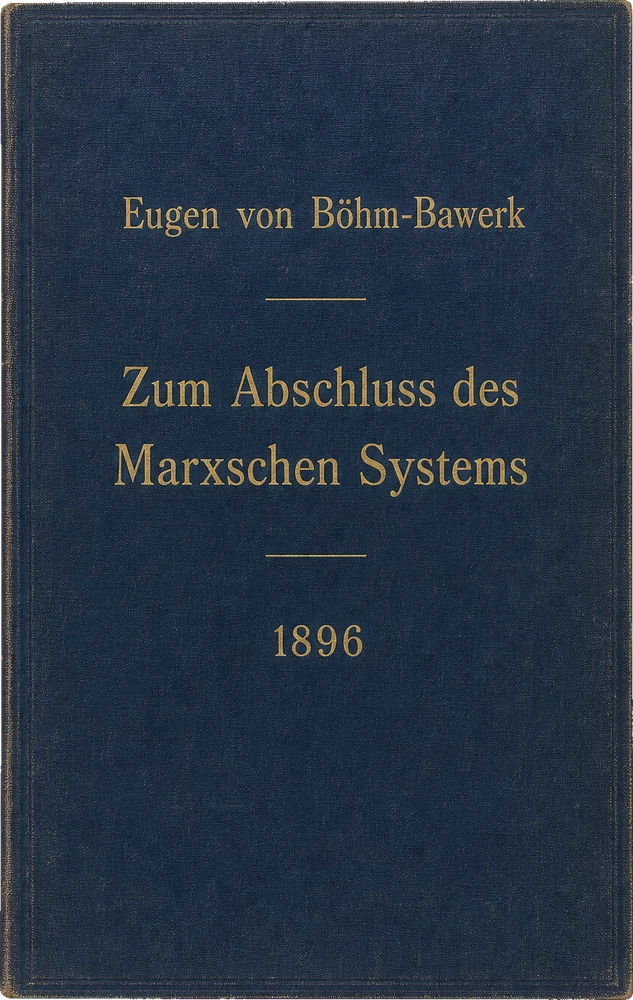
Eugen von Böhm-Bawerk, Zum Abschluß des Marxschen Systems (1896)
This single-author scholarly critique assesses Marx’s economic system after the posthumous appearance of the third volume of Das Kapital. Böhm-Bawerk treats that publication as the decisive test of Marx’s long-promised reconciliation between the labor theory of value and the equalization of profit rates. The essay moves from exposition to refutation: it first reconstructs Marx’s value and surplus-value theory, then the doctrine of average profit and production prices, then tests four possible defenses of consistency, before tracing the original error in Marx’s method and replying to Werner Sombart’s attempted rescue.
Hat Marx selbst sein Rätsel gelöst? Ist sein abgeschlossenes System sich und den Tatsachen getreu geblieben oder nicht?
English translation: Has Marx himself solved his riddle? Has his completed system remained true to itself and to the facts, or not?
Böhm-Bawerk’s central thesis is that Marx does not solve the contradiction but states it in another form. Volume I teaches that commodities exchange according to socially necessary labor time; Volume III admits that capitalist competition equalizes profit and therefore makes commodities sell at production prices systematically above or below their labor values. For Böhm-Bawerk, this is not mediation but abandonment.
Ich kann mir nicht helfen, ich sehe hier nichts von einer Erklärung und Versöhnung eines Widerstreites, sondern den nackten Widerspruch selbst.
English translation: I cannot help it: I see here nothing of an explanation and reconciliation of a conflict, but rather the naked contradiction itself.
The essay’s sharpest formulation is that Marx’s theory of production prices contradicts the value law on which the theory of exploitation had rested. Böhm-Bawerk insists that the issue is not a minor empirical deviation or market oscillation, but a necessary and permanent divergence: equal capital must earn equal profit, while labor-value exchange would imply unequal profit whenever capital compositions differ.
Der dritte Band Marx verleugnet den ersten. Die Theorie der Durchschnittsprofitorate und der Produktionspreise verträgt sich nicht mit der Theorie vom Werte.
English translation: The third volume of Marx disavows the first. The theory of the average rate of profit and of prices of production is incompatible with the theory of value.
The four defenses examined in the third section are all rejected. The claim that total prices equal total values is, for Böhm-Bawerk, a tautology irrelevant to the real problem of relative exchange. The claim that labor still “governs” price movements proves only that labor is one price factor, not the sole determinant. The appeal to primitive historical exchange at values is unsupported and implausible. Finally, the claim that value regulates production prices “in letzter Instanz” fails because wages, total capital, turnover, and average profit all enter price formation as independent determinants.
Böhm-Bawerk then turns from inconsistency to diagnosis. He argues that merely showing contradiction is not enough; criticism must locate the point at which error entered the system.
Der Nachweis, daß ein Schriftsteller sich selbst widersprochen hat, kann eine notwendige Etappe, darf aber nie das Endziel einer sachlichen und fruchtbaren Kritik sein.
English translation: The demonstration that a writer has contradicted himself may be a necessary stage, but it must never be the ultimate goal of a substantive and fruitful criticism.
That point, he says, lies in Marx’s opening derivation of value. Marx begins with commodities already narrowed to labor-products, excludes natural goods, abstracts from use-value, and then declares labor the remaining common substance. Böhm-Bawerk attacks this as a rigged dialectical procedure: the conclusion is obtained by placing only the desired material into the conceptual sieve. He further criticizes the reduction of complex to simple labor as circular, since the reduction ratios are themselves inferred from the exchange relations they are supposed to explain.
Sie weisen fast ebensoviele wissenschaftliche Kapitalfehler als Gedankenglieder auf – deren gar nicht wenige sind –, und sie tragen handgreifliche Spuren davon, daß sie nachträglich ausgeklügelt und zusammengekünstelt sind, um eine vorgefaßte Meinung als scheinbar natürliches Ergebnis eines wirklichen Forschungsganges hervorkommen zu lassen.
English translation: They exhibit almost as many fundamental scientific errors as links of reasoning—of which there are not a few—and they bear palpable traces of having been subsequently contrived and pieced together in order to make a preconceived opinion emerge as the seemingly natural result of a real course of investigation.
The final section takes up Sombart’s apology, which tries to save Marxian value as a conceptual rather than empirical category. Böhm-Bawerk rejects this retreat: if Marx’s value law is not meant to explain actual exchange, it loses scientific force; if it is meant to explain exchange, it is false. The essay is therefore both a critique of Marx and a methodological polemic against dialectical construction detached from empirical and psychological analysis.
Its relevance lies in its classic statement of the “transformation problem” critique: production prices cannot be derived from labor values without surrendering the claim that labor alone governs exchange. Böhm-Bawerk closes by granting Marx’s intellectual power while denying the durability of the system built on that foundation.
Das Marxsche System hat eine Vergangenheit und eine Gegenwart, aber keine dauernde Zukunft.
English translation: The Marxian system has a past and a present, but no lasting future.
Sections
This work was divided into 12 sections when it entered the library's research corpus—an apparatus for search and citation, not necessarily the author's own table of contents. Each title opens its summary.
1Front Matter and Preface to the Critique of Marx’s System
2Marx's Theory of Value and Surplus Value
3Marx's Theory of Average Profit and Production Prices
4The Question of Contradiction: Setup and Four Possible Defenses
5First Defense Critiqued: Aggregate Price-Value Cancellation
6Second Defense Critiqued: Labor-Time Changes and Price Movements
7Third Defense Critiqued: Primitive Exchange at Values
8Fourth Defense Critiqued: Indirect Regulation by the Value Law
9Origin of Marx's Error: The Dialectical Derivation of Labor Value
10Embedding the False Thesis: Skilled Labor, Abstraction, and Delayed Contradiction
11Competition, Supply and Demand, and the Failure of Marx's Price Explanation
12Werner Sombart's Apology and the Future of Marx's System
Put a question to this work; the Librarian answers from its 12 sections and cites the passage.
Ask the Librarian