About this work
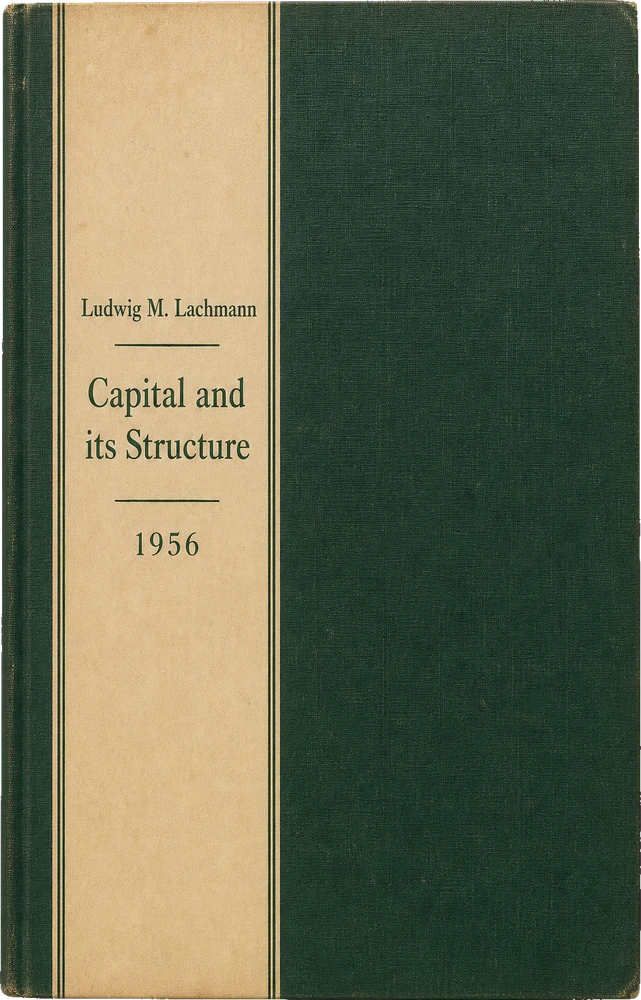
Ludwig M. Lachmann, Capital and Its Structure
The file contains the 1978 reissue of Lachmann’s 1956 seven-chapter theoretical monograph on capital theory. Its central thesis is that capital cannot be understood as a measurable homogeneous stock except under highly artificial equilibrium assumptions. Capital is an ordered, changing structure of heterogeneous goods whose economic character depends on entrepreneurial plans, expectations, and uses.
The generic concept of capital without which economists cannot do their work has no measurable counterpart among material objects; it reflects the entrepreneurial appraisal of such objects.
Chapter I formulates the book’s core move: replace the aggregate “quantity of capital” with a morphology of capital combinations. Lachmann’s argument begins from heterogeneity in use, not merely physical diversity. Capital goods have multiple possible uses, but only some uses fit with other goods in viable plans.
The root of the trouble is well known: capital resources are heterogeneous.
From heterogeneity he derives multiple specificity, complementarity, capital combinations, and finally capital structure. The entrepreneur’s function is therefore not merely to “hire factors” but to specify the concrete form and arrangement of capital within plans. This is why investment cannot be treated as a simple net addition to a stock: it alters the pattern into which old and new capital must fit.
The Theory of Capital is, in the last resort, the morphology of the forms which this pattern assumes in a changing world.
Chapters II and III supply the dynamic method. Lachmann treats expectations as interpretive acts formed from “problematical” experience, not as mechanically determined data. Prices communicate knowledge, but in a changing world they require decoding; some price movements are meaningful, others “functionless.” This epistemic view grounds his use of process analysis.
The formation of expectations is nothing but a phase in this continuous process of exchange and transmission of knowledge which effectively integrates a market society.
Process analysis follows plans through time, showing how disappointment leads to plan revision, capital regrouping, and new disequilibria. It rejects the idea that equilibrium analysis can explain the reshuffling of capital goods after failure, because prices and alternatives are themselves discovered through the process.
Process analysis, we may say, combines the equilibrium of the decision-making unit, firm or household, with the disequilibrium of the market.
Chapter IV defines capital structure as a pattern of functional relationships sustained, imperfectly, by the market’s communication system. Lachmann distinguishes plan complementarity within firms from structural complementarity across the economy. Flexible prices, forward markets, and the Stock Exchange help coordinate expectations, while price rigidity and misleading signals generate inconsistent capital change.
Chapter V reinterprets Böhm-Bawerk’s roundaboutness. Lachmann argues that progress is not simply “more capital” or “more time,” but a changing composition of capital made possible by specialization, indivisibilities, and increasing complementarity. Accumulation permits new stages of production and more complex combinations, but also destroys or devalues older capital.
Economic progress thus requires a continuously changing composition of the social capital. The new indivisibilities account for the increasing returns.
Chapter VI extends the analysis from physical capital to asset structure. Operating assets, reserve assets, securities, portfolios, and control structures are linked by flows of money and knowledge. Capital gains and losses register success and failure across these structures. Hence the capitalist and the manager are both entrepreneurs: each specifies capital in a different order of decision.
The final chapter applies the theory to the trade cycle, especially the “strong boom.” Lachmann criticizes models that analyze investment without a capital theory. If capital is heterogeneous, booms fail not only because aggregate demand changes but because specific complementary resources are missing. Malinvestment is structural: capital has been given forms that cannot be fitted together as expected.
The strong boom is thus an almost inevitable concomitant of an expanding industrial economy, and the system-wide regrouping of capital is its necessary consequence and corrective.
The book’s relevance lies in its subjectivist and Austrian reconstruction of capital theory. It links capital, knowledge, expectations, entrepreneurship, and disequilibrium into one framework. Its enduring conceptual contribution is to make capital theory a theory of order, failure, and regrouping rather than of measurable aggregates.
Sections
This work was divided into 22 sections when it entered the library's research corpus—an apparatus for search and citation, not necessarily the author's own table of contents. Each title opens its summary.
1Front Matter, Publication Data, and Contents
2Preface
3Chapter I: The Order of Capital
4Chapter II: On Expectations
5Chapter III: Process Analysis and Capital Theory (Opening)
6Process Analysis, Durable Capital Goods, and Capital Planning
7Capital Regrouping, Disequilibrium, Idle Capacity, and Liquidity Preference
8Capital Structure, Complementarity, and Consistent Capital Change
9Prices as Communication, Inflexibility, and Malinvestment
10Forward Markets, the Stock Exchange, and Keynes’s Casino Critique
11Capital Structure, Economic Progress, and the Theory of Interest
12Interest Rates and the Impossibility of Persistent Negative Rates
13Boehm-Bawerk, Roundabout Production, and the Division of Capital
14Asset Structure, Money, and the Classification of Assets
15Dynamic Integration of Asset Structures Through Success, Failure, and Money Flows
16Securities Pyramids, Holding Companies, and Entrepreneurial Control
17Chapter VII Introduction: Capital in the Trade Cycle
18Section I: Critique of Hicks, Ceilings, and Inconsistent Capital Change
19Section II: Austrian Theory, Dynamic Equilibrium, and Investment Errors
20Section III: Post-Crisis Capital Regrouping and Readjustment
21Index
22Back Cover Blurb and Publication Note
Put a question to this work; the Librarian answers from its 22 sections and cites the passage.
Ask the Librarian