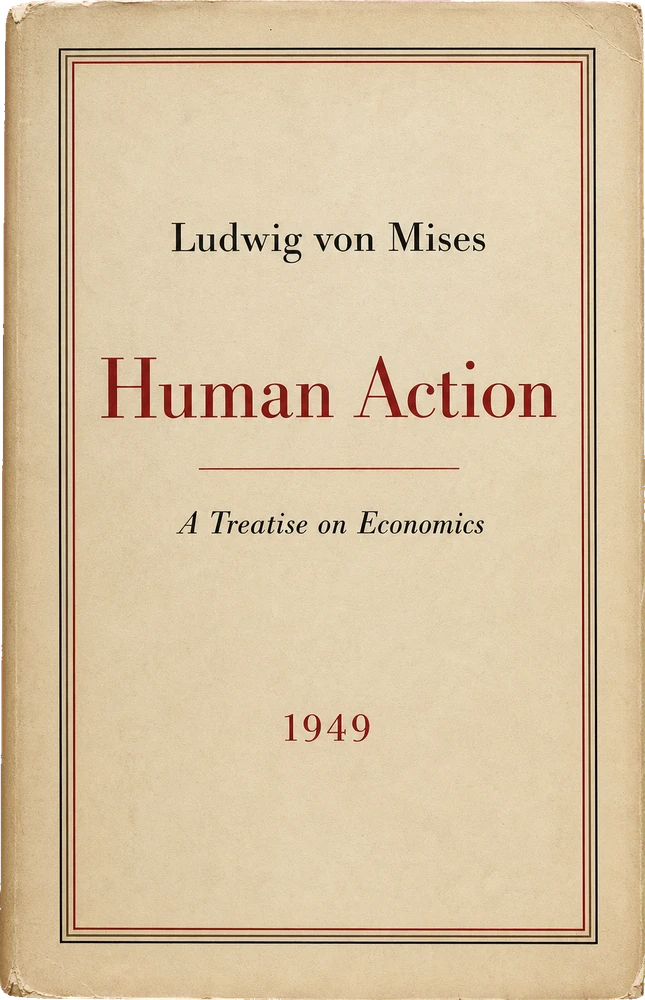
Ludwig von Mises · 1949
Human Action: A Treatise on Economics, The Scholar's Edition
About this work
Ludwig von Mises, Human Action — Summary
Mises’s Human Action presents economics as a science of purposive choice rather than a study of material aggregates. Its starting point is not wealth, production, or markets, but the formal fact that persons act by selecting means for preferred ends under conditions of scarcity:
Human action is purposeful behavior.
From this premise Mises constructs praxeology, a deductive account of action whose categories include value, cost, exchange, time, uncertainty, profit, loss, and calculation. His method rejects positivist imitation of the natural sciences, because economic phenomena are inseparable from meaning, intention, and interpretation. This is why his economics is both methodological individualist and subjectivist:
Economics is not about things and tangible material objects; it is about men, their meanings and actions.
The treatise then moves from action to social cooperation. Division of labor and exchange arise because individuals discover that cooperation better serves their diverse ends than autarky. The market is therefore not an impersonal machine but a continuing process in which plans are coordinated through prices, entrepreneurial judgment, and profit-and-loss tests. Consumers guide this process not by political command but through purchasing and abstention:
The market is a consumers’ democracy.
This phrase captures Mises’s account of capitalism as a system of disciplined service rather than arbitrary capitalist rule. Entrepreneurs own or direct resources only so long as they anticipate consumer demands better than rivals. Profit signals successful adjustment to future wants; loss removes control from those who misallocate scarce means. The core defense of the market is thus epistemic and calculational: money prices make heterogeneous goods comparable and permit rational allocation within complex production.
That argument grounds Mises’s famous critique of socialism. If the means of production are collectively owned and not exchanged, there can be no genuine market prices for capital goods. Central planners may possess engineering data, inventories, and intentions, but they lack the monetary calculation needed to compare alternative uses of scarce resources. Mises extends the same logic to interventionism: price controls, credit expansion, wage mandates, protectionism, and corporative schemes do not suspend market forces but distort signals, create shortages or surpluses, and invite further controls.
The analysis of money, capital, interest, and cycles develops the same framework. Money emerges from indirect exchange and becomes indispensable because it enables calculation across goods and time. Capital is not a single homogeneous fund but a structure of concrete, historically given goods whose value depends on anticipated future uses. Action is always temporal, comparing earlier and later satisfactions, so interest is not merely a monetary or technological return:
Originary interest is a category of human action.
This claim supports Mises’s theory of saving, investment, and the trade cycle. When credit expansion lowers market rates below those consistent with time preference, entrepreneurs undertake projects that appear profitable only under falsified conditions. The boom therefore contains malinvestment, and the bust reveals that labor and capital have been misdirected. Monetary disorder is, for Mises, a disorder of calculation.
The later chapters sharpen the critique of collectivist and interventionist alternatives. Syndicalism and corporativism wrongly treat industries as if they had autonomous internal interests, while Mises insists that production is interdependent and ultimately accountable to consumers. Welfare policy, war finance, and postwar monetary planning are criticized for concealing costs and imagining that command can replace appraisal. The book’s liberalism rests on the claim that private property, monetary calculation, and market exchange are the institutional conditions of advanced social cooperation.
The lasting significance of Human Action lies in its systematic ambition. It unites epistemology, value theory, market coordination, monetary theory, business-cycle analysis, and political economy around a single conception of purposeful action under scarcity and uncertainty. Whether or not one accepts Mises’s apriorism, the work remains a major statement of Austrian economics because it insists that economic institutions must be understood as frameworks through which human beings choose, calculate, err, learn, and cooperate over time.
Sections
This work was divided into 294 sections when it entered the library's research corpus—an apparatus for search and citation, not necessarily the author's own table of contents. Each title opens its summary.
1Front Matter, Dedication, and Publication Data
2Introduction to the Scholar's Edition, Section I: Human Action and the Austrian School Crisis
3Introduction to the Scholar's Edition, Section II: Mises's Preparation, Publication, and the Austrian Revival
4Introduction to the Scholar's Edition, Section V: Rationale for Restoring the First Edition
5Foreword by Ludwig von Mises
6Acknowledgments for Quotation Permissions
7Table of Contents
8Introduction, Section 1: Economics and Praxeology
9Introduction to the Scholar's Edition, Section III: Differences Between Human Action and Nationalökonomie
10Introduction, Section 2: The Epistemological Problem of a General Theory of Human Action
11Introduction, Section 3: Economic Theory and the Practice of Human Action
12Introduction, Section 4: Résumé
13Part One: Human Action — Purposeful Action and Animal Reaction
14The Prerequisites of Human Action
15On Happiness
16On Instincts and Impulses
17Human Action as an Ultimate Given
18Rationality, Irrationality, Subjectivism, and Objectivity in Praxeology
19Causality as a Requirement of Action
20The Alter Ego
21On the Serviceableness of Instincts
22The Formal and Aprioristic Character of Praxeology
23Primitive Logic, A Priori Reality, and the Epistemological Status of Praxeology
24The Absolute End
25The Principle of Methodological Individualism
26I and We
27Vegetative Man
28The Principle of Methodological Singularism
29Chapter II: Praxeology and History
30The Individual and Changing Features of Human Action
31The Scope and Specific Method of History
32The Scope and Specific Method of History (continued)
33Conception and Understanding
34Natural History and Human History
35On Ideal Types
36The Procedure of Economics
37The Limitations on Praxeological Concepts
38Economics and the Revolt Against Reason — The Revolt Against Reason
39The Logical Aspect of Polylogism
40The Praxeological Aspect of Polylogism
41Racial Polylogism
42Racial Polylogism (continued)
43Polylogism and Understanding
44The Case for Reason
45Ends and Means
46The Scale of Value
47The Scale of Needs
48Action as an Exchange
49Time: Temporal Character, Past, Present, and Future
50The Economization of Time
51The Temporal Relation Between Actions
52Uncertainty and Acting
53The Meaning of Probability and Class Probability
54Case Probability
55Numerical Evaluation of Case Probability
56Betting, Gambling, Games, Praxeological Prediction, and Chapter VII Opening
57Action Within the World: The Law of Marginal Utility
58Action Within the World: The Law of Returns
59Action Within the World: Human Labor as a Means
60Human Labor as a Means: Scarce Labor and Unused Material Factors
61Immediately Gratifying Labor and Mediately Gratifying Labor
62The Creative Genius
63Production
64Part Two: Action Within the Framework of Society — Human Society
65Human Cooperation
66A Critique of the Holistic and Metaphysical View of Society
67Praxeology and Liberalism
68Liberalism and Religion
69The Division of Labor
70The Ricardian Law of Association
71Current Errors Concerning the Law of Association
72The Effects of the Division of Labor
73The Individual Within Society
74The Fable of the Mystic Communion
75The Great Society and the Instinct of Aggression and Destruction
76Current Misinterpretations of Modern Natural Science, Especially of Darwinism
77The Social Implications of Darwinism
78Reason and Rational Behavior as Natural Phenomena
79The Role of Ideas: Human Reason
80World View and Ideology
81The Fight Against Error
82Might and Traditionalism as Ideologies
83Meliorism and the Idea of Progress
84Exchange Within Society: Autistic and Interpersonal Exchange
85Contractual Bonds and Hegemonic Bonds
86Calculative Action
87The Gradation of the Means
88The Barter-Fiction of the Elementary Theory of Value and Prices
89The Theory of Value and Socialism; The Problem of Economic Calculation
90Economic Calculation and the Market
91The Sphere of Economic Calculation: The Character of Monetary Entries
92The Limits of Economic Calculation
93The Changeability of Prices
94Stabilization
95The Sphere of Economic Calculation: Index Numbers and the Impossibility of Measuring Purchasing Power (continued)
96The Root of the Stabilization Idea
97Monetary Calculation as a Tool of Action: Monetary Calculation as a Method of Thinking
98Economic Calculation and the Science of Human Action
99Part Four: Catallactics or Economics of the Market Society — The Delimitation of Catallactic Problems
100The Denial of Economics
101The Method of Imaginary Constructions
102The Pure Market Economy
103The Maximization of Profits
104Pure Market Economy (continued): Business, Consumption, and Value Judgments
105The Autistic Economy
106States of Rest, the Evenly Rotating Economy, and the Stationary Economy
107The Integration of Catallactic Functions
108The Entrepreneurial Function in the Stationary Economy
109The Characteristics of the Market Economy
110Capital
111Capitalism
112The Sovereignty of the Consumers
113The Metaphorical Employment of the Terminology of Political Rule
114Competition
115Freedom
116Inequality of Wealth and Income
117Entrepreneurial Profit and Loss
118Entrepreneurial Profits and Losses in a Progressing Economy
119Some Observations on the Underconsumption Bogey and on the Purchasing Power Argument
120Promoters, Managers, Technicians, and Bureaucrats
121The Selective Process
122The Individual and the Market
123Business Propaganda and the “Volkswirtschaft”
124Prices: The Pricing Process
125Valuation and Appraisement
126The Prices of the Goods of Higher Orders
127A Limitation on the Pricing of Factors of Production
128Cost Accounting
129Cost Accounting, Fixed Costs, and the Limits of Plant Size
130Logical Catallactics Versus Mathematical Catallactics
131Monopoly Prices: Conditions, Competitive Prices, and Oligopoly
132Monopolized Factors, Margin Monopoly, Tariffs, Cartels, and Government Monopolies
133Monopoly Prices: Natural Margins, Scale, Failure Monopoly, Local Monopoly, and Labor Unions
134Mathematical Treatment of Monopoly Prices
135Good Will and Competition
136Monopoly Prices, Entrepreneurial Restriction, and Monopoly Gains
137Monopoly of Demand
138Consumption as Affected by Monopoly Prices
139Monopoly Prices (continued): Consumer Effects, Patents, Resources, and Cartels
140Price Discrimination on the Part of the Seller
141Price Discrimination on the Part of the Buyer
142The Connexity of Prices
143Prices and Income
144Prices and Production
145The Chimera of Nonmarket Prices
146Indirect Exchange: Media of Exchange, Money, and Monetary Errors
147Demand for Money and Supply of Money
148Carl Menger’s Theory of the Origin of Money
149The Determination of the Purchasing Power of Money
150The Problem of Hume and Mill and the Driving Force of Money
151Cash-Induced and Goods-Induced Changes in Purchasing Power
152Inflation and Deflation; Inflationism and Deflationism
153Monetary Calculation and Changes in Purchasing Power
154The Anticipation of Expected Changes in Purchasing Power
155The Specific Value of Money
156The Import of the Money Relation
157The Money-Substitutes
158The Limitation on the Issuance of Fiduciary Media
159Observations on the Discussions Concerning Free Banking
160The Size and Composition of Cash Holdings
161Balances of Payments
162Interlocal Exchange Rates
163Interest Rates and the Money Relation
164Secondary Media of Exchange
165The Inflationist View of History (beginning)
166Inflationary and Deflationary Policy: Conclusions Continued
167The Gold Standard
168International Monetary Cooperation
169Perspective in the Valuation of Time Periods
170Time Preference and the Evolution of Time-Preference Theory
171Capital Goods
172Period of Production, Provision Beyond Life, and Applications of Time Preference
173The Convertibility of Capital Goods
174The Influence of the Past Upon Action
175Patent Rights, Technological Innovation, and the Convertibility of Capital Goods
176Accumulation, Maintenance and Consumption of Capital
177Accumulation, Maintenance, and Consumption of Capital (continued)
178The Mobility of the Investor; Money and Capital, Saving and Investment
179The Phenomenon of Interest
180Originary Interest
181The Height of Interest Rates
182Originary Interest in the Changing Economy
183The Computation of Interest
184The Problems of Interest, Credit Expansion, and the Trade Cycle
185Entrepreneurial Component and Price Premium in the Gross Market Rate of Interest
186The Loan Market
187Effects of Changes in the Money Relation Upon Originary Interest
188Gross Market Interest Under Inflation and Credit Expansion
189The Alleged Absence of Depressions Under Totalitarian Management
190Gross Market Interest Under Deflation and Credit Contraction
191The Difference Between Credit Expansion and Simple Inflation
192The Monetary or Circulation Credit Theory of the Trade Cycle
193The Market Economy as Affected by the Recurrence of the Trade Cycle
194The Role Played by Unemployed Factors of Production in the First Stages of a Boom
195The Fallacies of the Nonmonetary Explanations of the Trade Cycle
196Critique of Disproportionality Theories of the Trade Cycle
197Introversive Labor and Extroversive Labor
198Joy and Tedium of Labor
199Wages and Marginal Productivity
200Catallactic Unemployment
201Gross and Net Wages, Subsistence Wage Theories, and Start of Labor Supply
202The Supply of Labor as Affected by the Disutility of Labor (continued)
203Remarks About the Popular Interpretation of the Industrial Revolution
204Wage Rates as Affected by the Vicissitudes of the Market
205The Labor Market
206The Work of Animals and of Slaves
207General Observations Concerning the Theory of Rent
208The Time Factor in Land Utilization
209The Submarginal Land
210The Land as Standing Room
211The Prices of Land
212The Myth of the Soil
213The Theory, Data, and Role of Power in the Market
214The Historical Role of War and Conquest
215Real Man as a Datum
216The Period of Adjustment
217Property Rights, External Costs, and External Economies
218The External Economies of Intellectual Creation
219Privileges and Quasi-privileges
220The Ultimate Source of Profit and Loss on the Market
221The Limitation of Offspring
222The Harmony of the Rightly Understood Interests
223Private Property
224The Conflicts of Our Age
225Historical Origin of the Socialist Idea
226The Socialist Doctrine
227Praxeological Character of Socialism
228The Problem of Economic Calculation Under Socialism
229Past Failures to Conceive the Socialist Calculation Problem
230Recent Suggestions for Socialist Economic Calculation
231Trial and Error, the Quasi-Market, and Differential Equations in Socialist Calculation
232XXVII. The Government and the Market — 1. The Idea of a Third System
233XXVII. The Government and the Market — 2. The Intervention
234XXVII. The Government and the Market — 3. The Delimitation of Governmental Functions
235XXVII. The Government and the Market — 4. Righteousness as the Ultimate Standard of the Individual's Actions
236XXVII. The Government and the Market — 5. The Meaning of Laissez Faire
237XXVII. The Government and the Market — 6. Direct Government Interference with Consumption
238XXVIII. Interference by Taxation — 1. The Neutral Tax
239XXVIII. Interference by Taxation — 2. The Total Tax
240XXVIII. Interference by Taxation — 3. Fiscal and Nonfiscal Objectives of Taxation
241XXVIII. Interference by Taxation — 4. The Three Classes of Tax Interventionism
242Tax Expropriation and the Limits of Interventionism
243The Nature of Restriction of Production
244The Price of Restriction
245Restriction as Privilege and as Quasi-Consumption
246The Government and the Autonomy of the Market
247Market Reaction to Price Controls, Roman Decline, Minimum Wages, and Labor Unionism
248The Government and the Currency
249Legal Tender, Gold Exchange Standards, and the Objectives of Devaluation
250Currency Devaluation and Inflationism, Continued
251Credit Expansion
252The Chimera of Contracyclical Policies
253Foreign Exchange Control and Bilateral Exchange Agreements
254Remarks About the Nazi Barter Agreements
255The Philosophy of Confiscation
256Land Reform
257Confiscatory Taxation
258Confiscatory Taxation and Risk-Taking
259The Syndicalist Idea
260The Fallacies of Syndicalism
261Syndicalist Elements in Popular Policies
262Guild Socialism and Corporativism
263Total War
264War and the Market Economy
265War and Autarky
266The Futility of War
267The Case Against the Market Economy
268Poverty
269Inequality
270Insecurity
271Social Justice
272The Harvest of Interventionism
273The Exhaustion of the Reserve Fund
274The End of Interventionism
275Socialism and the Abolition of Economic Calculation
276Part Seven: The Singularity of Economics
277Economics and Public Opinion
278The Illusion of the Old Liberals
279The Study of Economics
280Economics as a Profession
281Forecasting as a Profession
282Economics and the Universities
283General Education and Economics
284Economics and the Citizen
285Economics and Freedom
286Science and Life
287Economics and Judgments of Value
288Economic Cognition and Human Action
289Index: A–B
290Index: C–H
291Index: I–M
292Index: N–S
293Index: T–Y
294Colophon and Back Matter
Put a question to this work; the Librarian answers from its 294 sections and cites the passage.
Ask the Librarian