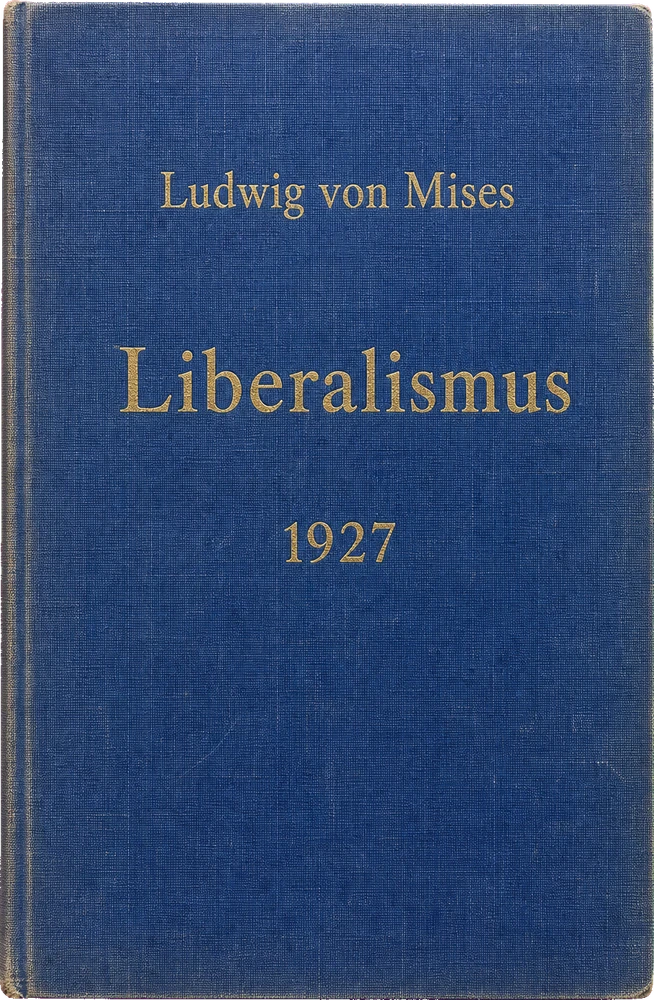
About this work
Mises’s Liberalism is a systematic defense of classical liberalism as the institutional philosophy of social cooperation. Its thesis is not that liberty is a romantic ideal or that capitalism favors a class, but that private property, peace, legal equality, free exchange, and limited government are the only durable framework for a society based on division of labor. Liberalism is therefore presented as practical social science: it asks which institutions allow human beings, pursuing improvement, to cooperate rather than plunder one another.
This impulse cannot be eradicated; it is the motive power of all human action.
From this anthropological premise Mises builds the book’s central conceptual move: the desire for betterment is not to be morally suppressed but institutionally ordered. Markets make self-interest socially productive because property and contract submit producers to consumer choice. Socialism and interventionism, by contrast, try to redirect action through command while weakening the information and incentives that make cooperation possible.
The opening structure makes clear that liberalism begins with institutions, not slogans.
The organization of human society according to the pattern most suitable for the attainment of the ends in view is a quite prosaic and matter-of-fact question, not unlike, say, the construction of a railroad or the production of cloth or furniture.
Those foundations are property, freedom, peace, equality before the law, democracy, toleration, and a sharply delimited state. Mises’s state is necessary but dangerous because it is defined by coercion:
We call the social apparatus of compulsion and coercion that induces people to abide by the rules of life in society, the state; the rules according to which the state proceeds, law; and the organs charged with the responsibility of administering the apparatus of compulsion, government.
This definition governs the whole argument. Government is justified as the protector of social cooperation—especially property and personal security—but becomes destructive when it substitutes political compulsion for voluntary coordination. Democracy is valued not as mystical majority rule but as a peaceful method for changing rulers and avoiding civil war. Equality means equal legal status, not equal outcomes; unequal wealth is defended insofar as it arises from service in the market rather than privilege.
The economic chapters extend this logic. Mises treats private ownership of the means of production as the indispensable condition of rational economic calculation. Without market prices for capital goods, socialist planners cannot compare alternative uses of resources. Interventionism fares no better: price controls, protection, inflation, and regulation generate unintended consequences that invite further controls, pushing society toward either renewed market freedom or socialism. Hence the work’s retrospective claim:
What was proved by science theoretically was corroborated in practice by the failure of all socialist and interventionist experiments.
The foreign-policy chapters apply liberalism internationally. Peace requires free trade, respect for self-determination, and the rejection of imperial privilege. Nationalism becomes dangerous when it is tied to interventionist states that make language, borders, and administration instruments of economic advantage. Mises’s cosmopolitanism follows from the same principle as his economics: cooperation widens prosperity, while political exclusion and conquest narrow it.
The later chapters confront parties, propaganda, and anti-liberal movements. Mises argues that liberalism cannot succeed by imitating interest-group politics, because it does not promise spoils to a faction. Its difficulty is that it offers general benefits through restraint, whereas its opponents promise visible favors through compulsion. He also stresses that liberalism has been historically uneven and fragile:
Hardly a breath of the liberal spirit has ever reached the peoples of eastern Europe.
The book’s relevance lies in this fusion of economics, political theory, and international order. Mises presents liberalism as a single architecture: property makes calculation possible; freedom makes innovation possible; peace makes division of labor possible; democracy makes political change nonviolent; toleration makes social coexistence possible. Its recurring opponent is the belief that coercive power can improve on voluntary cooperation without destroying the conditions that make prosperity and peace possible.
Sections
This work was divided into 19 sections when it entered the library's research corpus—an apparatus for search and citation, not necessarily the author's own table of contents. Each title opens its summary.
1Title Pages and Publication Metadata
2Preface, 1985
3Foreword
4Preface to the English-Language Edition
5Contents
6Introduction: Liberalism
7Introduction: Material Welfare
8Introduction: Rationalism
9Introduction: The Aim of Liberalism
10Introduction: Liberalism and Capitalism
11Introduction: The Psychological Roots of Antiliberalism
12Introduction (continued): Socialism as Psychological Consolation
13The Foundations of Liberal Policy
14Liberal Economic Policy
15Liberal Foreign Policy
16Liberalism and the Political Parties
17The Future of Liberalism
18Appendix: Literature of Liberalism and the Term Liberalism
19Back Matter: Endorsement and Publisher Information
Put a question to this work; the Librarian answers from its 19 sections and cites the passage.
Ask the Librarian