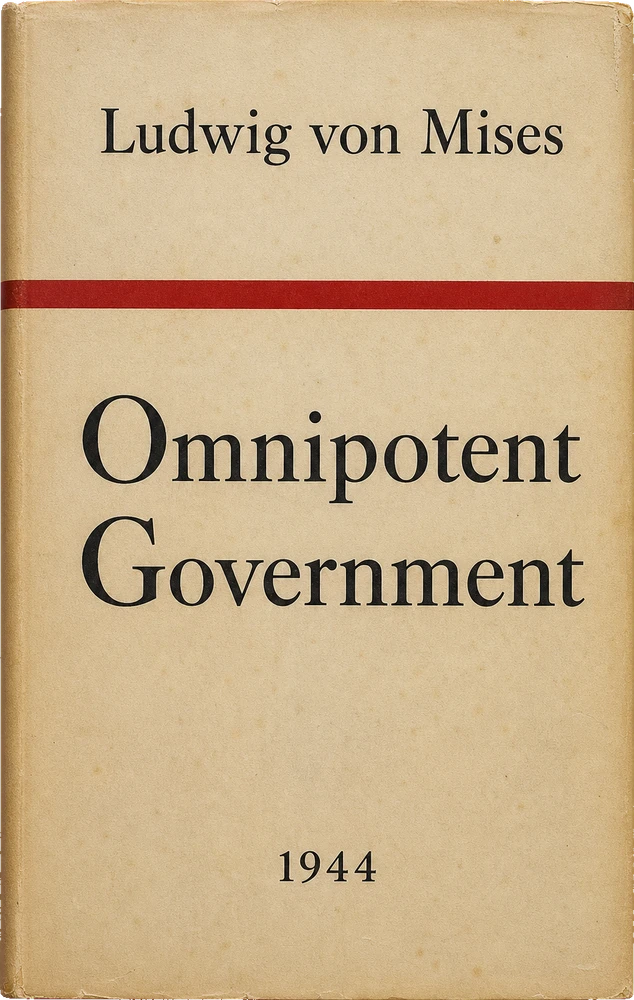
Ludwig von Mises · 1944
Omnipotent Government: The Rise of the Total State and Total War
About this work
Omnipotent Government — Summary
Mises’s Omnipotent Government explains Nazism as the extreme political result of a wider anti-liberal movement, not as an inexplicable German aberration. Its central argument is that interventionism, socialism, protectionism, and nationalism dissolve the conditions of peaceful cooperation by replacing market coordination with state command. Mises judges these doctrines by whether their policies can achieve their stated aims, and he concludes that the promise of security through government control culminates in economic disorder, international rivalry, and war.
The program of economic freedom is not negativistic.
This sentence captures Mises’s defense of liberalism as a positive institutional order rather than a refusal of social responsibility. Economic freedom rests on private property, monetary calculation, free exchange, and the international division of labor. The liberal state is limited not because social order is unimportant, but because coercive direction destroys the price signals and entrepreneurial adjustments on which complex cooperation depends. Planning appears to offer rational mastery, but in practice it politicizes production, labor, trade, and distribution.
The book’s methodological target is collectivist irrationalism, especially the doctrine Mises calls polylogism: the idea that classes, races, or nations possess distinct logics. Such a doctrine, he argues, immunizes ideology from criticism. If reasoning itself is racial or national, disputes cannot be settled by evidence or argument; they become contests of power. Mises therefore treats Nazi racial thought not as a scientific error alone, but as a denial of the universal standards of reason on which liberal discussion depends.
Polylogism is not a philosophy or an epistemological theory.
From this basis, Mises rereads modern German history as the defeat of liberal nationalism by statist nationalism. Early German nationalism could be liberal insofar as it opposed dynastic fragmentation and sought constitutional unity. But as liberalism weakened, nationalism became allied with militarism, bureaucracy, protectionism, and state social policy. The resulting catastrophe was not simply imposed by Prussia on an otherwise liberal society; it reflected the broad victory of doctrines that made the state the organizer of economic and social life.
Mises’s most important conceptual link is between aggressive nationalism and economic nationalism. In a liberal world economy, borders lose much of their economic importance because goods, capital, and persons move through voluntary exchange. Under protectionism and planning, however, territory becomes decisive. When governments regulate currencies, wages, imports, investment, migration, and production, foreign states appear as obstacles to national plans. Autarky then becomes attractive, and conquest becomes the violent extension of economic policy.
The further a nation goes on the road toward public regulation and regimentation, the more it is pushed toward economic isolation.
This is Mises’s theory of total war in compressed form. Interventionism is not a stable middle way between capitalism and socialism. Each control creates distortions that invite further controls, and each national plan turns access to markets, raw materials, food, and labor into a political problem. German expansionism is thus interpreted as the militarized consequence of policies that had already weakened international cooperation.
The analysis of Nazism is correspondingly broader than a biography of Hitler. Mises presents National Socialism as a synthesis of anti-liberal currents: socialism stripped of proletarian internationalism, nationalism stripped of market cosmopolitanism, militarism adapted to mass politics, and racial ideology used to sanctify coercion. Its socialism does not require formal nationalization of every firm. If private titles remain while all entrepreneurial decisions are dictated by the state, ownership has lost its economic substance.
The choice for mankind is not between two economic systems. It is between capitalism and chaos.
This stark alternative explains Mises’s rejection of interventionist compromise. Price controls, exchange restrictions, cartel privileges, and trade barriers do not preserve capitalism; they disorganize it and intensify the struggle for political privilege. Domestically, this means cumulative coercion. Internationally, it means rivalry among states for the resources and markets that their own policies have politicized.
Sections
This work was divided into 90 sections when it entered the library's research corpus—an apparatus for search and citation, not necessarily the author's own table of contents. Each title opens its summary.
1Front Matter and Publication Information
2Preface and Acknowledgment
3Contents
4Introduction I: Lebensraum, Economic Nationalism, and the Causes of War
5Introduction II: Germany as the Focal Point of the Crisis
6Introduction III: Individualism, State Omnipotence, and the Future West
7Introduction IV: Dogmatism, Statolatry, and the Failure to Stop Nazism
8Introduction V: Nationalist Misuse of History
9Part I, Chapter I, Section 1: The Ancien Régime and Liberalism
10Chapter I, Section 2: The Weakness of German Liberalism
11Chapter I, Section 3: The Prussian Army
12Chapter I, Section 4: The Constitutional Conflict in Prussia
13Chapter I, Section 5: The Little German Program
14Chapter I, Section 6: The Lassalle Episode and Opening of The Triumph of Militarism
15The Prussian Army in the New German Empire
16German Militarism
17The Liberals and Militarism
18The Current Explanation of the Success of Militarism
19Part II: Nationalism; III. Etatism; The New Mentality
20The State
21The Political and Social Doctrines of Liberalism
22Socialism
23Socialism in Russia and in Germany
24Interventionism
25Etatism and Protectionism
26Economic Nationalism and Domestic Monopoly Prices
27Autarky
28German Protectionism and Transition to Etatism and Nationalism
29Etatism and Nationalism: The Principle of Nationality
30Etatism and Nationalism: The Linguistic Group
31Etatism and Nationalism: Liberalism and the Principle of Nationality
32Etatism and Nationalism: Aggressive Nationalism
33Etatism and Nationalism: Colonial Imperialism
34Etatism and Nationalism: Foreign Investment and Foreign Loans
35Etatism and Nationalism: Total War
36Etatism and Nationalism: Socialism and War
37Refutation of Fallacious Explanations: Shortcomings of Current Explanations
38Refutation of Fallacious Explanations: The Alleged Irrationality of Nationalism
39Refutation of Fallacious Explanations: The Aristocratic Doctrine
40Refutation of Fallacious Explanations: Misapprehended Darwinism
41Refutation of Fallacious Explanations: The Role of Chauvinism
42Refutation of Fallacious Explanations: The Role of Myths
43German Nazism: The Awakening of German Nationalism
44German Nazism: The Ascendancy of Pan-Germanism
45German Nationalism Within an Etatist World
46A Critique of German Nationalism
47Nazism and German Philosophy
48Polylogism
49Pan-Germanism and Nazism
50The Legend
51Marxism and the Labor Movement
52The German Workers and the German State
53The Social Democrats Within the German Caste System
54The Social Democrats and War
55Anti-Semitism and Racism
56Anti-Semitism and Racism: Racism and the Myth of the Jewish Mind
57Interventionism and Legal Discrimination against Jews
58The Stab in the Back Myth
59Anti-Semitism as a Factor in International Politics
60The Weimar Constitution and the Failure of Parliamentary Democracy
61The Abortive Socialization
62The Armed Parties
63The Treaty of Versailles
64The Economic Depression
65Nazism and German Labor
66The Foreign Critics of Nazism
67The Weimar Republic (continued): Shared Etatist Dogmas and the Nazi Economy
68Nazism as a World Problem: Scope and Limitations of History
69The Fallacy of the Concept of National Character
70Germany’s Rubicon
71The Alternative: Defeating Nazism or Losing Freedom
72The Delusions of World Planning: The Term Planning
73The Dictatorship Complex
74A World Government
75Planned Production
76Foreign Trade Agreements
77Monetary Planning
78Planning International Capital Transactions
79Peace Schemes: Armament Control
80A Critique of Some Other Schemes Proposed
81The Union of the Western Democracies
82Peace in Eastern Europe
83The Problems of Asia
84The Role of the League of Nations
85Conclusion I
86Conclusion II: Condensed International Problems
87Conclusion II (continued): Etatism, Autarky, and Economic Nationalism
88Conclusion III: War, Autarky, and Regression from the Division of Labor
89Conclusion IV: Europe and the Catastrophe of Autarky
90Index
Put a question to this work; the Librarian answers from its 90 sections and cites the passage.
Ask the Librarian