About this work
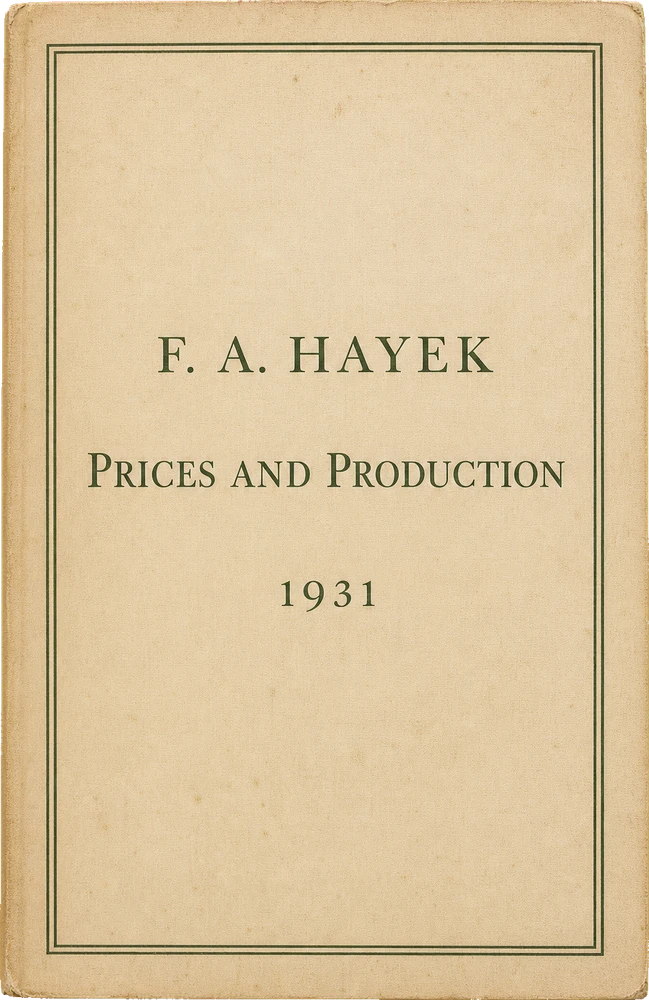
Friedrich A. Hayek, Prices and Production (Second Edition, 1935)
Hayek’s second edition collects four London lectures, with second-edition qualifications and appendices, into a program for restoring monetary theory to price and capital theory. He refuses to treat the trade cycle as a movement of “the price level” alone. Money matters because it enters at determinate points, changes relative prices, alters the loan rate, and shifts resources across the time-sequence of production. The result is an explicitly anti-aggregate method:
I would even go so far as to assert that, from the very nature of economic theory, averages can never form a link in its reasoning; but to prove this contention would go far beyond the subject of these lectures.
The first lecture criticizes both crude quantity theory and stabilization doctrines. Hayek’s target is not every use of monetary aggregates, but the idea that an average level can supply a causal account of individual plans. If entrepreneurs, workers, savers, and consumers respond to concrete prices and interest rates, then a constant index of commodity prices may coexist with serious discoordination. This is why Hayek replaces the ideal of stable purchasing power with the benchmark of neutral money:
Not a money which is stable in value but a neutral money must therefore form the starting point for the theoretical analysis of monetary influences on production, and the first object of monetary theory should be to clear up the conditions under which money might be considered to be neutral in this sense.
The second lecture supplies the capital theory needed for this claim. Production is not a simultaneous aggregate but a sequence of stages reaching from early, remote processes to final consumers’ goods. Voluntary saving permits a lengthening of this structure because consumer demand falls and resources are released for more roundabout production. Bank credit, however, can imitate that signal without the real abstinence that would make it sustainable. Hayek’s “forced saving” analysis describes how new purchasing power diverts goods and labor toward investment while consumers have not chosen the corresponding reduction in consumption.
The third lecture turns this into a cycle theory. When the money rate is held below the rate consistent with voluntary saving, entrepreneurs receive a misleading sign: longer processes appear profitable, capital values rise, and production is rearranged toward earlier stages. The boom is therefore not general prosperity with a harmless monetary accompaniment, but a pattern of malinvestment. Its instability appears when consumer demand persists, costs rise, margins are squeezed, and the incomplete capital structure has to be shortened. Depression is thus the liquidation and re-coordination of plans made inconsistent by credit expansion, not simply a deficiency of spending.
The fourth lecture gives the policy implication, but Hayek frames it cautiously. He rejects the assumption that a growing economy requires compensating credit expansion to keep prices stable; productivity-driven falls in prices may be compatible with equilibrium and may even be part of the signal that allows real gains to reach consumers. At the same time, velocity, payment habits, non-bank credit, and institutional change prevent a simple mechanical rule. Hence the book’s conclusion is analytical rather than technocratic:
It is probably an illusion to suppose that we shall ever be able entirely to eliminate industrial fluctuations by means of monetary policy.
The appendices broaden the argument historically and defensively. Hayek links his view to Cantillon, Hume, Thornton, Tooke, Wicksell, and Mises, presenting the older doctrine of uneven monetary injection as superior to price-level mechanics. He also answers critics by distinguishing an explanatory norm from an immediate central-bank formula:
The first is that the concept of neutral money was meant in the first place to be an instrument of theoretical analysis and not necessarily a tool of practical policy.
The lasting force of Prices and Production lies in its insistence that monetary disturbances are structural. Credit does not merely increase “demand”; it changes the apparent profitability of production through time. Hayek’s controversial contribution is to make the crisis intelligible as the consequence of plans set in motion by false intertemporal prices, so that recovery requires not only spending but the realignment of capital, saving, and consumption.
Sections
This work was divided into 9 sections when it entered the library's research corpus—an apparatus for search and citation, not necessarily the author's own table of contents. Each title opens its summary.
1Title Page and Publication Note
2Preface to the Second Edition
3Lecture 1: Theories of the Influence of Money on Prices
4Lecture 2: Equilibrium between Consumers’ Goods and Producers’ Goods
5Lecture 3: The Price Mechanism in the Credit Cycle
6Appendix to Lecture 3: History of Capital-Structure Cycle Theories
7Lecture 4: The Case For and Against an Elastic Currency
8Appendix to Lecture 4: Supplementary Remarks on Neutral Money
9Appendix: Capital and Industrial Fluctuations: A Reply to a Criticism
Put a question to this work; the Librarian answers from its 9 sections and cites the passage.
Ask the Librarian