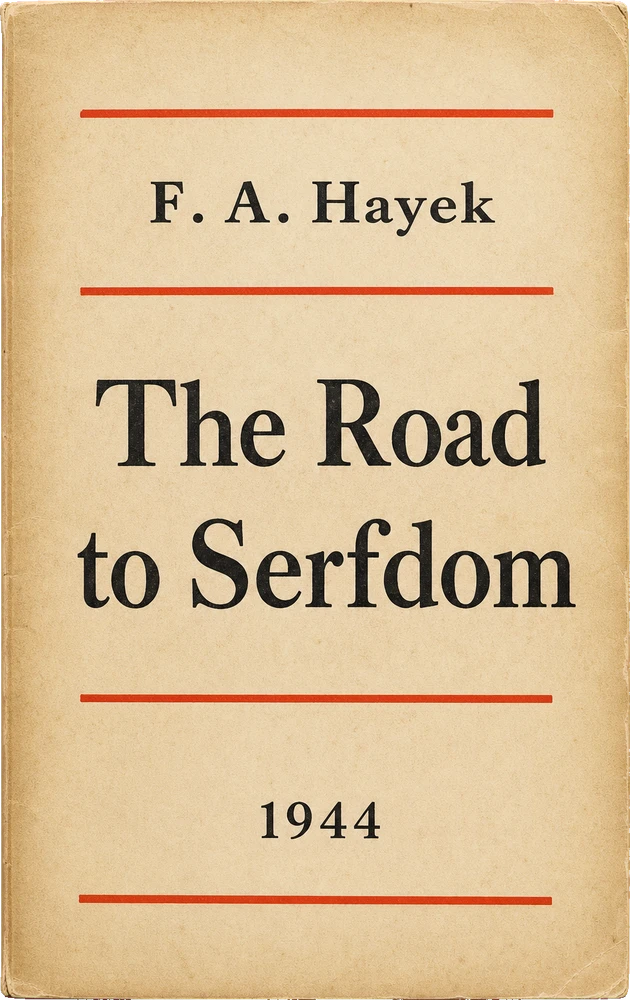
Friedrich August von Hayek · 1944
The Road to Serfdom: Text and Documents--The Definitive Edition
About this work
The Road to Serfdom — Summary
Hayek’s The Road to Serfdom is a wartime argument that political freedom cannot survive comprehensive economic planning. Hayek treats socialism less as a party label than as a shared modern temptation, a planning impulse claimed across the political spectrum:
The socialists of all parties have appropriated the term “planning” for planning of the latter type, and it is now generally accepted in this sense.
Hayek’s target is not every public measure, nor government as such. He distinguishes a constitutional order of general rules, within which individuals and firms make their own plans, from a command economy in which a public authority must choose prices, outputs, occupations, and priorities. The danger is institutional: once society tries to replace the market’s decentralized coordination with a single “social” plan, political power must rank competing human ends.
The book’s early chapters present this as a crisis of liberal civilization. Liberalism, for Hayek, rests on the recognition that knowledge, values, and purposes are dispersed. Competitive markets allow people with different aims to cooperate without agreeing on a common scale of ends. Socialism promises to enlarge freedom by subjecting production to collective will, but Hayek reverses that promise: to control production is also to decide which purposes may be pursued.
The more the state 'plans' the more difficult planning becomes for the individual.
This sentence captures the book’s central hinge. Planning is not objectionable because order is bad, but because centralized planning displaces the private planning through which freedom is exercised. Democracy cannot by itself remove the problem, since majorities do not possess a complete and agreed hierarchy of social values. As planning expands, legislatures must delegate detailed choices to administrators; disagreement over ends is converted into discretionary command over means.
Hayek’s middle chapters develop the contrast between liberty under law and rule by administrative discretion. Freedom depends not on benevolent rulers but on limits that make official coercion predictable, general, and impersonal. Citizens can shape their own lives only when the conditions of action are not constantly revised by officials deciding what outcomes are socially desirable.
Stripped of all technicalities, this means that government in all its actions is bound by rules fixed and announced beforehand—rules which make it possible to foresee with fair certainty how the authority will use its coercive powers in given circumstances and to plan one’s individual affairs on the basis of this knowledge.
Central planning fails this test because it cannot operate by abstract rules alone. It must decide concrete questions: which industries expand, which wages are allowed, what work is necessary, and whose consumption claims prevail. Hayek therefore rejects the idea that “economic” control can be confined to a merely technical sphere. Because nearly all purposes require material means, control over production becomes control over the practical conditions of life.
Economic control is not merely control of a sector of human life which can be separated from the rest; it is the control of the means for all our ends.
Private property, in this argument, is valuable chiefly as a decentralizing institution. It prevents any single authority from monopolizing employment, credit, housing, and opportunity. Where resources are divided among many owners, individuals can refuse, move, bargain, and begin again. Where the state becomes universal employer and allocator, civil liberties remain formally present but materially weakened.
The later chapters trace the moral consequences of collectivism. Since no plural society agrees on ultimate ends, a planned order must create unity by propaganda, suppress inconvenient information, and reward leaders willing to subordinate conscience to collective purpose. Hayek’s comparison with fascism and Nazism is not a claim that democratic socialists intend tyranny; it is a claim about the logic of institutions. Monopoly over economic life, politicized truth, and the replacement of law by purpose are the mechanisms through which totalitarian power grows.
The conclusion turns from warning to reconstruction. Hayek calls for a liberal order that preserves competition, restrains monopoly, maintains stable law, and allows limited social protections without making security a license for comprehensive control. The book remains influential because it defines liberty not as the absence of all government, but as a constitutional condition: power must be limited, rules must be general, and no authority should command the material means by which diverse persons pursue their own ends.
Sections
This work was divided into 25 sections when it entered the library's research corpus—an apparatus for search and citation, not necessarily the author's own table of contents. Each title opens its summary.
1Title Page, Epigraphs, and Dedication
2Preface to the Original Editions
3Foreword to the 1956 American Paperback Edition
4Preface to the 1976 Edition
5Introduction
6Chapter One: The Abandoned Road
7Notes to Chapter One (continued)
8The Great Utopia
9Individualism and Collectivism; start of Chapter Four
10The “Inevitability” of Planning
11Planning and Democracy
12Planning and the Rule of Law
13Notes to Chapter Six (continued)
14Chapter Seven: Economic Control and Totalitarianism
15Chapter Eight: Who, Whom? and Chapter Nine Heading
16Chapter Nine: Security and Freedom
17Chapter Ten: Why the Worst Get on Top
18The End of Truth
19The Socialist Roots of Naziism
20Chapter Thirteen Heading Fragment
21The Totalitarians in Our Midst
22Chapter Fourteen: Material Conditions and Ideal Ends
23Chapter Fifteen: The Prospects of International Order
24Chapter Sixteen: Conclusion
25Bibliographical Note
Put a question to this work; the Librarian answers from its 25 sections and cites the passage.
Ask the Librarian