About this work
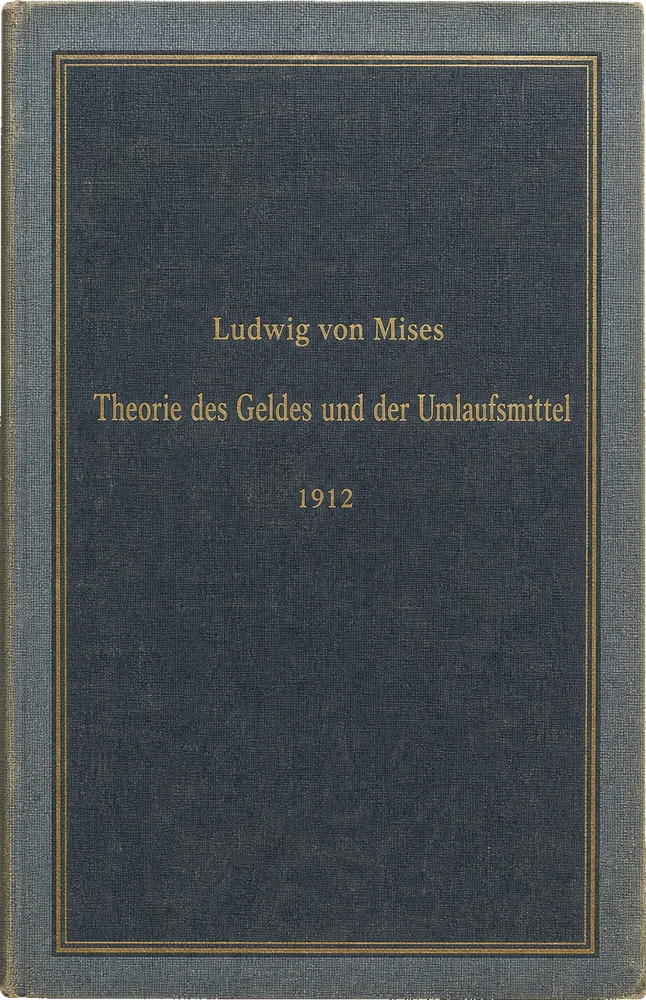
Ludwig von Mises, Theorie des Geldes und der Umlaufsmittel (1912)
Mises’s monograph gives a systematic theory of money, money substitutes, and fiduciary media. Its central aim is to integrate money into marginal utility theory while rejecting legalistic, metallic, and purely nominal accounts of monetary value. Money is defined by its market function in exchange, not by its outward form or official designation. This is why Mises sharply distinguishes money from token coins, banknotes, and claims that may resemble money without being money in the strict sense.
Oberflächliche Beurteiler werden möglicherweise selbst geneigt sein, sie als Geld zu bezeichnen, weil sie aus Silber, Nickel oder Kupfer in runden Platten, welche ganz das Aussehen von Geldstücken haben, hergestellt werden.
English translation: Superficial observers may even be inclined to call them money, because they are made of silver, nickel, or copper in round discs that entirely resemble coins.
The book’s theoretical core is historical and subjective. Mises argues that the purchasing power of money cannot be explained by assuming fixed valuations or by treating money as an abstract measuring rod. Monetary value must be traced back through actual exchange relations and individual valuations. His critique is directed at any theory that evades this problem by positing an unchanged economic subject outside time.
Da muß nun zu einer ganz nebelhaften und unzulässigen Fiktion eines ewigen Menschen mit ewig unveränderlichen Wertschätzungen gegriffen werden.
English translation: One would then have to resort to the wholly nebulous and inadmissible fiction of an eternal man with eternally unchanging valuations.
From this standpoint, changes in the quantity of money or fiduciary media are never neutral. New money enters at definite points, alters relative prices unevenly, and redistributes wealth before any general price level can be described. Inflation is therefore not merely a statistical rise in prices but a social process in which early receivers gain at the expense of later receivers.
Die Zeche müssen diejenigen Klassen oder Völker bezahlen, zu denen die Geldwertverringerung zuletzt gelangt.
English translation: The bill must be paid by those classes or peoples whom the depreciation of money reaches last.
The later part of the work extends this analysis to banking. Mises treats banknotes and deposit claims as economically equivalent when they circulate as money substitutes. If they are not fully backed by money reserves, they become fiduciary media and can expand purchasing power beyond existing money. Legal restrictions on note issue alone therefore miss the deeper problem, because credit expansion can shift into deposit banking.
This leads to Mises’s account of discount policy and the limits of bank credit. Banks must manage redemption, reserves, and interbank claims whether or not the law imposes formal cover requirements.
Die sogenannte Diskontpolitik müßten die Banken auch betreiben, wenn keine gesetzlichen Vorschriften über die Notendeckung bestünden.
English translation: The banks would have to pursue the so-called discount policy even if no statutory prescriptions concerning note cover existed.
The most dangerous case is an autonomous interest-rate policy that expands credit without corresponding saving. For Mises, such policy falsifies market signals, distorts the structure of production, and tends toward continuing depreciation of money.
Die autonome Zinspolitik muß notwendigerweise zur fortschreitenden Geldentwertung führen.
English translation: An autonomous interest-rate policy must necessarily lead to progressive depreciation of money.
The work’s importance lies in joining monetary theory, banking theory, and social analysis. It explains money through exchange and valuation, treats uncovered circulating claims as central to modern monetary systems, and presents inflation and credit expansion as processes with uneven institutional and class effects.
Sections
This work was divided into 86 sections when it entered the library's research corpus—an apparatus for search and citation, not necessarily the author's own table of contents. Each title opens its summary.
1Title Pages and Corrigenda
2Preface
3Table of Contents
4Opening of Book One: The Nature of Money
5Chapter 1, Section 1: General Economic Preconditions of Money Use
6Chapter 1, Section 2: The Origin of Money
7Chapter 1, Section 3: The So-Called Secondary Functions of Money
8On Value Measurement: Ordinal Subjective Value
9Total Value and the Valuation of Goods Stocks
10Money as Price Indicator, Not Value Measure
11Forms of Money: Money Substitutes and Money Claims
12Legal-Economic Treatment of Money Substitutes and Monetary Terminology
13Commodity Money versus Nominalist and State Theories
14Chapter Four: Money and the State
15Chapter Five: The Position of Money among Economic Goods
16Opponents of Money: Money and Socialist Exchange
17Opponents of Money: Moralism, Anti-Metal Schemes, and Free Credit
18Book II: The Nature of the Value of Money and Purchasing Power
19Objective Exchange Value and the Price of Money
20Money Value, Commodity Use, and the Monetary Function
21Chapter Three, Section A: Historical Continuity of Money’s Objective Exchange Value
22Marginal Utility, the Regression of Money Value, and Internal versus External Exchange Value
23Monetary Function, Inconvertible Money, and the Core of the Quantity Theory
24Money-Supply and Money-Demand Changes, Non-Proportional Effects, and Hoarding
25Special Causes of Changes in Money's Internal Objective Exchange Value
26Critique of Wagner's Supply-Side Explanation of General Price Increases
27Critique of Wieser's Monetization Theory of Rising Money Prices
28Exchange Expansion, Subjective Value, and Wieser’s Price Equalization Error
29Indirect Exchange, Fixed Prices, Price Passing, and Money Demand
30Excursus on Monetary Unit Size and Coin Denomination
31Chapter 3 Opening: Money Location and the Law of Interlocal Prices
32Rejection of Local Differences in the Purchasing Power of Money
33Local Cost of Living versus Local Purchasing Power
34Chapter 4: The Mutual Exchange Ratio of Several Kinds of Money
35Chapter 5: The Problem of Measuring the Objective Exchange Value of Money and Its Changes
36Chapter Six, §1: General Social Effects of Money-Value Changes
37Chapter Six, §2: Gradual Diffusion, Inflationary Redistribution, and Deflationary Redistribution
38Chapter Six, §§3-4: Currency Exchange Ratios, Foreign Trade, and Credit Contracts
39Money-Value Policy: Concept and Political Disguises
40State Instruments for Money-Value Policy
41Policies to Raise the Purchasing Power of Money
42Inflationism, Paper Money, and Bimetallism
43Critique of Inflationism as Protectionist Policy
44Stable Money and the Limits of State Control
45Bimetallism and the Shift to a Single World Money
46Conclusion: Limits of Money-Value Policy and Fiduciary Media
47Opening of Book Three: Fiduciary Media and Money
48Chapter 1, §1: Scope and Branches of Banking
49Chapter 1, §2: Banks as Credit Intermediaries
50Chapter 1, §3: Commodity Credit, Circulation Credit, and Fiduciary Media
51Chapter 1, §4: Deposits, Demand Claims, and Credit Creation
52Chapter 1, §5: Banknotes, Bills of Exchange, and the Nature of Circulation Credit
53Chapter 1, §6: Terminology, Money Substitutes, and the Opening of Chapter Two
54Definition and Historical Development of Fiduciary Media
55Clearing, Set-Off, Credit, and Bills of Exchange as Money-Saving Devices
56Domestic Fiduciary Media and the Gold Exchange Standard
57International Clearing and the Possibility of International Fiduciary Media
58Heading: Third Chapter
59Chapter Three, §1: Clearing Systems and the Social Economy of Fiduciary Media
60§§2–3: Fluctuations in Money Demand and the Limits of Clearing
61§4: Critique of the Banking School’s Elasticity Doctrine
62§§5–6: German Bank Law, Commercial Bills, and Capital Demand
63§7: No Automatic Adaptation of Fiduciary Media to Money Demand
64Chapter Four: Redemption of Fiduciary Media into Money — Money Substitutes and the Need for Redemption
65Redemption Funds Cannot Protect Against Panic
66Why Fiduciary Media Were Not Suppressed Despite Full-Reserve Proposals
67Limits of Issue, Central Banks, International Payments, and Legal Restrictions
68Safety, Liquidity, and the Illiquidity of Fiduciary-Media Banking
69Short-Term Lending as a Practical Limit on Fiduciary-Media Expansion
70Security of Cover and the Insufficiency of Illiquid Guarantee Funds
71Foreign Exchange in Redemption Funds and the Internationalization of Fiduciary Media
72Money, Fiduciary Media, and Interest: Problem, Money-Interest Effects, and Free Credit (§§1–3)
73Unified Fiduciary-Media Expansion and the Return to the Natural Rate (§4)
74Circulation Credit and Economic Crises (§5, beginning)
75Section 1: Peel's Bank Act, Currency Theory, and Limits on Fiduciary Media
76Section 2: Discount Policy, World Capital Market, and National Interest Rates
77Section 3: Gold Premium Policy of the Bank of France
78Section 4: Gold Redemption, Worn Coin, and Small Means of Delaying Gold Exports
79Section 5: Legitimate versus Speculative Gold Demand
80Section 7: German Check and Giro Reform, Reichsbank Reserves, and the Transition to the Fourth Book
81Future of Money and Fiduciary Media: Limits of Stable Money
82Fiduciary Media, World Banking, and the Case for Restricting Issue
83Cartels, Trusts, Monopoly, and the Future of Money
84Duncker & Humblot Catalogue: Banking, Finance, and Social Policy Works
85Duncker & Humblot Advertisements: Knapp and Bendixen on Money
86Publisher Advertisements and Printing Notice
Put a question to this work; the Librarian answers from its 86 sections and cites the passage.
Ask the Librarian