About this work
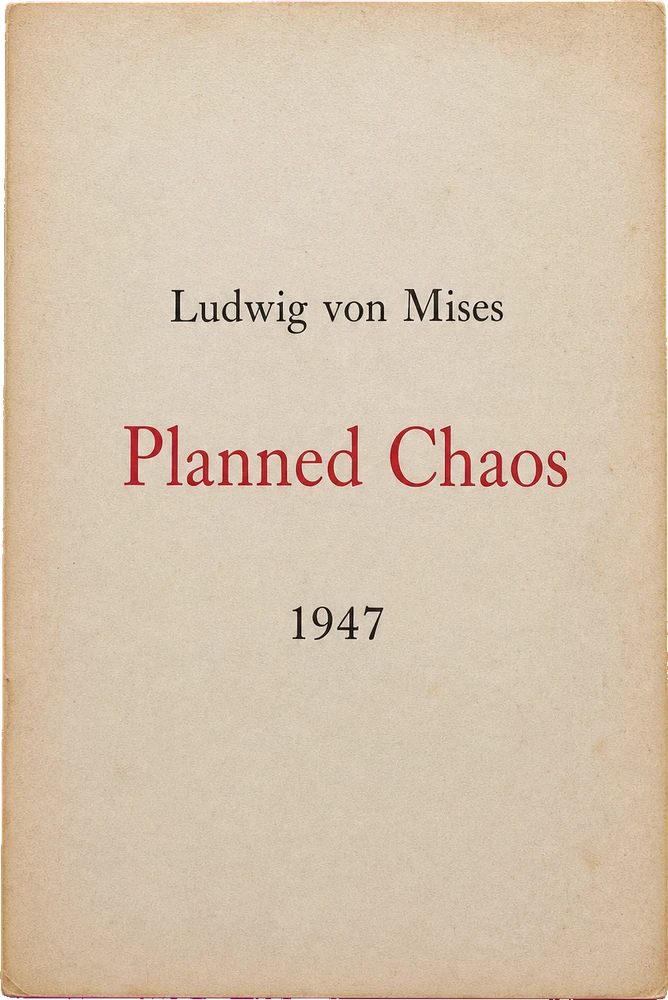
Summary — Planned Chaos
Ludwig von Mises’s Planned Chaos argues that the twentieth century’s crisis is not the failure of capitalism but the failure of attempts to obstruct capitalism while preserving its fruits. The book argues against interventionism: the belief that governments can correct markets through selected controls without abolishing private enterprise. For Mises, this is the central error. Controls disturb the price system, generate consequences their authors did not intend, and then invite further controls. What is called planning is therefore not order replacing chaos, but coercive command replacing market coordination.
Mises begins by distinguishing capitalism, interventionism, and socialism. Public ownership alone is not decisive if enterprises still buy, sell, and calculate through market prices. Socialism begins when production is no longer guided by exchange but by authoritative direction. He treats Russian state ownership and German command economy as variants of the same principle: in one, the state openly owns; in the other, private owners remain in name but obey official orders.
"The authority, not the consumers, directs production."
This distinction grounds the book’s central economic claim. Interventionism cannot remain a stable middle way. A wage law above the market rate creates unemployment; a price ceiling creates shortages; an effort to cure the shortage requires controls over costs, supply, labor, and further inputs. Each measure forces the government either to retreat or to extend command until planning becomes comprehensive.
"There is no third solution available."
Mises’s defense of capitalism is thus a defense of the price system as a form of social coordination. Profit and loss are not merely rewards and penalties for owners; they communicate whether resources are being used in ways consumers value. Buyers, by purchasing or refusing to purchase, continually redirect production. Intervention substitutes official preference for this dispersed judgment and weakens the very mechanism that makes complex production intelligible.
"The market is a democracy in which every penny gives a right to vote."
From this economic argument Mises derives a political one. Planning is not the opposite of planlessness, since individuals and firms always make plans. The question is whether many plans may coexist under general legal rules or whether one plan is imposed on all. Liberalism protects plural purposes; socialism elevates a single official purpose and must treat dissent as obstruction. For this reason, Mises presents planning as inherently anti-democratic: it centralizes economic choice and turns disagreement into disobedience.
The book then interprets the major collectivist movements of the age through this framework. Leninism, Stalinism, Trotskyism, Fascism, and Nazism differ in rhetoric and party mythology, but Mises reads them as rival forms of dictatorial anti-capitalism. His discussion of Trotsky reduces the conflict with Stalin to a struggle for power rather than a principled dispute over liberty. Fascism and Nazism are likewise treated as systems of monopoly, compulsion, and ideological regimentation, not as genuine alternatives to socialism in the liberal sense.
The moral warning becomes explicit in the discussion of legality and violence. When the rule of law is dismissed as a bourgeois restraint, officials claim discretion to decide whose interests may be sacrificed for alleged social benefit. Economic planning therefore carries juridical consequences: it weakens predictable limits on power and authorizes coercion against those who resist the plan. Mises’s fear is not only shortage or inefficiency but the transformation of politics into administration backed by police force.
His treatment of Soviet Russia combines geopolitical alarm with methodological caution. He denies that Soviet history can be read as a simple experiment whose facts speak for themselves. Historical evidence must be interpreted through theory, especially the theory of economic calculation.
"Historical experience never comments upon itself."
For Mises, the calculation problem remains decisive. Without market prices for the means of production, planners cannot rationally compare alternative uses of resources. They may issue commands, but they cannot know whether they are economizing or wasting. Soviet planning appears to function only because it borrows prices, techniques, and comparisons from the surrounding capitalist world. Its poverty and despotism therefore do not refute Mises’s critique; they illustrate it.
Sections
This work was divided into 14 sections when it entered the library's research corpus—an apparatus for search and citation, not necessarily the author's own table of contents. Each title opens its summary.
1Title Page and Introductory Heading
2Table of Contents (continued)
3Introductory Remarks
41 The Failure of Interventionism
52 The Dictatorial, Anti-Democratic and Socialist Character of Interventionism
63 Socialism and Communism
74 Russia's Aggressiveness
85 Trotsky's Heresy
96 The Liberation of the Demons
10Fascism
11Nazism
12The Teachings of Soviet Experience
13The Alleged Inevitability of Socialism
14Notes and Publication Back Matter
Put a question to this work; the Librarian answers from its 14 sections and cites the passage.
Ask the Librarian