- 1956
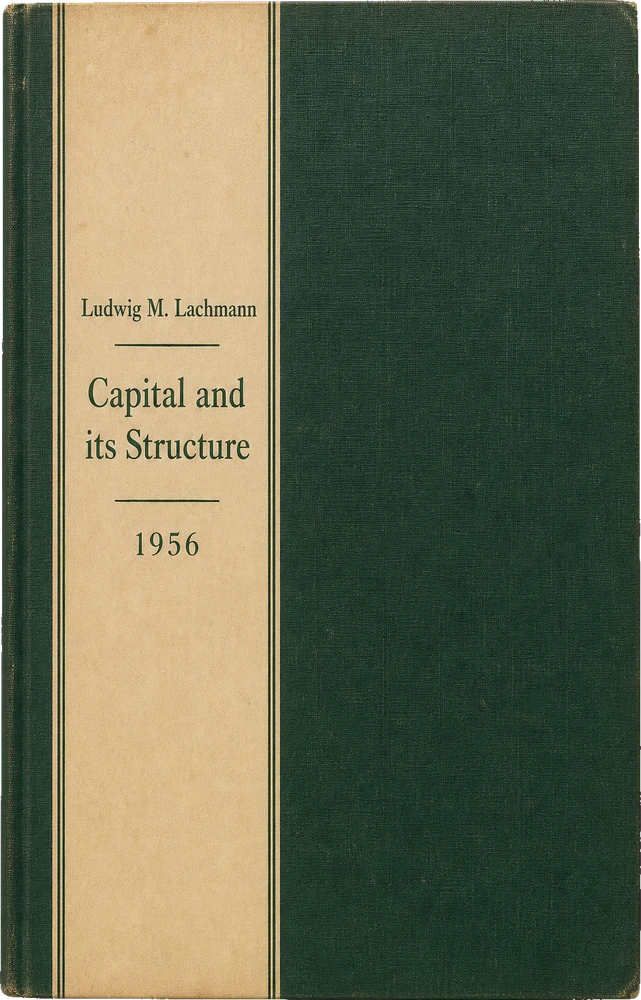
Capital and Its Structure
Ludwig M. Lachmann · 22 sectionsCapital has no measurable counterpart among material objects; it exists only in the entrepreneur's appraisal of heterogeneous goods—and from that premise Lachmann builds an entire theory. Against the aggregate 'quantity of capital,' he substitutes an ordered pattern of capital combinations, deriving multiple specificity, complementarity, and finally capital structure from the plain fact that capital resources are heterogeneous. Expectations are interpretive acts, not mechanical data; prices communicate knowledge but must be decoded, some movements meaningful and others functionless. Process analysis follows plans through disappointment, regrouping, and fresh disequilibrium, while forward markets and the Stock Exchange help coordinate divergent expectations that price rigidity would betray. Reinterpreting Böhm-Bawerk's roundaboutness as changing composition rather than more time, and applying the framework to the strong boom, this 1956 work makes capital theory a study of order, failure, and regrouping.
The Theory of Capital is, in the last resort, the morphology of the forms which this pattern assumes in a changing world.
- 1938Investment and Costs of Production
Investment and Costs of Production
Ludwig Lachmann · 5 sectionsProsperity can undermine the investment that set it in motion. In “Investment and Costs of Production,” Ludwig Lachmann explains how rising consumption can increase construction costs without improving the expected long-term returns on durable assets. His distinctive move is to examine relative profitability rather than aggregate income: unemployed workers and idle machinery do not eliminate shortages of the particular skills and equipment a project requires. Readers can discover why cheap credit may fail to overcome these bottlenecks—and why commodity speculation may accelerate the cost increases that discourage investment. The article develops a qualified defence of Austrian cycle theory, while refusing to infer that falling costs will necessarily restart interrupted production. Its central tension is between an expansion’s apparent resources and the specific combinations needed to sustain it.
- 1940A Reconsideration of the Austrian Theory of Industrial Fluctuations
A Reconsideration of the Austrian Theory of Industrial Fluctuations
Ludwig M. Lachmann · 8 sectionsWritten as Keynesian ascendancy pushed Austrian cycle theory to the margins, this reconstruction insists that its critics had mistaken its character: the theory is not a static contrast between saving and credit but a dynamic account of how investment reshapes the interdependence of industries over time. Its hinge is irreversibility—investment transforms fluid resources into specific, complementary capital that mistaken expectations can no longer unwind. Lachmann gives the theory a sectoral anatomy of consumers' goods, equipment, raw-material, and 'dynamic key' industries, and joins the Lundberg effect to the Ricardo effect to show how falling real wages during a boom divert entrepreneurs from long-period deepening toward speculation. Candid about limits, he finds the nineteenth-century railway booms fit the model but concedes that the 1929 crisis, with its stable prices and rising raw-material stocks, does not.
Once "free Capital" has been converted into buildings and machinery, any failure of events to conform to expectations will upset everything.
- 1942[Review of Fluctuations in Income and Employment, by Thomas Wilson]
[Review of Fluctuations in Income and Employment, by Thomas Wilson]
Ludwig Lachmann · 1 sectionsA convincing account of a crisis need not rest on a convincing theory of economic change. In this review of Thomas Wilson’s Fluctuations in Income and Employment, Ludwig Lachmann praises much of the analysis of American fluctuations while challenging the theoretical synthesis behind it. His objections are concrete: raw-material shortages can interrupt expansion, industrial equipment differs in age and productivity, and expectations cannot simply be treated as given. These concerns sharpen his defence of Austrian cycle theory against what he regards as Wilson’s static assumptions. The review culminates in a question that reaches beyond their disagreement: if investment opportunities are exhausted, what explains the human effort through which new ones arise? Readers encounter a compact example of Lachmann testing economic explanation against changing resources and purposeful action.
- 1942[Review of Productivity, Wages, and National Income by Spurgeon Bell]
[Review of Productivity, Wages, and National Income by Spurgeon Bell]
Ludwig Lachmann · 1 sectionsHow can economists measure the gains from technical progress when innovation changes the capital they are measuring? In this 1942 review of Spurgeon Bell’s Productivity, Wages, and National Income, Ludwig Lachmann welcomes evidence on American productivity and income distribution while challenging the accounting used to interpret it. He singles out Bell’s finding that, after 1933, productivity gains accrued to wage earners rather than consumers and profit recipients. His sharper objection concerns comparisons of capital across periods marked by idle capacity, asset write-downs, and machinery replaced before it wears out. This compact review shows why, for Lachmann, empirical detail and theoretical criticism belong together: a study can document technological change yet conceal its effects through the measures it employs.
- 1943[Review of The Theory of Competitive Price, by George J. Stigler]
[Review of The Theory of Competitive Price, by George J. Stigler]
Ludwig M. Lachmann · 1 sectionsWhat should a rigorous theory of competitive price explain—and where does clarity leave questions unresolved? In this brief 1943 review of George J. Stigler’s textbook, Ludwig M. Lachmann welcomes an exposition shaped by Frank Knight’s teaching, particularly its consistent treatment of costs as foregone alternatives. His praise makes the reservations revealing: expectations raise a problem of determinateness that Stigler scarcely recognises, while inventories unsettle the rigid distinction between short and long run without prompting a sufficiently developed analysis of time. Lachmann calls these minor defects, not grounds for rejecting the book. The review offers a compact view of his critical priorities: conceptual consistency deserves recognition, but expectations and time demand more than tidy exposition.
- 1943[Review of This Age of Fable: The Political and Economic World We Live In, by Gustav Stolper]
[Review of This Age of Fable: The Political and Economic World We Live In, by Gustav Stolper]
Ludwig M. Lachmann · 1 sectionsCan a critic of political myths remain captive to one himself? In this 1943 review of Gustav Stolper’s This Age of Fable, Ludwig M. Lachmann applauds an assault on economic and political formulas of both Right and Left, but challenges its picture of security before 1914. For Lachmann, nationalist agitation had already undermined Austria-Hungary and the precarious European balance: national self-determination belongs among the promises requiring scrutiny, not outside them. This brief review brings his conception of historical inquiry into focus—recovering human purposes and plans beneath inherited world-pictures—and shows how that standard turns admiration into a precise objection to Stolper’s historical frame.
- 1943The Role of Expectations in Economics as a Social Science
The Role of Expectations in Economics as a Social Science
Ludwig M. Lachmann · 5 sectionsHow can expectations enter a science of action when the future is uncertain and every observable fact admits rival readings? The answer here refuses two easy paths: against Keynes, Morgenstern, and Myrdal, Lachmann denies that expectations are ultimate data like tastes and resources; against Lundberg and Schumpeter, he denies they can be deduced from objective business situations. A price rise may signal reversion or inflation, so meaning arrives only through the actor's interpretation, and economics needs ideal types and historical understanding rather than deterministic law. From this he builds a theory of plan-guided action and tests it on Hicks's elasticity of expectations and on interest-rate formation, concluding that an Austro-Wicksellian crisis requires a particular expectational climate. The essay makes intelligibility, not determinateness, the proper aim of social science.
The Social World consists not of facts but of our interpretations of the facts.
- 1944Finance Capitalism?
Finance Capitalism?
Ludwig Lachmann · 4 sectionsDoes the power of bankers mark a new stage of capitalism, or does it arise when industry faces problems its own managers cannot solve? In this 1944 article, Ludwig Lachmann tests the finance-capitalism thesis against contrasting British, German, and American experience. His decisive distinction is between financial influence—lending, underwriting, or holding legal rights—and entrepreneurship: actively planning and carrying out economic change. He argues that financiers sometimes assume this role by reorganising industries or reconstructing failed enterprises, rather than inevitably taking command as capitalism matures. The article offers a concrete way to distinguish control over securities from initiative in production, while showing how investment opportunities can be created through the recombination of existing productive assets.
Investment opportunities are never simply "there"; they are the result of human action, the outcome of a process in which will-power and intensity of effort play a most prominent part.
- 1945[Review of The Economics of Full Employment: Six Studies in Applied Economics prepared at the Oxford University Institute of Statistics]
[Review of The Economics of Full Employment: Six Studies in Applied Economics prepared at the Oxford University Institute of Statistics]
Ludwig M. Lachmann · 2 sectionsCan policies that sustain spending also preserve the incentives to produce? In this 1945 review of six Oxford studies on full employment, Ludwig M. Lachmann praises the theoretical contributions of Balogh and Kalecki while testing their policy proposals against profitability, international trade, and political bargaining. His sharpest objection concerns plans to hold prices steady while wages rise: redistributing income may strengthen demand, he argues, yet undermine supply if profits disappear. He also examines the tension between independent national employment policies and an integrated world economy. The review offers a compact encounter with Lachmann’s critical method: appreciation of analytical ingenuity coupled with concrete questions about tax exemptions, producers’ incomes, and the political interests concealed by appeals to “social priorities.”
For in the absence of profit no amount of "effective demand" will call forth effective supply.
- 1945[Review of Theoretische Grundlagen der Wirtschaftspolitik, Band I, by Walter Adolf Jöhr]
[Review of Theoretische Grundlagen der Wirtschaftspolitik, Band I, by Walter Adolf Jöhr]
Ludwig Lachmann · 1 sectionsCriticism of perfect competition is not yet a programme for economic policy. That distinction drives Ludwig Lachmann’s brief 1945 review of the first volume of Walter Adolf Jöhr’s Theoretische Grundlagen der Wirtschaftspolitik. Jöhr identifies monopoly, frictions, weakened profit motivation and power as obstacles to the theoretical market model; Lachmann asks what would protect economic freedom and competition under those conditions. His objection is precise: rejecting laissez faire leaves the constructive task unresolved. Yet his verdict is not simply dismissive. He welcomes Jöhr’s movement from advocacy of a corporative economy towards appreciation of competitive markets. The review offers a compact example of Lachmann separating recognition of a market’s imperfections from an account of how policy should address them.
- 1945A Note on the Elasticity of Expectations
A Note on the Elasticity of Expectations
Ludwig Lachmann · 2 sectionsWhy does one price movement leave expectations unchanged while another forces people to rethink the future? In this article, Ludwig Lachmann distinguishes measuring the responsiveness of expectations from explaining it. Against accounts based on fixed psychological sensitivity or a single expected price, he examines the range of outcomes people consider plausible. A movement near its boundary may encourage expectations of reversal; a movement beyond it may undermine the very assumptions on which a forecast rests. His distinctive claim is that expectations arise through interpretation: people diagnose the forces at work before predicting their effects. The article shows why identical numerical changes can carry different economic meanings—and why a narrow range of expectations can both stabilise a market and make its eventual disruption more abrupt.
The formation of expectations is always incidental to the diagnosis of the situation in which we find ourselves; no prognosis without diagnosis.