- 1956
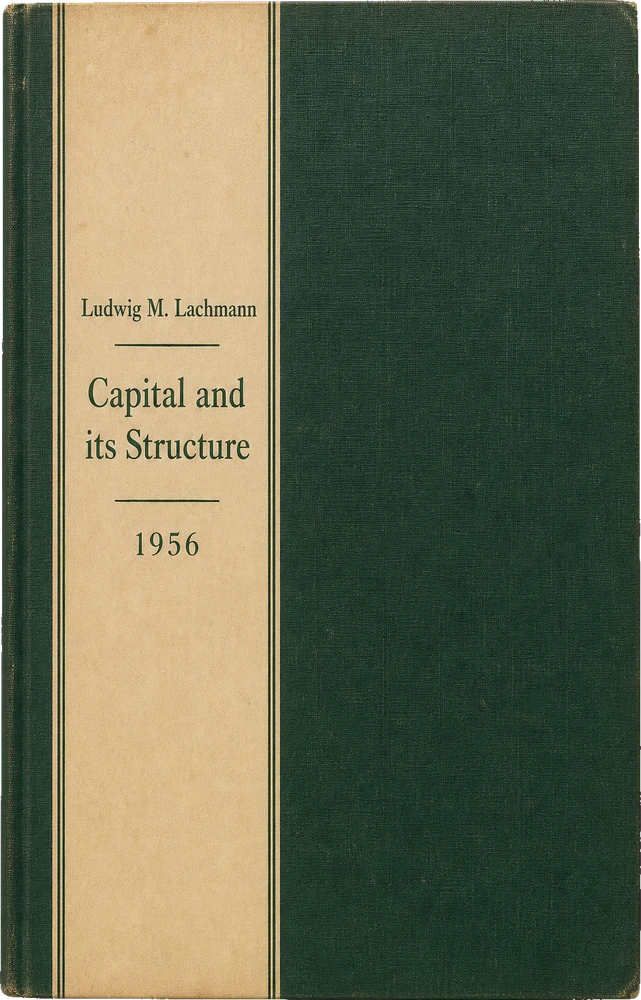
Capital and Its Structure
Ludwig M. Lachmann · 22 sectionsCapital has no measurable counterpart among material objects; it exists only in the entrepreneur's appraisal of heterogeneous goods—and from that premise Lachmann builds an entire theory. Against the aggregate 'quantity of capital,' he substitutes an ordered pattern of capital combinations, deriving multiple specificity, complementarity, and finally capital structure from the plain fact that capital resources are heterogeneous. Expectations are interpretive acts, not mechanical data; prices communicate knowledge but must be decoded, some movements meaningful and others functionless. Process analysis follows plans through disappointment, regrouping, and fresh disequilibrium, while forward markets and the Stock Exchange help coordinate divergent expectations that price rigidity would betray. Reinterpreting Böhm-Bawerk's roundaboutness as changing composition rather than more time, and applying the framework to the strong boom, this 1956 work makes capital theory a study of order, failure, and regrouping.
The Theory of Capital is, in the last resort, the morphology of the forms which this pattern assumes in a changing world.
- 1940A Reconsideration of the Austrian Theory of Industrial Fluctuations
A Reconsideration of the Austrian Theory of Industrial Fluctuations
Ludwig M. Lachmann · 8 sectionsWritten as Keynesian ascendancy pushed Austrian cycle theory to the margins, this reconstruction insists that its critics had mistaken its character: the theory is not a static contrast between saving and credit but a dynamic account of how investment reshapes the interdependence of industries over time. Its hinge is irreversibility—investment transforms fluid resources into specific, complementary capital that mistaken expectations can no longer unwind. Lachmann gives the theory a sectoral anatomy of consumers' goods, equipment, raw-material, and 'dynamic key' industries, and joins the Lundberg effect to the Ricardo effect to show how falling real wages during a boom divert entrepreneurs from long-period deepening toward speculation. Candid about limits, he finds the nineteenth-century railway booms fit the model but concedes that the 1929 crisis, with its stable prices and rising raw-material stocks, does not.
Once "free Capital" has been converted into buildings and machinery, any failure of events to conform to expectations will upset everything.
- 1943[Review of The Theory of Competitive Price, by George J. Stigler]
[Review of The Theory of Competitive Price, by George J. Stigler]
Ludwig M. Lachmann · 1 sectionsWhat should a rigorous theory of competitive price explain—and where does clarity leave questions unresolved? In this brief 1943 review of George J. Stigler’s textbook, Ludwig M. Lachmann welcomes an exposition shaped by Frank Knight’s teaching, particularly its consistent treatment of costs as foregone alternatives. His praise makes the reservations revealing: expectations raise a problem of determinateness that Stigler scarcely recognises, while inventories unsettle the rigid distinction between short and long run without prompting a sufficiently developed analysis of time. Lachmann calls these minor defects, not grounds for rejecting the book. The review offers a compact view of his critical priorities: conceptual consistency deserves recognition, but expectations and time demand more than tidy exposition.
- 1943[Review of This Age of Fable: The Political and Economic World We Live In, by Gustav Stolper]
[Review of This Age of Fable: The Political and Economic World We Live In, by Gustav Stolper]
Ludwig M. Lachmann · 1 sectionsCan a critic of political myths remain captive to one himself? In this 1943 review of Gustav Stolper’s This Age of Fable, Ludwig M. Lachmann applauds an assault on economic and political formulas of both Right and Left, but challenges its picture of security before 1914. For Lachmann, nationalist agitation had already undermined Austria-Hungary and the precarious European balance: national self-determination belongs among the promises requiring scrutiny, not outside them. This brief review brings his conception of historical inquiry into focus—recovering human purposes and plans beneath inherited world-pictures—and shows how that standard turns admiration into a precise objection to Stolper’s historical frame.
- 1943The Role of Expectations in Economics as a Social Science
The Role of Expectations in Economics as a Social Science
Ludwig M. Lachmann · 5 sectionsHow can expectations enter a science of action when the future is uncertain and every observable fact admits rival readings? The answer here refuses two easy paths: against Keynes, Morgenstern, and Myrdal, Lachmann denies that expectations are ultimate data like tastes and resources; against Lundberg and Schumpeter, he denies they can be deduced from objective business situations. A price rise may signal reversion or inflation, so meaning arrives only through the actor's interpretation, and economics needs ideal types and historical understanding rather than deterministic law. From this he builds a theory of plan-guided action and tests it on Hicks's elasticity of expectations and on interest-rate formation, concluding that an Austro-Wicksellian crisis requires a particular expectational climate. The essay makes intelligibility, not determinateness, the proper aim of social science.
The Social World consists not of facts but of our interpretations of the facts.
- 1947Complementarity and Substitution in the Theory of Capital
Complementarity and Substitution in the Theory of Capital
Ludwig M. Lachmann · 7 sectionsComplementarity and substitution are not, Lachmann argues, symmetrical static relations between factors: complementarity is the coherence of means within a single production plan, while substitution is the response to disruption, error, or revised expectations. A locomotive substitutes for another locomotive yet complements wagons, crews, tracks, and timetables—so which relation holds depends entirely on the plan through which the goods are read. Beginning from the Hicks-Lange-Harrod debate but pulling the question out of demand analysis and into the structure of production, this early essay dissolves the fiction of homogeneous capital without collapsing into mere physical classification. Capital goods are artifacts made for purposes; spare parts, standardization, and reserve capacity are not accidental frictions but devices for preserving a wider pattern of complementarity. Accumulation, working through chain reactions of gain and loss, makes any single rate of profit meaningless.
We have to provide for many minor changes in order to prevent a major one.
- 1950Economics as a Social Science
Economics as a Social Science
Ludwig M. Lachmann · 9 sectionsEconomics is a science, a social science, and an analytical social science—Lachmann's 1950 inaugural lecture unfolds each claim in turn. As science it seeks systematic, value-free generalizations about observable phenomena, leaving judgments of the good to philosophy; as social science it studies not a special material object called man but phenomena—prices, output, employment—intelligible only as consequences of human choice under scarcity. Borrowing Robbins's ends-and-scarce-means framework, Lachmann insists economics is not psychology: it analyzes the logical implications of choices once made, not the motives behind them. Its method is compositive, tracing complex phenomena back to the plans that compose them, so that even failure becomes intelligible only by reconstructing the plans that failed. The lecture also polices history, warning against pseudo-explanations that personify 'Capitalism' or 'Industrialization,' and denying that any single invariant 'Trade Cycle' exists.
The Logic of Action is essentially a Logic of Success.
- 1951The Science of Human Action
The Science of Human Action
Ludwig M. Lachmann · 8 sectionsHuman Action supplies the occasion, but the deeper subject is the autonomy of the social sciences against positivism. Reading Mises's treatise, Lachmann fixes on its methodological core: the distinction between praxeology, the general science of human action, and catallactics, the analysis of market exchange, and the claim that categories such as means, ends, choice, and time are presupposed rather than generalized from data. He presses the argument toward process—profit and loss as signals that sort successful anticipations from failed ones—and toward a capital theory that abandons Böhm-Bawerk's average period of production for heterogeneous, time-structured assets. That perspective grounds his reading of socialist calculation, which fails for want of an entrepreneurial capital market, and of the trade cycle, where credit expansion breeds malinvestment rather than mere excess.
There is therefore such a thing as a Logic of Action closely linked to the logic of our thought.
- 1954Some Notes on Economic Thought, 1933-1953
Some Notes on Economic Thought, 1933-1953
Ludwig M. Lachmann · 7 sectionsBetween 1933 and 1953, economics was reshaped by three visible debates—Keynesian macroeconomics, the theories of imperfect and monopolistic competition, and the new welfare economics of Hicks and Kaldor—but the deeper story, Lachmann contends, is the slow displacement of static equilibrium by problems of time, knowledge, and expectation. Welfare economics he dismisses as ingenious yet politically remote; Keynesian theory as coherent but valid only for extreme situations of depression or wartime inflation, where factors can be treated as homogeneous. Chamberlin, Robinson, and Harrod exposed the unreality of perfect competition yet still classified market forms statically. The constructive alternative is Swedish Process Analysis, which distinguishes the coherence of a single plan from the compatibility of all plans, together with a redefinition of competition not as a market form but as the process by which knowledge spreads and one form turns into another.
In reality, as every newspaper reader knows, politicians pursue power, not welfare.
- 1956The Market Economy and the Distribution of Wealth
The Market Economy and the Distribution of Wealth
Ludwig M. Lachmann · 8 sectionsEven sympathetic critics concede that market allocation may be efficient while inherited wealth renders its results unjust—unless the state periodically redistributes. That concession is the target here. The mistake, Lachmann argues, lies in treating the distribution of wealth as a fixed datum rather than a continuously revised outcome of the market process. He separates the two senses of 'datum'—something merely observed at an instant, and an independent determinant in equilibrium theory—and denies wealth the second role. Because capital goods are heterogeneous and their value hangs on complementarities discovered only under change, the market itself redistributes through capital gains and losses, passing wealth to those quicker to read new scarcities. The result is Pareto's circulation of elites: a leveling process, a game of skill rather than chance, in which no class of owners—shareholder or bondholder—escapes revaluation.
The owners of wealth, we might say with Schumpeter, are like the guests at a hotel or the passengers in a train: They are always there but are never for long the same people.
- 1958Mrs. Robinson on the Accumulation of Capital
Mrs. Robinson on the Accumulation of Capital
Ludwig M. Lachmann · 6 sectionsJoan Robinson's The Accumulation of Capital drew admiration for its rigour, but Lachmann reads its 'Generalisation of the General Theory' as neither Keynesian nor Marxist so much as a Ricardian revival—distribution, accumulation, and technique handled through class categories rather than marginal choice. His critique fastens on what he calls the integrability condition: Robinson must treat the capital stock as the summed total of past net investment, and her 'golden age' is the moving-equilibrium device that keeps that stock measurable under change. But technical progress defeats it. Innovation brings failed experiments, fossilized equipment, and capital gains and losses the model cannot house. Behind the technical objection lies an epistemological one: Robinson's stylized workers, rentiers, and entrepreneurs suppress the divergent judgments and market process through which industrial progress actually occurs.
Homogeneity and progress are at bottom incompatible with each other.
- 1959Professor Shackle on the Economic Significance of Time
Professor Shackle on the Economic Significance of Time
Ludwig M. Lachmann · 5 sectionsTime, in G. L. S. Shackle's De Vries Lectures, is not a neutral point on a calendar axis but the setting where imagination, decision, and expectation occur—his 'moment-in-being' destroying any easy analogy between economics and mechanics. Lachmann accepts the attack on homogeneous naturalistic time yet resists its solipsistic edge: if every present were wholly self-contained, learning and plan revision would become unintelligible. His repair distinguishes the discontinuity of ends from the relative continuity of knowledge about means, adding to subjective utility a subjectivism of interpretation. Where Shackle's dynamics stays close to the isolated individual, Lachmann extends it to forward markets, which give plans a socially observable form and coordinate expectations without predicting them. Economics forgoes positive forecasting but keeps negative prediction and the interpretive reconstruction of purposes.
As soon as we permit time to elapse we must permit knowledge to change, and knowledge cannot be regarded as a function of anything else.